
You must break things yourself. However, the problem most beginners face is that real applications are either too complex or legally untouchable.
This is where intentionally vulnerable applications become essential and among them, Damn Vulnerable Web Application (DVWA), bWAPP (buggy web application), OWASP Juice Shop, WebGoat, OWASP Mutillidae etc. are remains the best hands-on training environments ever created in the web security domain. Damn Vulnerable Web Application (DVWA) is a popular open-source platform designed for hands-on application security training/practice. It simulates common web security vulnerabilities in a controlled environment, making it ideal for penetration testers and developers to practice ethical hacking skills.
DVWA is a PHP/MySQL-based web app intentionally riddled with security flaws having levels — Low, Medium, High, and Impossible. While practicing these challenges, start at Low to grasp basics, then escalate to mimic hardened defenses.
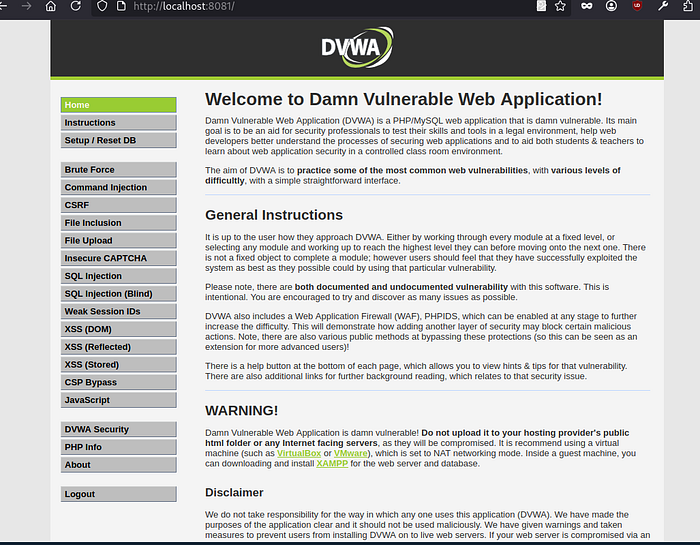
Key Vulnerabilities Covered: Brute Force: Comes under Authentication attacks. Simulates a login portal vulnerable to credential guessing. Demonstrates absence or weakness of authentication protections such as weak rate-limiting, lockout etc.
Command Injection: Comes under Server-Side Injection attacks. OS command execution via user inputs where input is passed to system commands without proper sanitization.
CSRF (Cross Site Request Forgery): Comes under Session Abuse/Authorization Bypass attacks. Performs actions on behalf of an authenticated user without their consent.
File Inclusion: Comes under Server-Side Code Execution. Local/Remote File Inclusion (LFI/RFI) where application includes files based on user input.
File Upload: Comes under Unrestricted Upload category. Improper validation of uploaded files allows execution on the server may lead to RCE attack.
Insecure CAPTCHA: Comes under Business Logic Bypass. Captcha exists but validation is implemented incorrectly leading to bypass of weak image/math challenges.
SQL Injection: Comes under Input Validation/Injection category. User input concatenated into SQL queries directy without any validation.
SQL Injection (Blind): Comes under Input Validation/Injection category. Time/error-based inference without visible output and boolean/timing exploits.
Weak Session IDs: Comes under Session management flaws. Predictable session tokens leading to session compromise.
XSS (DOM): Comes under Input Validation/Injection category. Client-side script manipulation via document writes and JavaScript sinks vulnerable.
XSS (Reflected): Comes under Input Validation/Injection category. User input reflected immediately in response.
XSS (Stored): Comes under Input Validation/Injection category. Persists malicious scripts in database and executes upon user visit.
CSP Bypass: Comes under Defense Bypass. Application uses CSP but incorrectly by allowing unsafe-inline or unsafe-eval.
JavaScript: Demonstrates how trusting client-side JavaScript for security decisions allows attackers to manipulate or bypass logic by analyzing and modifying code in the browser.
Ultimately, DVWA is only a lab and run it in isolated environment i.e. Docker/VMs, never production. Its value depends entirely on how you use it. Simply running the application is not practice instead analyzing behavior, understanding root causes, and observing how defenses are implemented is where the learning happens.
DVWA is an open-source project created and maintained by its respective authors. I do not own, endorse, or promote it and this post shares educational setup purely for ethical AppSec learning.
The real understanding begins when you interact with vulnerabilities yourself.
Thanks for reading and Happy (safe) hacking!!