June 2, 2026
Cybersecurity for Small Businesses: The Complete 2026 Guide
Cybersecurity for small businesses means protecting your company, your staff, and your clients from the growing range of digital threats…
Tal Anish - LBM Cyber
4 min read
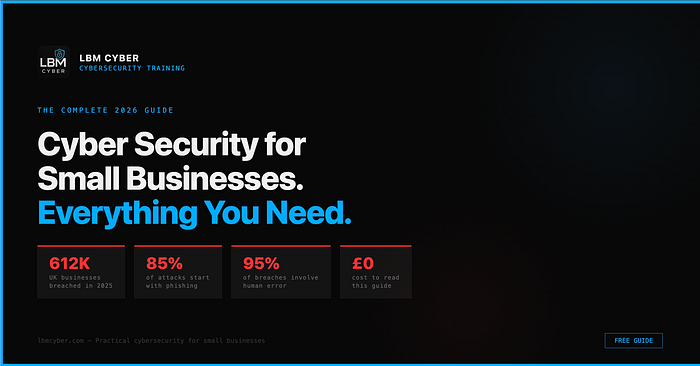
Cybersecurity for small businesses means protecting your company, your staff, and your clients from the growing range of digital threats targeting businesses of every size. In 2026, this is no longer optional. 43% of all cyberattacks target small and medium businesses, and the average cost of a breach for a small business exceeds £65,000 in the UK.
This guide covers everything you need to know, written for business owners without a technical background.
Why Small Businesses Are the Primary Target
The assumption that hackers only go after large corporations is one of the most dangerous myths in cybersecurity. The data tells a different story.
According to the UK Government's Cyber Security Breaches Survey 2025, 32% of small businesses reported a cyberattack or breach in the previous 12 months. The Verizon Data Breach Investigations Report consistently shows that small businesses face as many attacks as enterprises, with far less ability to defend against or recover from them.
Attackers choose small businesses for a simple reason: they offer the lowest resistance. Large enterprises invest millions in security teams, training programs, and technical controls. Small businesses typically invest nothing, or close to nothing. For an organised criminal group, targeting a small business is faster, easier, and increasingly profitable as the tools for doing so become more accessible.
60% of small businesses that suffer a major cyberattack close within six months, according to the National Cyber Security Centre (NCSC). The threat is existential, not merely inconvenient.
The Biggest Cybersecurity Threats Facing Small Businesses in 2026
Phishing and Email Fraud
Phishing is the most common attack vector against small businesses by a significant margin. A phishing attack is an attempt to trick an employee into clicking a malicious link, entering credentials on a fake website, or transferring money based on a fraudulent request.
Business Email Compromise (BEC) is a particularly damaging variant. Attackers impersonate executives, suppliers, or clients to request urgent wire transfers or sensitive information. UK businesses lost over £1.2 billion to BEC attacks in 2024, according to Action Fraud data.
To learn how to train your team, read our detailed guide: How to Spot a Phishing Email: A Guide for Non-Technical Staff.
Ransomware
Ransomware is malicious software that encrypts your business files and demands payment for their release. The average ransom demand for small businesses reached $812,000 in 2024, according to Coveware's ransomware report. 91% of ransomware attacks begin with a phishing email.
Learn how to protect your business: What is Ransomware and How to Protect Your Small Business.
Credential Theft
Over 15 billion stolen credentials are currently available on the dark web, according to Digital Shadows research. When employees reuse passwords across personal and work accounts, a single breach from years ago can provide attackers with access to your business systems today.
Social Engineering
Social engineering attacks manipulate people rather than systems. Attackers research their targets using LinkedIn and public websites before contacting them by phone or email. With staff names, roles, and email patterns publicly visible, personalised attacks are easy to construct and difficult to detect without training.
The Human Factor: Your Most Important Security Variable
95% of successful cyberattacks involve human error as a contributing factor, according to IBM's Cost of a Data Breach Report 2024. This is not a criticism of employees. It is a recognition that attackers have identified the human being as the most exploitable element of any security system.
Firewalls and antivirus software address technical vulnerabilities. They cannot address the employee who clicks a phishing link because they are busy, distracted, or simply unaware of what a convincing phishing email looks like in 2026.
The most effective security investment any small business can make is training their team. A 90-minute awareness session covering phishing recognition, social engineering, safe password practices, and incident reporting dramatically reduces risk at a cost most small businesses can afford.
Five Essential Cybersecurity Actions for Small Businesses
- Enable Multi-Factor Authentication
Multi-factor authentication (MFA) requires a second verification step when logging in, typically a code sent to a phone or generated by an authenticator app. Enabling MFA on email, cloud storage, and accounting software blocks 99.9% of automated credential attacks. It is free and available on virtually every major business platform.
- Train Your Employees
A 90-minute security awareness session for your team covering phishing, social engineering, passwords, and incident reporting is the single highest-impact security investment available to a small business.
- Fix Your Email Authentication
Setting up DMARC, SPF, and DKIM records prevents attackers from sending emails that appear to come from your domain. This protects your clients from fraud conducted in your name. Full instructions in our guide: What is DMARC and Why Does Your Small Business Need It?
- Check Your Breach Exposure
Visit haveibeenpwned.com and search every staff email address. If any appear in known breach databases, change those passwords immediately across all accounts where they may be reused.
- Back Up Your Data
Follow the 3–2–1 rule: three copies of your data, on two different media types, with one copy stored offsite or in an isolated cloud backup. Test your backups regularly.
For a complete prioritised list, see our Cybersecurity Checklist for Small Business 2026.
What a Cybersecurity Assessment Reveals
Most small businesses do not know what attackers can already see about their business. A free external assessment scans your digital footprint and identifies vulnerabilities including breached staff credentials, email authentication gaps, and exposed infrastructure, before an attacker finds them first.
LBM Cyber provides this assessment free of charge with no obligation.
Get your free company exposure report at lbmcyber.com
Frequently Asked Questions
What is the biggest cybersecurity risk for small businesses?
The biggest cybersecurity risk for small businesses is human error. 95% of successful cyberattacks involve a human mistake, most commonly an employee clicking a phishing link or using a weak or reused password.
How much does cybersecurity cost for a small business?
Basic cybersecurity for a small business costs very little. Multi-factor authentication, email authentication (DMARC, SPF, DKIM), and breach checking are all free. Employee training typically costs £500–2,000 per year for a team of 5–50 people, which is a fraction of the average breach cost.
Do small businesses really get hacked?
Yes. 43% of all cyberattacks target small businesses specifically. Small businesses are targeted because they typically have less protection, no dedicated security team, and untrained staff. Many attacks go undetected for months.
What should a small business do first to improve cybersecurity?
The highest impact first step is enabling multi-factor authentication (MFA) on all business accounts. This single action blocks 99.9% of automated credential-based attacks and costs nothing to implement.
What is the best cybersecurity training for small business employees?
The most effective cybersecurity training combines a live awareness session covering phishing, social engineering, and safe practices with regular phishing simulations. The simulations test what staff have learned and identify who needs additional support.
Originally published at lbmcyber.com
LBM Cyber delivers practical cybersecurity training for small businesses, law firms and accounting practices in the UK and US. Book a free 45-minute training session at lbmcyber.com