
Phase 1: Reconnaissance
I started by navigating to the web application. The site presented a "Lo-Fi Music Player" interface.
While exploring the site, I clicked on one of the music tracks ("Chill"). I noticed the URL changed to include a parameter fetching a PHP file:
Press enter or click to view image in full size

Observation: The page= parameter seems to be loading local files (chill.php). This is a classic indicator of a potential Local File Inclusion (LFI) or Path Traversal vulnerability.
Phase 2: Vulnerability Testing
Attempt 1: The Direct Approach
I attempted to access the sensitive Linux password file directly using an absolute path:
Payload: /?page=/etc/passwd
Press enter or click to view image in full size
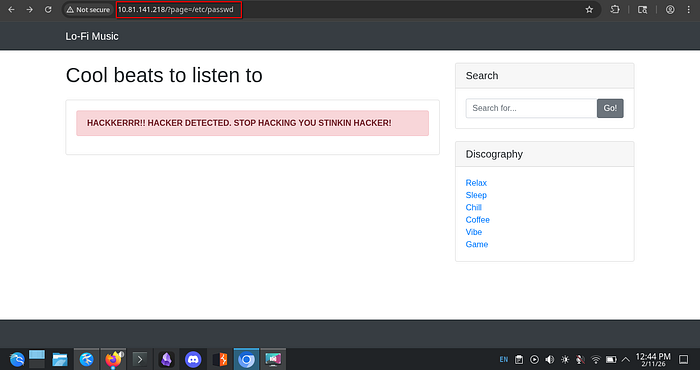
Response: The server responded with a custom error message/WAF (Web Application Firewall) blocking the request:
"HACKKERRR!! HACKER DETECTED. STOP HACKING YOU STINKIN HACKER!"
Analysis: The application is likely filtering inputs that start with / (absolute paths) or checking for specific keywords, but the error confirms that my input is being processed by the backend.
Attempt 2: The Bypass (Directory Traversal)
Since the direct path failed, I decided to use Directory Traversal (../) to move up from the current directory (likely /var/www/html/) to the root directory.
Payload: /?page=../../../etc/passwd
Press enter or click to view image in full size
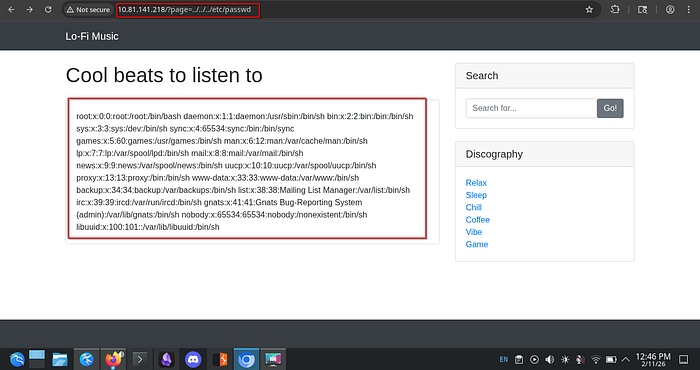
Response: Success! The application leaked the contents of /etc/passwd
This confirms the Path Traversal vulnerability exists and the application is running as www-data.
Phase 3: Capturing the Flag
Now that I had confirmed arbitrary file read capabilities, I looked for the flag. Standard CTF convention often places flags in flag.txt in the upper directories.
Payload: /?page=../../../flag.txt
Press enter or click to view image in full size
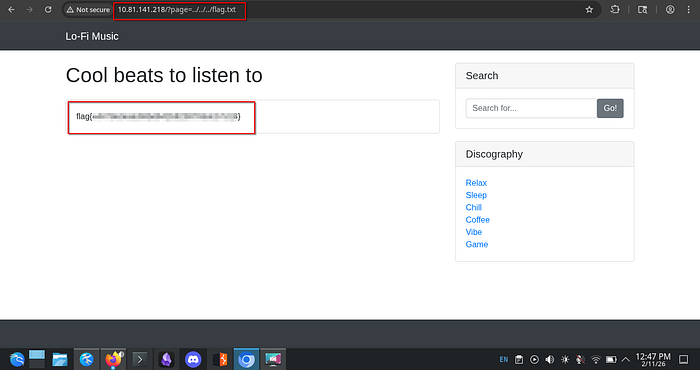
Result: The server returned the flag!