
At 2:13 AM, your systems go down. By 2:17 AM, your customers start noticing. By 2:25 AM, your executives are asking for answers you don't yet have.
This is the moment most organizations realize something uncomfortable. Crisis management is not response. It is leadership under uncertainty.
We often think of crisis management as escalation procedures, incident playbooks, or response frameworks. But those are designed for known conditions. A true crisis begins when those structures are no longer enough. It is the point where the system stops behaving predictably, and decisions must be made without clarity.
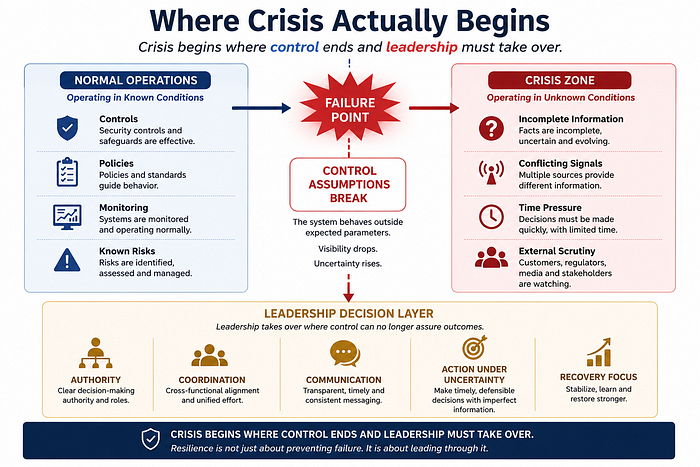
A crisis is not just a disruption. It is an abnormal condition that threatens strategic objectives, reputation, financial stability, and long-term survival. At that point, the organization is no longer operating within defined risk models. It is operating in uncertainty.
Most enterprises invest heavily in prevention. They build security controls, implement compliance frameworks, maintain risk registers, and design business continuity plans. These are necessary foundations, but they are built on an assumption: that risk can be anticipated and managed within known boundaries.
Crisis management challenges that assumption.
It assumes that controls will fail. It assumes that information will be incomplete. It assumes that decisions must be made before all the facts are known. And it assumes that the external narrative — customers, regulators, and media — may move faster than the internal understanding of events.
At that point, the problem is no longer technical. It becomes a leadership problem.
Leadership under uncertainty is not about perfect information. It is about making timely, defensible decisions with incomplete information. It requires clarity of authority, alignment across functions, and the ability to maintain trust while the situation is still unfolding.
A real-world example makes this clear.
Consider a large enterprise facing a ransomware attack. Critical systems are impacted, access to data is disrupted, and initial indicators suggest possible data exfiltration. The security team is still investigating. The scope is unclear. Legal is assessing regulatory exposure. Meanwhile, business operations are already affected, and customers begin experiencing disruptions.
At this moment, there is no complete picture. Yet decisions cannot wait.
Should systems be shut down to prevent further spread, even if it impacts global operations? Should customers be notified immediately, even if the facts are still evolving? Should external responders be engaged, or should internal teams continue containment?
These are not technical decisions. They are leadership decisions.
If leadership waits for certainty, the crisis expands. If communication is delayed, trust erodes. If authority is unclear, response efforts become fragmented. In many cases, the damage caused by delayed decisions exceeds the impact of the incident itself.
Now consider the same scenario in an organization with strong crisis capability.
There is a predefined crisis governance structure. Roles and authority are clearly defined. There is a central coordination function integrating security, legal, operations, and communications. Decisions are made based on available information, with explicit acknowledgment of uncertainty. Communication is transparent and timely, even when incomplete. Recovery planning begins alongside containment, not after.
The difference is not the absence of risk. The difference is the presence of leadership.
Crisis management is not an extension of incident response. It is a distinct capability. It sits at the intersection of strategy, governance, and execution. It requires organizations to design how decisions are made when systems fail, not just how systems are protected.
This is where many organizations fall short. They build strong defenses, but they do not design how the organization will operate when those defenses fail. They prepare for incidents, but not for crises.
The organizations that navigate crises effectively are not those that avoid failure. They are the ones that can absorb failure without losing direction. They have structured leadership, clear authority, cultural alignment, and the courage to act before certainty emerges.
Crisis capability is not optional. It is a measure of institutional maturity.
In an increasingly complex environment, uncertainty is not the exception. It is the default condition during failure. Organizations that recognize this and design for it respond with coherence and confidence. Those that do not discover, too late, that their controls and plans are not enough.
The future of resilience is not just better prevention. It is better leadership under uncertainty.
Author: Mahfuzur Rahman is an Enterprise Cybersecurity Architect (CISSP, CCSP, CISM) specializing in Zero Trust architecture, cloud security, identity governance, and cryptographic trust across modern distributed systems. His work focuses on risk-aligned control design, governance-driven security architecture, and post-quantum readiness.
LinkedIn: https://www.linkedin.com/in/rh-mahfuzur-rahman/ GitHub: https://github.com/rhmahfuzurrahman Bio: https://www.mahfuzurrahman.tech x: https://x.com/mahfuzur_sec