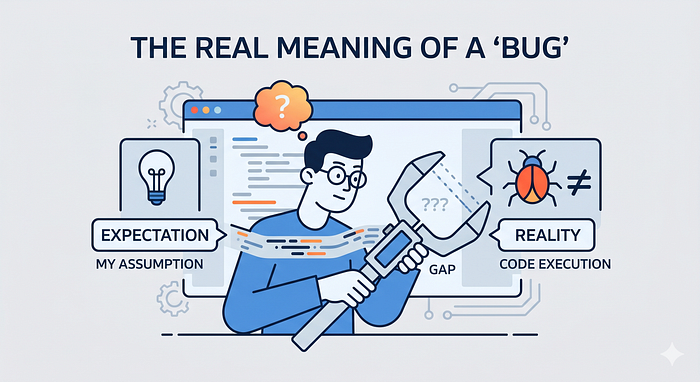


You write a few lines. You run the program. Something does not work. Not a crash, not an error message. Just a quiet wrongness. A number that should be higher. A button that does nothing. A page that stays blank.
You stare at the screen. You check the logic. It looks fine. You check it again. Still fine. The confusion settles in. Why is this not working? The immediate assumption arrives on its own: the code is wrong. Something must be incorrect. A typo. A misplaced condition. A forgotten return statement.
But what if the code is not wrong? What if it is doing exactly what you told it to do? What if the issue is not the code itself, but the gap between what you expected and what you actually expressed?
That gap has a name. We call it a bug. But the name hides more than it reveals.
What We Call a Bug

In everyday software work, a bug is a problem. Something that needs fixing. Something that slipped through. Something that should not be there. The word carries a quiet judgment. An error. A mistake. A flaw.
We track bugs in databases. We assign them priorities. We fix them and close them and move on. The language is mechanical, almost clinical. A bug is an unwanted thing in an otherwise ordered system.
But this framing misses something important. It treats the bug as an object. A piece of wrong code that someone wrote. The natural next question becomes: who wrote it? And from there, the quiet blame begins.
The Mismatch

A bug is rarely just a piece of incorrect syntax. It is almost always a mismatch. Two things that do not align.
On one side: your expectation. What you believe should happen when the code runs. This belief comes from your mental model of the system, the language, the data, the problem itself.
On the other side: reality. What the system actually does when it follows your instructions. Not what you meant. What you wrote.
The bug lives in the space between these two. Not in the code alone. Not in your head alone. In the relationship between them.
This is why the same line of code can be correct in one context and a bug in another. The code has not changed. Your expectation has.
Types of Misunderstandings

These mismatches take different forms.
You might misunderstand the problem itself. The requirement was not what you thought it was. The user does not actually want what you assumed. The edge case you ignored turns out to be the main case.
You might misunderstand the tool. The language does something subtle that you did not know. The framework has a default behavior that surprises you. The library function does not work the way its name suggests.
You might misunderstand the data. The input is not shaped the way you expected. A value is null when you assumed it would be present. A string contains invisible characters. A number is not a number.
You might misunderstand your own assumptions. You assumed a list is never empty. You assumed an ID is always unique. You assumed an operation is atomic. None of these were written anywhere. They just lived in your head. And the system had no way of knowing they were there.
A Concrete Example

Imagine a simple function that calculates the average of a list of numbers.
def average(numbers):
    return sum(numbers) / len(numbers)
You write a test. You pass in [10, 20, 30]. It returns 20.0. Perfect.
Later, someone passes in an empty list. The program crashes. Division by zero.
You call this a bug. But look closely at the code. It does exactly what you told it to do. Sum the list. Divide by its length. When the length is zero, dividing by zero is mathematically undefined. The system correctly refuses to guess.
The problem is not the code. The problem is your expectation. You expected that no one would pass an empty list. Or you expected the function to handle it gracefully. But you never wrote that expectation into the code. The mismatch is not between the code and some objective standard of correctness. It is between what you assumed and what you actually built.
This is subtle but important. The fix is not to say the code was wrong. The fix is to align your expectation with reality. Either handle empty lists explicitly, or document that the function does not support them. The code was honest. You were optimistic.
The Thinking Layer

Bugs are useful not because they reveal broken code, but because they reveal broken thinking. Or more gently, incomplete thinking.
Every bug is a small signal that your mental model of the system had a gap. You assumed something that turned out not to be true. You forgot something that mattered. You simplified something that was more complex than you realized.
This is not a failure. This is learning. The system is teaching you where your understanding is fuzzy. The bug is not an enemy to be destroyed. It is a mirror.
When you approach debugging this way, the experience changes. Instead of frustration, there is curiosity. Instead of blame, there is investigation. What did I assume? Why did I assume it? What is the system actually doing? Where did my model diverge from reality?
These questions lead somewhere. Anger does not.
Why This Perspective Matters

Shifting how you see bugs does not make them disappear. But it changes how you respond to them.
If a bug is just wrong code, the solution is to find the mistake and correct it. That is often enough for small problems. But for larger, stranger issues, it falls short. Because the mistake is not always in the code. Sometimes the mistake is in the question you are asking.
When you treat bugs as mismatches, you stop looking for a single wrong line. You start looking for the gap between expectation and reality. That gap can be anywhere. In the requirements. In the data. In the documentation. In your own head.
This reduces frustration because it removes the assumption that you should have known better. You did not know. That is fine. Now you know. The bug taught you something.
It also shifts focus from fixing to understanding. The goal is not just to make the symptom go away. The goal is to align your understanding with how the system actually behaves. Once those two things match, the bug often resolves itself.
A Subtle Shift

Here is the insight that changes things.
Debugging is not primarily about fixing code. Debugging is the act of aligning your understanding with reality. The code is just the medium. The real work happens in your head.
When you sit down to fix a bug, you are not a mechanic replacing a broken part. You are a cartographer correcting a map. The territory has not changed. The system was always doing what it does. Your map had a mistake. The bug is just the place where the map no longer matches the ground.
This is why experienced developers often say that the hardest bugs are not in the code. The hardest bugs are in their own assumptions. The code is doing something perfectly consistent. It is their expectation that is inconsistent.
Once you see this, the phrase "the code is wrong" starts to feel strange. The code is just text. It has no intentions. It cannot be wrong in the way a person can be wrong. It can only be misaligned with what you wanted. And that misalignment is not a flaw in the system. It is information.
The next time something does not work, pause before assuming the code is wrong. Ask a different question. Not "what is broken?" but "what did I expect, and what is actually happening?"
The answer will not always be comfortable. Sometimes you will realize you misunderstood the problem. Sometimes you forgot an edge case. Sometimes you trusted an assumption you never tested.
But that realization is not a failure. It is the moment learning actually happens.
The code did exactly what it was told. The misunderstanding was mine. And now, because of that misunderstanding, I understand a little more than I did before.