
In 2023, the global average cost of a data breach reached $4.45 million the highest figure ever recorded by IBM's annual Cost of a Data Breach Report. That same year, ransomware attacks disrupted hospitals, shut down pipelines, and forced government agencies offline across three continents. The threats are not theoretical. They are here, they are expensive, and they are evolving at a pace that outstrips the defenses most organizations have in place.
Section 1: What Do We Mean by 'Emerging Trends in Information Security'?
The phrase 'emerging trends in information security' refers to the evolving set of technologies, threat vectors, attack methodologies, and defensive strategies that are currently reshaping how organizations protect their digital assets, systems, and data. These are not hypothetical future concerns. They are active developments some already mainstream, others still gaining adoption that every security professional, IT leader, and policy maker needs to understand right now.
Why does this matter more today than it did a decade ago? Four forces have converged to create a uniquely dangerous environment. First, digital transformation has moved virtually every critical function from banking and healthcare to energy and logistics onto networked systems. Second, the remote work revolution triggered by the COVID-19 pandemic permanently dissolved the traditional corporate network perimeter. Third, artificial intelligence has become a tool available not just to defenders but to attackers, dramatically lowering the skill bar for sophisticated attacks. And fourth, nation-state cyber operations have gone from a niche concern to a daily geopolitical reality, with state-sponsored groups targeting critical infrastructure, elections, and intellectual property around the world.
Together, these forces mean that information security is no longer a back-office IT concern. It is a boardroom issue, a policy issue, and increasingly, a matter of national security. The trends outlined in this article are not isolated developments. They are interconnected responses to a threat landscape that has fundamentally and permanently changed.
Information security is no longer a back-office IT concern. It is a boardroom issue, a policy issue, and a matter of national security.
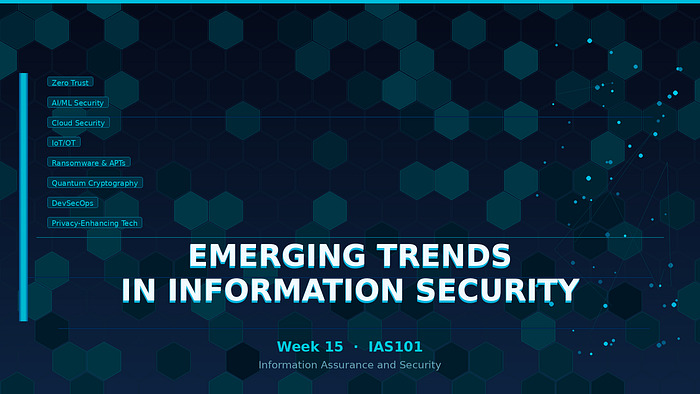
Section 2: The 8 Trends Reshaping Information Security
1. Zero Trust Architecture: Never Trust, Always Verify
For decades, network security operated like a medieval castle: build a strong wall (the firewall), keep the bad guys outside, and trust everyone on the inside. This 'perimeter model' made sense when employees worked from a fixed office, connecting to servers in the same building. But that world no longer exists. Today, employees access corporate systems from home, from coffee shops, from their phones, and from cloud platforms that sit entirely outside any corporate wall. The castle model is not just outdated. It is dangerous.
Zero Trust Architecture (ZTA) is the response. The core principle is simple: trust nothing and no one by default, regardless of whether they are inside or outside the network. Every user, every device, and every application must continuously authenticate and prove it has the right to access what it is requesting. Access is granted on a least-privilege basis you get exactly what you need for the task at hand, nothing more. If a user's credentials are compromised or a device is infected, the blast radius is contained because that user or device cannot move freely through the network.
Google was among the first major organizations to implement this model at scale. After being targeted in 'Operation Aurora' in 2010 a sophisticated Chinese state-sponsored attack that exploited the implicit trust of their internal network Google rearchitected their entire security posture around what they called BeyondCorp. The premise: any employee should be able to work from any network without a VPN, but every access request is evaluated based on user identity, device health, and context. Today, BeyondCorp is the blueprint that vendors like Zscaler, Palo Alto Networks, and Microsoft have built multi-billion-dollar businesses around. The U.S. federal government formally mandated a Zero Trust strategy for all agencies in 2021 through Executive Order 14028.
2. AI and Machine Learning in Cybersecurity: The Double-Edged Sword
Artificial intelligence has arrived in cybersecurity, and it has arrived on both sides of the battlefield simultaneously. For defenders, AI and machine learning (ML) represent a genuine force multiplier. Traditional rule-based security tools like antivirus software that checks files against a list of known malicious signatures cannot keep up with the volume and novelty of modern threats. AI-powered tools can analyze millions of events per second, identify subtle anomalies that would take a human analyst hours to spot, and flag potential intrusions in near-real time. Security information and event management (SIEM) platforms like Splunk and Microsoft Sentinel now embed ML models to detect patterns of behavior that deviate from normal a technique called user and entity behavior analytics (UEBA).
For attackers, AI is equally transformative. Large language models have made it trivial to generate highly personalized phishing emails that lack the spelling errors and awkward phrasing that used to tip off suspicious recipients. AI-generated deepfake audio and video are already being used in business email compromise (BEC) scams in one documented case in 2019, attackers used AI-cloned audio of a CEO's voice to instruct a finance executive to wire $243,000 to a fraudulent account. Generative AI tools can automate vulnerability scanning, write malware that evades signature-based detection, and adapt attack strategies dynamically.
The security community is now in a genuine AI arms race. Organizations that do not adopt AI-powered defensive tools will find themselves at a structural disadvantage against adversaries who are already using AI offensively. The key insight: AI does not replace human security analysts it augments them, handling the volume and speed of machine-scale threats so humans can focus on the judgment calls that require context and creativity.
AI does not replace human security analysts. It augments them, handling machine-scale threats so humans can focus on the judgment calls that require context and creativity.
3. Cloud Security and the Shared Responsibility Model
The cloud has become the default infrastructure for virtually every modern organization. AWS, Microsoft Azure, and Google Cloud Platform collectively host the data and applications of millions of businesses. But with that shift has come a pervasive and dangerous misunderstanding: many organizations assume that moving to the cloud means the cloud provider handles security. It does not at least not entirely.
Every major cloud provider operates under what is called the Shared Responsibility Model. The provider secures the underlying infrastructure the physical data centers, the hypervisors, the core networking. But the customer is responsible for securing everything they put on top of that infrastructure: their data, their access controls, their application configurations, their network settings. The line between provider and customer responsibility varies by service type (IaaS, PaaS, SaaS), but the fundamental principle is the same: you own your data, and you are responsible for protecting it.
Misconfigurations are now the leading cause of cloud security breaches, according to the Verizon Data Breach Investigations Report. A misconfigured S3 bucket left public-facing, an overly permissive IAM role, an unencrypted database these are not exotic hacking techniques. They are administrative errors that expose sensitive data to anyone who happens to look. The 2019 Capital One breach, which exposed the personal data of over 100 million customers, traced back to a misconfigured web application firewall in AWS. The lesson: cloud security is not automatic. It requires deliberate, ongoing configuration management and a clear understanding of where your responsibilities begin.
4. IoT and OT Security: The Billion-Device Problem
The Internet of Things (IoT) refers to the billions of internet-connected devices that are not traditional computers or smartphones: security cameras, smart thermostats, medical monitors, industrial sensors, factory robots, power grid controls. Operational Technology (OT) refers specifically to the hardware and software that monitors and controls physical processes think the systems that run a water treatment plant, a hospital, or an electrical grid. What these devices share is that they were often designed for functionality and cost, not security. Many run outdated or embedded operating systems that cannot be patched. Many use default passwords that are never changed. Many communicate over unencrypted protocols.
The consequences of compromised IoT and OT systems are not limited to data theft. They can be physical. In December 2015, Russian-linked attackers used malware called BlackEnergy to shut down portions of Ukraine's power grid, leaving approximately 230,000 people without electricity for hours the first confirmed cyberattack to cause a power outage. In 2021, an attacker accessed the control systems of a water treatment plant in Oldsmar, Florida, and temporarily increased sodium hydroxide levels to potentially dangerous concentrations before an operator noticed and reversed the change. In healthcare, connected infusion pumps and patient monitors have been shown to carry exploitable vulnerabilities that could, in theory, allow an attacker to alter drug dosages.
The scale of the problem is staggering. As of 2024, estimates suggest there are over 17 billion connected IoT devices globally, with that number projected to exceed 29 billion by 2030. Securing this ecosystem requires a combination of network segmentation (isolating IoT devices from critical systems), rigorous device inventory management, mandatory security standards for manufacturers, and zero trust principles applied at the device level. The NIST Cybersecurity Framework and the EU's Cyber Resilience Act are beginning to establish baseline requirements, but enforcement remains fragmented.
5. Ransomware and Advanced Persistent Threats: The Geopolitical Weapon
Ransomware malware that encrypts a victim's files and demands payment for the decryption key has evolved from a nuisance into a strategic threat. The 2021 attack on Colonial Pipeline, which operates the largest fuel pipeline on the US East Coast, forced a six-day shutdown that caused fuel shortages across multiple states. The operator paid $4.4 million in Bitcoin to the DarkSide criminal group to restore operations (most was later recovered by the FBI). That same year, ransomware attacks targeted Ireland's national health service, forcing the cancellation of thousands of medical appointments, and hit JBS, the world's largest meat processor, disrupting food supply chains globally.
Modern ransomware groups have professionalized their operations, adopting business models like Ransomware-as-a-Service (RaaS), where criminal enterprises license their malware to affiliate attackers in exchange for a percentage of ransoms collected. They have also innovated tactically: double extortion is now standard practice, meaning attackers not only encrypt files but also exfiltrate sensitive data and threaten to publish it unless a second ransom is paid. Triple extortion adds a third layer threatening to notify the victim's customers or partners unless they pay as well.
Advanced Persistent Threats (APTs) represent the elite tier of this threat landscape sophisticated, long-duration campaigns typically conducted by nation-state actors or state-sponsored groups. Unlike opportunistic ransomware, APTs are targeted and patient. They may spend months inside a network, quietly mapping systems and exfiltrating data, before triggering any visible action. Groups like APT29 (Russia's SVR), APT41 (China), and Lazarus Group (North Korea) have been linked to some of the most damaging cyber operations in history, including the SolarWinds supply chain attack that compromised nine US federal agencies and hundreds of private companies in 2020.
Ransomware has evolved from a nuisance into a strategic threat. Modern groups operate like businesses, with affiliate programs, customer service portals, and negotiation specialists.
6. Quantum Computing and Post-Quantum Cryptography: The Clock Is Ticking
Most of the encryption that protects the internet today from your online banking to classified government communications relies on mathematical problems that are computationally infeasible for classical computers to solve. RSA encryption, for instance, depends on the difficulty of factoring very large numbers into their prime components. ECC (Elliptic Curve Cryptography) relies on the difficulty of the elliptic curve discrete logarithm problem. A sufficiently powerful quantum computer, using an algorithm called Shor's Algorithm, could solve these problems exponentially faster than any classical machine, rendering current encryption effectively useless.
We are not there yet. As of 2024, quantum computers remain noisy, error-prone, and far below the qubit counts needed to break production-grade RSA-2048 or AES-256. But the security community is not waiting. Nation-states and well-resourced adversaries are believed to be harvesting encrypted data today intercepting and storing encrypted communications with the intention of decrypting them once quantum capability matures. This 'harvest now, decrypt later' threat is real and urgent for any data that must remain confidential for 10 to 20 years: classified intelligence, medical records, financial contracts, state secrets.
In August 2024, NIST finalized the first set of post-quantum cryptographic standards, based on years of global competition and evaluation. The standards include CRYSTALS-Kyber (now called ML-KEM) for key encapsulation, and CRYSTALS-Dilithium (now called ML-DSA) for digital signatures. Organizations are advised to begin a cryptographic inventory cataloging where RSA and ECC are used and to develop migration roadmaps. The transition will take years, and starting now is not optional for any organization with long-term data security obligations.
7. DevSecOps and Shift-Left Security: Building Security In
Traditional software development treated security as a final checkpoint: build the application, then hand it to a security team to test before release. This approach has a fundamental flaw by the time vulnerabilities are discovered at the end of the pipeline, they are enormously expensive to fix. According to research by NIST, a vulnerability found and fixed during the design phase costs roughly $80 to remediate. The same vulnerability discovered in production can cost $7,600 or more to address. Fixing it after a breach can cost millions. The arithmetic is clear: security needs to move left in the development timeline closer to the beginning.
DevSecOps is the practice of integrating security into every phase of the software development lifecycle (SDLC), from initial design through coding, testing, deployment, and operations. Rather than treating security as an external audit or gate, DevSecOps teams embed security tools and practices directly into the CI/CD (continuous integration / continuous deployment) pipeline. Static application security testing (SAST) tools scan source code for vulnerabilities as it is written. Dynamic analysis tools test running applications for exploitable weaknesses. Software composition analysis (SCA) tools identify known vulnerabilities in third-party libraries before they ever reach production.
The cultural dimension of DevSecOps is as important as the technical tooling. Security cannot be the job of a single team working in isolation. Developers need to understand secure coding practices. Operations teams need to understand threat modeling. Everyone needs shared accountability for the security of what they ship. Organizations that have fully embraced DevSecOps including tech giants like Netflix, Google, and Amazon report significantly faster remediation times and lower breach rates than those still running traditional waterfall security models.
8. Privacy-Enhancing Technologies: Protecting Data While Using It
Privacy and utility have long been treated as opposites: the more you can use data, the less private it is. Privacy-Enhancing Technologies (PETs) challenge that assumption by enabling organizations to extract value from sensitive data while preserving individual privacy. These technologies are moving from academic research into mainstream deployment, driven by tightening data protection regulations like GDPR, CCPA, and HIPAA, and by growing public awareness of privacy rights.
Three PETs are particularly significant. Differential privacy adds carefully calibrated mathematical noise to datasets, making it statistically impossible to identify any individual record while still allowing accurate aggregate analysis. Apple uses differential privacy to collect usage statistics from iPhones and Macs without Apple ever seeing individual user behavior. The US Census Bureau used it in the 2020 Census to protect respondent data. Federated learning allows machine learning models to be trained across many decentralized devices without the raw data ever leaving those devices only model updates are shared. Google uses federated learning to improve keyboard autocomplete on Android phones without seeing what users type. Homomorphic encryption is perhaps the most ambitious: it allows computation to be performed directly on encrypted data, so a cloud service can process sensitive information without ever decrypting it.
These technologies are not just academic curiosities. They are becoming competitive differentiators and, in some industries, regulatory requirements. Medical researchers can now collaborate on sensitive patient datasets across institutions without sharing the underlying records. Financial institutions can run fraud detection models on customer data without centralizing it. For students and professionals entering the field, fluency with PETs is increasingly valuable the intersection of privacy engineering, cryptography, and data science is one of the fastest-growing specializations in tech.
Section 3: Common Misconceptions Let's Clear the Air
Even among professionals who work in IT and security, certain persistent misunderstandings keep circulating. Here are four of the most important ones to correct.
Misconception 1: 'We're too small to be a target.'
This is probably the most dangerous misconception in cybersecurity. The reality is that most ransomware and many phishing campaigns are not targeted at all they are automated, opportunistic sweeps across the internet, exploiting whatever vulnerabilities they find. Small businesses and universities often have weaker defenses than large enterprises, making them more attractive targets, not less. According to the 2023 Verizon DBIR, small businesses accounted for 46% of all breach victims. Size is not protection. Basic hygiene patching, MFA, backups is.
Misconception 2: 'Moving to the cloud makes us more secure.'
Cloud platforms offer significant security capabilities that most organizations could not replicate on-premises. But the cloud does not automatically make you secure. As discussed, misconfigurations are the leading cause of cloud breaches. Moving to the cloud without understanding the Shared Responsibility Model, without properly configuring access controls, and without ongoing monitoring is not a security improvement. It is a new attack surface.
Misconception 3: 'Post-quantum cryptography is a future problem.'
The 'harvest now, decrypt later' threat means this is a present problem for anyone handling data with long-term sensitivity requirements. Intelligence agencies, healthcare organizations, financial institutions, and government contractors need to be assessing their cryptographic exposure today. NIST has finalized standards. The migration roadmap needs to start now, because these transitions take years to execute across complex enterprise environments.
Misconception 4: 'Zero Trust is a product you can buy.'
Vendors love to label their products as 'Zero Trust solutions,' and security teams sometimes believe that purchasing such a product means they have implemented Zero Trust. Zero Trust is an architectural philosophy, not a product. Implementing it requires a combination of identity management, device health verification, network segmentation, access policies, and continuous monitoring along with significant organizational change management. Products can help implement the components, but no single product delivers Zero Trust.
Section 4: What This Means for You
These trends are not abstract. They have direct implications for virtually every role in the technology and business ecosystem. If you are a developer, DevSecOps is reshaping your job description. Security is increasingly a first-class concern in code review, dependency management, and CI/CD pipeline design. Employers in 2024 and beyond are looking for developers who write secure code by habit, not as an afterthought. Learning OWASP Top 10 vulnerabilities, using static analysis tools, and understanding secure authentication patterns are no longer optional skills they are table stakes.
If you are a system administrator, cloud engineer, or IT operations professional, the combination of Zero Trust, cloud security, and IoT/OT challenges defines your near-term workload. Network segmentation, privileged access management (PAM), and cloud configuration auditing are critical competencies. The transition to post-quantum cryptography will also land squarely on your plate certificate management and PKI infrastructure will need to be rearchitected. If you are a manager or executive, your role is to ensure that security investment keeps pace with business risk, that security teams have the resources and organizational authority to do their jobs, and that your board understands the financial and reputational exposure at stake.
For students entering the field, this is both a challenging and genuinely exciting moment. The eight trends in this article represent eight distinct career specializations, each with strong demand and limited supply of qualified practitioners. Cloud security architects, AI/ML security engineers, post-quantum cryptography specialists, privacy engineers, and threat intelligence analysts are among the most sought-after profiles in the industry. The U.S. Bureau of Labor Statistics projects 32% growth in information security analyst employment through 2032 roughly four times the average for all occupations. The field is not just hiring. It is urgently hiring.
The U.S. Bureau of Labor Statistics projects 32% growth in information security analyst employment through 2032 roughly four times the average for all occupations. The field is not just hiring. It is urgently hiring.
Section 5: Conclusion
Security is not a problem you solve once. It is a continuous process of adaptation, learning, and improvement in the face of an adversary that never stops evolving. The eight trends explored in this article Zero Trust, AI in security, cloud security, IoT/OT, ransomware and APTs, quantum threats, DevSecOps, and privacy-enhancing technologies are not separate conversations. They are facets of a single, interconnected challenge: how do we protect digital systems and the people who depend on them in a world of relentless, sophisticated, and increasingly automated threats?
The organizations that navigate this landscape successfully will be those that treat security as a strategic function, not a compliance checkbox. They will embed security into their development processes rather than bolting it on at the end. They will adopt Zero Trust principles not because a vendor told them to, but because they understand why perimeter security is insufficient. They will prepare for quantum threats now, not when the first cryptographically relevant quantum computer is announced. They will take shared responsibility in the cloud seriously, auditing configurations the same way they would audit financial statements.
For individuals in the field, staying current is a professional obligation. The landscape of 2024 looks radically different from 2019, and the landscape of 2029 will look different still. Reading Verizon's annual DBIR, following researchers like Brian Krebs and Bruce Schneier, engaging with NIST and ENISA publications, and pursuing relevant certifications are not optional extras for ambitious professionals. They are baseline expectations in a field where ignorance carries real-world consequences.
The security landscape is indeed changing faster than most organizations can keep up. But the gap between those who are keeping up and those who are not is a choice, made one decision at a time: to invest or not to invest, to learn or not to learn, to prioritize security or to assume someone else will handle it. The trends in this article represent the map. The journey is yours to take.
Section 6: Put Your Knowledge to the Test
ACTIVITY: Put Your Knowledge to the Test
Reflection Questions
• Reflect on an organization you are familiar with (your university, workplace, or a well-known company). Which of the eight trends covered in this article do you think represents their greatest unaddressed security risk? What evidence leads you to that conclusion?
• The Zero Trust model requires organizations to verify every user and device continuously. What are the practical trade-offs between security and user experience that a Zero Trust implementation creates? How would you balance them?
• Quantum computing is not yet capable of breaking today's encryption, but NIST has already finalized post-quantum standards. Do you think this proactive approach is the right policy? What are the risks of moving too early or too late?
Practical Challenge
• Choose one of the eight trends from Section 2. Audit your university or workplace against that specific trend. For example: Does your institution apply Zero Trust principles to its network access? Does it have a formal DevSecOps pipeline? Does it maintain an IoT device inventory? Document one concrete gap you identify and propose a realistic remediation step. Present your findings as a one-page memo to a hypothetical IT director.
Group Discussion Prompt
'Ransomware groups are now so well-organized and technically capable that paying the ransom is sometimes the rational choice for an affected organization. The debate about whether paying ransoms should be legally prohibited is no longer academic.' In groups, argue both sides: Should paying ransomware be illegal? Consider the perspectives of hospital administrators, law enforcement, insurance companies, national security officials, and affected patients. What policy would you recommend and why?
References and Further Reading
1. IBM Security. (2023). Cost of a Data Breach Report 2023. IBM Corporation. https://www.ibm.com/reports/data-breach
2. Verizon. (2023). 2023 Data Breach Investigations Report (DBIR). Verizon Business. https://www.verizon.com/business/resources/reports/dbir/
3. NIST. (2024). Post-Quantum Cryptography Standardization. National Institute of Standards and Technology. https://csrc.nist.gov/projects/post-quantum-cryptography
4. NIST. (2018). Framework for Improving Critical Infrastructure Cybersecurity (Version 1.1). National Institute of Standards and Technology. https://doi.org/10.6028/NIST.CSWP.04162018
5. ENISA. (2023). ENISA Threat Landscape 2023. European Union Agency for Cybersecurity. https://www.enisa.europa.eu/publications/enisa-threat-landscape-2023
6. Mandiant. (2023). M-Trends 2023: Mandiant Special Report. Google Cloud / Mandiant. https://www.mandiant.com/resources/reports/m-trends-2023
7. Rose, S., Borchert, O., Mitchell, S., & Connelly, S. (2020). Zero Trust Architecture (NIST SP 800–207). National Institute of Standards and Technology. https://doi.org/10.6028/NIST.SP.800-207
8. Ward, R., & Beyer, B. (2014). BeyondCorp: A New Approach to Enterprise Security. USENIX ;login: Magazine, 39(6), 6–11. https://www.usenix.org/publications/login/dec14/ward
9. Krebs, B. (ongoing). Krebs on Security. https://krebsonsecurity.com Authoritative investigative reporting on cybercrime and security incidents.
10. Schneier, B. (ongoing). Schneier on Security. https://www.schneier.com Commentary and analysis from one of the field's most respected security technologists.
11. U.S. Cybersecurity and Infrastructure Security Agency (CISA). (2023). Ransomware Guide. https://www.cisa.gov/stopransomware/ransomware-guide
12. European Parliament. (2022). Cyber Resilience Act Proposal for a Regulation on Cybersecurity Requirements for Products with Digital Elements. https://eur-lex.europa.eu/legal-content/EN/TXT/?uri=CELEX%3A52022PC0454