In the modern web, servers are no longer just static vaults, they are talkative agents. They fetch images from URLs, query APIs, and communicate with microservices. But what happens when an attacker tricks your server into talking to the wrong person?
Enter Server-Side Request Forgery (SSRF) — a vulnerability that turns your own backend infrastructure into a weapon against itself.
What is SSRF?
Server-Side Request Forgery (SSRF) occurs when a web application fetches a remote resource without validating the user-supplied URL. Instead of fetching a harmless public image, the attacker forces the server to send a request to an internal destination that should be inaccessible from the outside world. Because the request originates from the trusted server itself (and not the attacker's machine), firewalls often let it pass.
What Can You Do With It?
The impact of SSRF ranges from "nuisance" to "total takeover."
- Cloud Takeover: Attackers can query cloud metadata services (e.g.,
http://169.254.169.254) to steal temporary IAM credentials and gain administrative access to your AWS, GCP, or Azure environment. - Internal Reconnaissance: Attackers can port scan your internal network, identifying unpatched databases, Redis instances, or admin panels running on
localhost. - Data Exfiltration: By hitting internal APIs, attackers can read sensitive configuration files or customer data that was never meant to be public.
Enter See-SURF: The AI-Powered Scanner
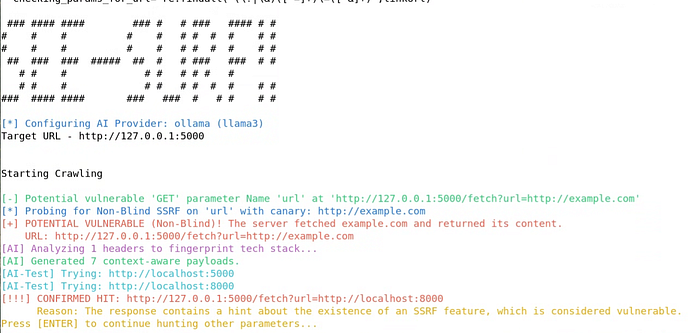
See-SURF is an open-source security tool designed to identify and exploit SSRF parameters, but with a major new upgrade: AI-driven detection.
Instead of blindly fuzzing every parameter with thousands of payloads, See-SURF now leverages Large Language Models (LLMs) — supporting Ollama for local privacy, as well as Gemini, Claude, and OpenAI — to act like a smart Red Teamer.
Key Features:
- Hybrid Scanning: It combines classic reconnaissance (parsing HTML, Burp Suite sitemaps) with modern AI analysis.
- Smart Payload Generation: The AI analyzes the target's technology stack (fingerprinted via headers) to generate custom, context-aware payloads (e.g., specific internal paths for a Tomcat server vs. a Django app).
- AI Validation: It doesn't just check if a connection happened, it uses AI to analyze the context of the HTTP response headers and body to determine exploitability.
Stop relying on dumb fuzzers. Upgrade your bug bounty and pentesting workflow with a tool that understands the target.
Check it out on GitHub: https://github.com/In3tinct/See-SURF