
Let's be honest. We've all seen that one message in our family WhatsApp group: "Amazon is giving away free iPhones to celebrate its 500th anniversary! Click here!" First of all, Amazon isn't that old. Second, they aren't that generous.
Today I'm going to tell you why clicking that link is a bigger mistake than replying to your ex at 2 AM. 🚩
1. The "Freebie" Trap (Lalach Buri Bala Hai) 🎁 Scammers know our weaknesses. Whether it's a "Free Recharge", "Government Subsidy" or "Win a Car" they use Social Engineering. * The Logic: If it's too good to be true, it's probably a scam. * The Reality: You aren't winning an iPhone; you are gifting them your data.
2. "Click Here or Die" (The Fake Urgency) ⏰ Ever noticed how these links always say "Limited time offer" or "Account expires in 10 minutes"? That's not a deadline; it's a panic trigger. They want you to click before your brain actually starts working.
When you click these links, you aren't taken to a legitimate site. Instead, you land on a Phishing Page — a pixel-perfect replica of a bank or social media login page. Once you enter your credentials or OTP, the scammer has full control over your financial or personal data.
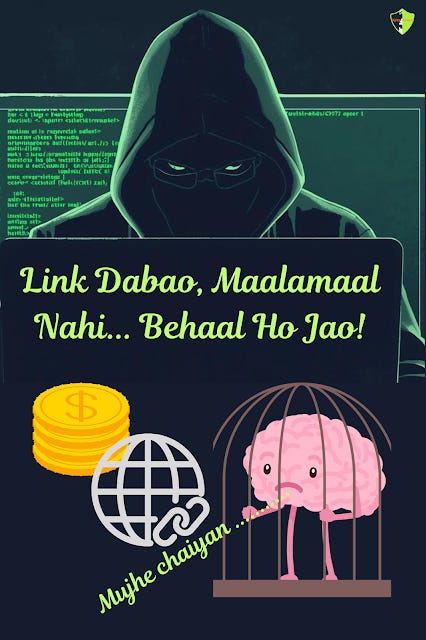
Why Social Engineering Works Scammers don't just 'hack' systems; they 'hack' humans. They use: * Authority: Pretending to be a police officer or a bank manager. * Scarcity: Making you feel you will miss out on a big reward. * Trust: Using a hacked friend's account to send you the malicious link.
3. The "Look-Alike" Websites (The Identity Crisis) 🎭 You click the link and see a page that looks exactly like your Bank or Amazon. * Pro Tip: Look at the URL. If it says www.amozon-free-gift.co.in, run! It's as fake as a ₹2000 note with a 'Churan' label.
4. Your Shield Against Scams (The Superhero Move) 🛡️ To stay safe, follow these golden rules: * Check the URL: Legitimate sites use https:// and have clear domain names (e.g., bank.com vs bank-secure-verify.xyz). * Verify via Secondary Channels: If you get a suspicious message from a friend or bank, call them directly before clicking. * Enable 2FA: Two-factor authentication is your second line of defense even if your password is stolen. * Hover before you Click: See where the link is taking you. * Report & Block: Don't just ignore it. Report it so the scammer has a bad day too.
The Bottom Line: Your digital safety is in your thumb. Think before you tap. Stay safe, stay witty, and don't let a "Free Prize" turn into a "Costly Lesson." If you found this helpful, follow Digital Kavach for more deep dives into the world of cybersecurity.
Originally published at https://digital-kavach.blogspot.com.