


McDonald's team built an AI-assisted workflow that turned a six-week migration analysis into a two-day process, enabling accurate, scalable system transitions.
by: Arth Shah, Software Engineer, Restaurant Technology
Quick Bytes:
- AI‑generated pandas scripts now complete migration analysis in two days instead of six weeks
- Automated decoding and validation reduce manual effort and improve data accuracy
- This approach enabled the GLS → Restaurant Profile transition and created a scalable blueprint for future migrations
Why AI + pandas matter for enterprise data migration Enterprise system migrations are rarely glamorous. They often require analyzing thousands of records across multiple data models, with manual extraction, field mapping, and validation stretching into months — time that modern businesses simply don't have. And every extra week adds risk to data integrity.
By combining AI-generated code with pandas processing — an open-source Python library for fast, flexible data handling — and real-time documentation access, we can turn months of manual migration analysis into weeks of automated data validation.
Modernizing legacy systems at enterprise scale Our team was tasked with analyzing data compatibility between the legacy Global Location Service (GLS) system and Restaurant Profile for the US market. We analyzed 178K+ facility instances across 22 facility types to support the transition, a process that traditionally required six weeks of manual work per model.
The aha moment: From manual mapping to AI-powered analysis The breakthrough came when we realized that data migration analysis follows predictable patterns — ideal for AI code generation. Instead of manually writing extraction and validation scripts for each data model comparison, we shifted to a smarter approach:
- AI-generated decoders to generate Base64/gzip decoders from data format descriptions
- Pandas-powered analysis for efficient field coverage analysis across 18,000+ records
- Model Context Protocol (MCP) to pull validation requirements from live documentation systems
- Maintain human control over business logic decisions and data quality thresholds
Cracking the code: Our prompt engineering breakthrough Our key discovery was simple but powerful: structured prompts with context produce production-ready code. Instead of vague requests, we developed prompt templates that deliver consistent, accurate outputs.
PROMPT TEMPLATE: "Generate a pandas function to analyze field coverage in {data_type} data from {source_system} with {record_count} records. Requirements: {business_rules}. Output: coverage percentages, missing data patterns, and validation summary."
Example: "Analyze facility coverage patterns in compressed JSON data from GLS APIs with 18K+ records. Requirements: identify missing phone numbers, coordinates, time zone data. Output: coverage percentages and critical gaps."
Result: Complete pandas analysis function in 30 seconds vs. 2+ hours of manual coding.
But generating code was only part of the solution. To make this approach scalable and reliable, we needed more than one‑off AI‑generated scripts. We built a Python framework that could orchestrate the extraction, processing, and validation steps end‑to‑end, while still giving engineers full control over business rules and data‑quality requirements.
Why the Python framework mattered The Python framework became the backbone of our solution, creating a repeatable and auditable process for large-scale migrations. By combining automation with human validation, we ensured accuracy while enabling a consistent workflow that can scale across markets.
Our three-layer architecture: The secret sauce behind speed We built a Python framework combining AI code generation, pandas processing, and real-time documentation access:
AI-Assisted Data Analysis Workflow: 1. DATA EXTRACTION (AI + Python)
- AI generates extraction scripts from requirements
- Handles Base64 + Gzip decoding automatically
- Fetches from multiple API endpoints
2. DATA PROCESSING (Pandas + AI)
- pandas DataFrames for bulk processing
- AI generates transformation logic
- Statistical analysis and pattern recognition
3. BUSINESS VALIDATION (MCP + Human Oversight)
- MCP pulls business rules from documentation
- Human-defined validation criteria
- AI generates validation code from business rules
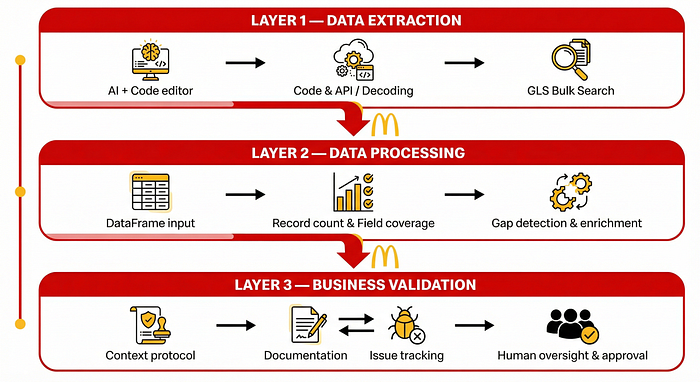
How this architecture is implemented: It's powered by an advanced AI code-generation model, integrated with MCP for real-time business rule access and an AI-enabled development environment. Together, these components automate pandas code generation, connect live documentation, and streamline the entire workflow from extraction to validation.
Real-world impact: How we scaled migration analysis This approach significantly reduced the time required for migration analysis, accelerating system modernization.
So, what changed?
- Scale: Automated processing of 18,000+ records and 178,000+ facility instances
- Accuracy: AI-generated decoders eliminated Base64/gzip parsing errors
- Coverage: Panda's analysis identified gaps in field coverage (76.8% vs 100%)
- Reusability: The framework works across multiple system migrations
This speed and precision delivered measurable business impact. For the US market, the team rapidly completed the GLS → Restaurant Profile analysis, identified critical data gaps early, and helped ensure Restaurant Profile as the primary data source.
And the best part? This approach is built for adaptability. All scripts are stored in source control and can be iteratively improved, making it easy to extend the framework to other markets. The prompt engineering patterns and analysis workflows are flexible enough to accommodate different data structures and regional requirements — creating a blueprint for global scalability.
What worked and what we learned Looking back, these elements made the biggest impact:
- AI for repetitive tasks: Automated extraction and validation code generation
- Pandas for data processing: Efficiently handled large datasets without memory issues
- MCP for current rules: Integrated documentation kept validation logic up to date
- Human oversight: Maintained control over business decisions and code approval
We reinforced the importance of early error handling for compressed data and maintaining human validation checkpoints through the process.
What sets this approach apart and why it matters for McDonald's tech future This work demonstrates how AI can act as a force multiplier for complex data analysis. By combining advanced AI code generation, MCP's real-time documentation access, and AI-integrated development tools, we created a new paradigm for technical analysis work — one that accelerates processes without sacrificing accuracy or control.
This approach not only enabled the GLS (Global Location Service) → Restaurant Profile transition but also established reusable patterns for enterprise data analysis. By pairing AI assistance with human oversight, we built a scalable solution that integrates seamlessly into existing workflows.
Looking ahead, this model sets a blueprint for future migrations, proving how AI can accelerate modernization at a global scale while supporting McDonald's vision for faster, smarter technology solutions.