

Let me be honest with you before we move ahead. The first 3 days were really brutal, I had to force myself.
Not in a motivational kind of way. In a 'what is wrong with me and why am I standing in the dark at 4:30 in the morning' kind of way. EVERYONE is sleeping.
I have now completed many many (dont even remember how many) challenges in the past few years. For example the latest one,
Walked 10k steps daily for 30 days
Each one taught me something the previous one did not. But this challenge, waking up at 4:30 AM for 30 days consistently, is for sure one of the hardest one. My wife asked me why 4:30, why not 5 or 6pm.
Why 4:30 AM and not 5 or 6?
Being a mathematician I love numbers, I did my BS in Math and just love odd, prime numbers. I actually set my alarm for 4:29 or 4:31 AM instead of 4:30. I know its weird but again, I love weird numbers.
Before 5 AM, pretty much everyone sleeps, you wont find many people in gym or even at home or if you are living a hostel, that's kind a sacred time, super quite.
Your phone is not buzzing, no call, no text, none (In fact, I do not suggest phone early in the morning regardless when you wake up, the first 90 minutes should be yours, no one else).
Nobody is emailing you, (I dont check emails until 9am, just 2–3 times a day).
That window between 4:30 and 7:30 AM, roughly 3 hours, became the most productive, I could focus on whatever I want.
Also, it's strange how waking up that early changes your mindset, you don't want to waste time. You're less likely to jump on YT or any social media, because your brain almost tells you, you sacrificed your sleep, so now it's time to make it count.
It feels like the moment to work on your best project. Don't just take my word for it, try waking up at 4:30 AM consistently for a week and see what happens.
There is also something neuroscientists call sleep inertia, the grogginess you feel in the first 15–30 minutes after waking. By choosing a fixed, early time and sticking to it for 30 days, my body began anticipating the wake time through a process called the cortisol awakening response.
By day 8, I was waking up at 4:25 AM naturally (no alarm).
The science of the cortisol awakening
Around 30-45 minutes before your usual wake time, your brain begins releasing cortisol. Worth mentioning, this is not stress cortisol. It is preparatory cortisol, a natural biological alarm system that primes your alertness, metabolism, and immune function for the day.
Research (Nature) found that this response is 50-100% stronger in people who wake at consistent times. Consistency itself is the main mechanism.
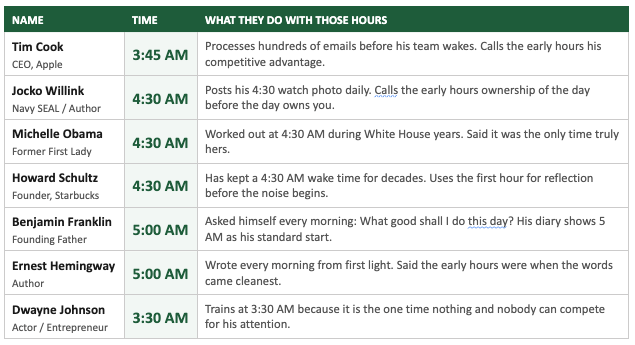
Why do the most successful people in the world wake up early?
Before I got into this challenge, I did research into the morning routines of successful people ( I truly believe discipline plays a major role in your life, and a morning routine is a part of it).
What I found was not a coincidence. It was a clear pattern. The most productive, most creative, most intentional people shared ONE THING>
Successful people owned the early morning hours.
What is interesting is that these people are not waking up early because they are naturally morning people. Most of them were not.
They are waking up early because they made a decision that the first hours of the day were too valuable.
My 4:30 AM routine, step-by-step (different)
Let me explain exactly what I did every single morning. The real one, including what the first couple of days felt like before any of it became natural in the end of 2nd week.
4:30 AM (Do not touch your phone)
The alarm goes off at 4:30AM.
The single most important rule I set for myself was this, do not pick up the phone, trick, buy a cheap alarm. (worth sharing, I dont take my phone in bed even before this routine)
The moment you touch your phone, you have handed your first conscious minutes of the day to social agenda, you brain hard wired to start exploring.
The first morning I did this, I lay there for about 1–2 minutes feeling completely weird/tired about what I was doing. By day 5, I was sitting up before the alarm done its first ring.
A study found that checking your phone within the first minutes of waking activates the brain's threat detection system, elevating anxiety & cortisol before the day has even started. People in reactive morning mode reported 34% lower feelings of control over their day.
A tall glass of water (room Temperature, sometimes lemon or electrolytes)
The very first thing I consume every morning is a tall glass of water, usually around 500ml, of course after brushing teeth.
I love drinking water at room temp because cold water first thing in the morning feels like a shock to a system that is still warming up (By the way, I dont drink room temp water because its healthy, I do because I like it, regardless what science says).
Sometimes I add a squeeze of fresh lemon (30 day challenge on the way…) or electrolytes.
Here is the main thing most people do not realize.
You just spent 7–8 hours without any water intake, your brain, which is 75% water, is already low. Even a 1-2% reduction in hydration is enough to measurably impair cognitive function, concentration, + your mood.
Research found that mild dehydration of just 1.5% water(fluid) loss caused measurable impairment in mood, concentration, + working memory. Rehydrating first thing in the morning reverses this deficit within about 20 minutes and activates the sympathetic nervous system, giving you a natural energy lift before any caffeine.
4:38 AM Cold plunge (3-5 Minutes at 39 F (4 C))
I am not going to pretend this ever gets easy. It does not.
What changes is that you stop fearing it in the roughly 2 weeks. By week 2, I was walking towards the cold plunge with something closer to anticipation than fear or whats gonna happen. Not because 39 degrees feels good, it doesn't.
The protocol I used was 3-5 minutes of immersion not the face/head (at 39 F or 4 C.
No counting seconds obsessively, just controlled breathing, relaxed body, eyes open. I kind learned if you are not shivering or dont feel its cold enough, its not working.
My bold finding about the cold plunge
What I felt after stepping out of the cold plunge each morning was not something I expected. Within about 90 seconds of exiting the cold plunge, there was a rush of clarity + energy that no amount of coffee has ever did for me.
By day 10, cold plunge was my single favourite part of the morning.
A study found that cold water immersion increases dopamine (feel good) levels by up to 250% and norepinephrine by up to 300%. Research from Dr. Andrew Huberman at Stanford shows these elevations can last 2–4 hours after a single cold water exposure. The cold plunge also activates brown adipose tissue, increases metabolism, and dramatically improves alertness (that's what I observed rush of energy) through its effect on the locus coeruleus ( maintain the blood-brain barrier).
4:45 AM, warm up, squats + plank
After the cold plunge, the body needs to warm back up pretty quick, especially when you do cold plunge at 39F. I kept this pretty simple, a set of just your bodyweight squats followed by a plank hold as much as you can. No gym, just your body.
Just enough movement to bring the body temp back up, activate the major muscle groups, and signal to the nervous system.
Recall, I am not trying to train hard at 4:45 in the morning. I am trying to warm up my machine.
The cold plunge releases energy and the movement directs it to the right way.
Research shows that even 5 minutes of moderate morning movement increases core body temperature, cerebral blood flow, and the production of brain derived neurotrophic factor (BDNF), which improves learning capacity and neuroplasticity.
5:00 AM, black dark roast coffee + sometimes with creatine
This is my one non negotiable, I spent a lot of time researching benefits of coffee, and invested heavily in fresh beans, quality bean grinders,machines etc.
A large, black, dark roast coffee. no milk, no sugar.
Nothing between me and the caffeine (dark roast).
I have been a black coffee person for years and I am not apologizing for it (I tried a 30 day challange to to quit but do not recommend it).
Sometime I add creatine to my coffee.
I know that sounds weird but the research on creatine as a cognitive improve, separate from its well known benefits for physical performance, is really worth it.
One important note here.
I drink my coffee after my water and after my cold plunge, plank, squats etc.
Many people make the mistake of reaching for coffee the moment they wake up. That's a big NO.
Cortisol is naturally peaking in the 30-45 minutes after waking.
Consuming caffeine during this window actually reduces its effectiveness and builds tolerance faster.
Waiting 45-90 minutes after waking, as Dr. Andrew Huberman recommends, means the caffeine do hit your nervous system that is ready for it.
My rule: First 30 minutes no phone, no caffeine.
Study shows that creatine supplementation significantly improved working memory and processing speed in healthy adults. A meta analysis in Nutrients covering 23 studies confirmed meaningful cognitive benefits, especailly, under conditions of mental fatigue or sleep deprivation. Both apply to early mornings.
5:05 AM, straight to the home office, 2–3 hours of DEEP WORK
That's the whole point, DEEP WORK. Everything before this is just prep.
By 5:05 AM I am sitting at my desk, coffee next to me, notebook open, and I work for 2-3 hours on whatever the most cognitively demanding (the hard task of the day ) thing on my plate is.
Writing
Learning something hard
Coding
Building something new
Whatever that project currently is, it gets the first and the msot alert hours of my brain
Deep work (great book under the same title, highly recommend) means work that needs your full attention, uninterrupted long focus.
Writing, creating frameworks, learning/mastering difficult material, solving really complex problems. The kind of work that, if interrupted every 10 minutes, produces nothing of value.
What I found during this challenge was that 2 hours of deep work at 5 AM helped me to produce more meaningful results than 5-6 hours of work tried during a normal day time schedule.
Cal Newport's (Deep Work author) research, found that the average knowledge worker is interrupted every 11 minutes and takes 23 minutes to return to full cognitive engagement after each interruption. Between 4:30 and 7:30 AM, there are truly ZERO interruptions. The compounding effect of 2–3 uninterrupted hours vs. 5 interrupted ones is not linear. It's for sure exponential.
What actually happened
Here is where I am going explain what worked and what did not (lask me int eh comments if you have any questions)
Week 01
Days 1–3 were really hard, I was tired by 1/2 PM.
The cold plunge in the first few days was the hardest and demanded way more willpower than almost anything I have done.
On day 2 I nearly quit at 4:28 AM when the alarm went off and decided to go back to sleep. I did not quit tho.
My simple rule
I have a simple 30-day challenge rule: if I miss one day, that's fine, the challenge continues. But if I miss two days in a row, I quit the challenge. It used to be three days in a row. Also, if I miss more than 4–5 days during the 30-day challenge, I have to start the challenge over.
Days 4–7, something truly chnaged, the 1-2 PM tiredness moved to 3–4 PM. The morning tiredness gone faster. By day 6, I noticed I was sleeping more deeply ( hack, go to bed early instead of waking up early)
Week 02
Day 8 was the real thing, I woke up 2–3 minutes before my alarm went off. That had never happened to me at this hour in the past past week.
The cortisol awakening response was beginning to work.
The deep work sessions were helping a lot to produce quality work without interruption.
I even started tracking my word count and quality of ideas.
The numbers from week 02 were pretty much double what they were from week 01. The cold plunge helped to shift from feeling like punishment ( It was for sure in the first week) to feeling like a healthy habit in progress.
Week 03 & 04
I want you to reread this part, this is the part nobody talks about.
By week 03, something had changed that was not about productivity or quality sleep.
I had started to think of myself differently, I was may more reflective on my ideas, life, where the life is going, whats happening.
Not as someone who was trying to wake up early.
But as someone who wakes up at 4:30 AM, that is a tiny but profound thought.
James Clear writes about this in Atomic Habits, every action you take is a vote for the kind of person you are.
By day 21, I had cast 19 votes for a specific identity, the habit was no longer something I was doing. It was becoming part of who I was.
What each of tiny routines do to your biology
- No Phone on waking, at least 30–90 minutes
- Prevents reactive cortisol spike, preserves proactive morning state
- Phone use as soon as you up reduces sense of daily control by 34%
- Water First (500ml), I prefer room temp
- Reverses overnight dehydration, activates sympathetic nervous system
- 1.5% dehydration impairs mood + memory
- Cold plunge at 39F/4C
- Dopamine +250%, norepinephrine +300%, 2-4 hours
- Squats and plank, → core temp rise, cerebral blood flow increase
- 5 min movement primes brain for learning + memory encoding
No caffeine first 30–90 minutes (BEST 90 minutes), Huberman Lab suggest 45-90 min delay optimises caffeine effectiveness
- Caffeine hits post cortisol peak, maximum adenosine blocking effect
- Creatine addition, phosphocreatine replenishment in brain, improved working memory
- 2-3 hrs Deep Work, Zero interruption, peak alertness 2-4 hrs when you up
- 23 min need per interruption to focus again
- Newport 4 hrs max REAL deep work
The things nobody talks about in morning routine
When you wake at 4:30 AM, you cannot stay up until midnight anymore, I also don't suggest anyone, I was going to bed max 9PM most of the time 8:30Pm.
I started going to bed by 8:30 to 9 PM.
What I did not expect was how much I would start to value those quiet evening hours differently.
Instead of scrolling aimlesslsly or sitting in front of TV (I am gald, I dont watch TV much, just whatever show is goign on, sitting with my wife) out in front of screens until late, I was reading, reflecting, and truly winding down.
The early wake time forced me to be intentional (your brain wont even think to waste time).
Your relationship with silence/early hours
At 4:30 AM, the world is truly quiet, no noise, just you.
For the first few days, this felt a little bit uncomfortable. I think our ears are accostomed to noise at ceratin level without noise, you will feel weird.
I realized I had spent years filling every quiet moment with noise, music, podcasts, or screens.
By week 02, I had started to need that silence. It became something I protected rather than something I escaped from especially in my ealry 20s.
Your confidence
Every morning that you do this, you have already done something hard before most people have opened their eyes.
There is a psychological effect to this that is difficult to quantify but impossible to miss.
By the time your family, colleagues and friends are just starting their day at 8 or 9 AM, you have already done a cold plunge, 2–3 hours of deep work.
That sense accomplishment carries through the rest of the day in a way that affects your decisions, your conversations, and your confidence in yourself!
Deep work
I have done deep work sessions many times during the day especially, during my grad program. I wish I had done this 30 day 4:30AM waking up challange that time to complete my research way ahead on time.
Nothing compares to what happens between 4:30 and 7:30 AM. The silence, the post cold plunge neurochemistry, the absence of any competing demands, and the biological alertness peak all converge into a cognitive state that I truly cannot replicate at any other time.
My best work of the past two years was produced in those early mornings.
What did not work
I committed to always sharing the failures, not just the wins. Here is what went wrong.
By the way, waking up at 4:30 AM is not for everyone. Some readers work all night, and this is simply an experiment based on what worked for me. I'm also fortunate that I was able to devote my time to it.
- Days 1–3 were really miserable, you will feel tired. Your body will resist (it's also temporary).
- Social life for sure takes adjustment. I had to leave two dinners early. I said no to a late evening event I really wanted to attend. If you have a partner, roommates, or family, this has to be discussed in advance. You dont want to disturb your partner especially waking up at 4:30AM.
- Weekends are the hardest part, at least for me. Again I dont like to use screens or work on Sundays. That's why I did not even bother to wake up on Sundays.
- Sleep quality matters more than your 30 day challenge. You might not be able to wake up at 4:30 especially if you are going to bed late I highly suggest focus on improving your quality sleep first (8 solid hours).
+41% Deep work compared to normal schedule days (no noise +++ point)
+28% Sleep quality (vote goes to cold plunge) Apple watch sleep score
Day 8 Inflection point (Waking before alarm)
The concluding thoughts
Should you try this?
Let me answer this as directly as I can, because I think the honest answer is YES.
If you are a parent of young children who wakes multiple times a night, this is probably not the right challenge for you, at least right now. You already sleep deprived, I dont suggest this challenge.
Sleep deprivation is a real health risk and optimizing your sleep should come before optimizing your wake time.
If you have 7-8 hours of quality sleep, a serious (In my case always curious) project you are trying to build, and a true desire to find uninterrupted time that nobody can take from you, then a 100% YES.
This is the challenge I would recommend above almost everything else I have tested!!
The question is not whether waking up at 4:30 AM makes you more productive, the data on that is clear, the question is whether you are ready to also go to bed at 9:00 PM.
If the answer to that is yes, then I want to make you ONE PROMISE. By day 8 or 9, you will not want to stop.
A 4:30 AM wake time is not a goal. It is a system (gonna take time)
Suggestion
Start with one week before committing to 30 days regardless the challenge.
If you want to follow these experiments in real time, including the clear frameworks, systems, and tools I'm creating behind the scenes.
I write about all of it in The Pathway, my newsletter on thinking better, using AI better, and building things better.
Every Tuesday I publish a full framework. Every Saturday, one idea. No BS, no fluff.
Subscribe HERE
If this was useful, share it with one person who needs to start walking. That's the only ask.
Sufyan Maan, M.Eng | Engineer | Systems Thinker | Writer