

What about ditching sugar and dairy & loading up on salmon, blueberries, and greens? Did it improve my focus, productivity, and energy?
I do roughly 185 miles (300 km) of hikes every year, exercise 3 to 4 times a week, and eat clean-ish about 80% of the time. When I say clean eating, I mean completely staying away from processed foods. Also, I don't like sugar.
Now that the basics are out, I've been really honest with myself. There was a problem I couldn't shake.
Every afternoon, my brain felt like it was wrapped in bubble wrap.
- Fuzzy
- Heavy
- Uncooperative
- Confused, I would say foggy
I'd power through the rest of my workday with caffeine (I'm glad I only consumed black coffee, no sugar, no milk), but I couldn't help but think:
Is there a better way to improve my mental health?
How can I stay alert all day?
I was doing pretty much everything in a healthy way.
Is there a better way to eat healthy that actually makes my brain feel…sharp?
I had tried all the popular brain-boosting diets: Keto, Whole30, Paleo, Bulletproof, Slow-Carb, you name it.
They were either too restrictive, too complicated, or had no flavor, or were too boring.
And one missed day, I felt like I had to start over again.
I wanted something that is easy to do. Something as simple as brushing your teeth every morning is effortless.
Something backed by research.
And most importantly, something that wouldn't make me miserable or too expensive to sustain in the long run.
That's how I found the MIND DIET, a flexible, science-based eating plan designed specifically to improve your cognitive health.
What started as a mere 7-day test turned into a 30-day challenge, and honestly, it changed the way I think about food.
Why I Chose the MIND Diet (And What It Actually Is)
The MIND diet, short for Mediterranean-DASH Intervention for Neurodegenerative Delay, is a hybrid of the Mediterranean and DASH diets.
Researchers at Rush University and Harvard School of Public Health developed it.
Here's what makes it different:
It was designed to improve BRAIN function, not WEIGHT LOSS.
It's based on longitudinal studies, including one that followed nearly 1,000 people for 9 years.
The people who followed strictly reduced their risk of Alzheimer's by 53%.
Moderate followers still saw a 35% drop in risk.
The diet is built around 10 brain-healthy food groups:
Green leafy vegetables (like spinach, kale, lettuce, arugula, etc)
Other fresh veggies
Berries (especially blueberries), I consume blueberries every single day.
Nuts
Whole grains
Beans (I consumed black beans)
Fish (ONLY FRESH, no frozen or canned stuff)
Chicken
Extra virgin Olive oil
Wine (I did not consume any wine or any type of alcohol)
It limits but doesn't say you should stay away 100% from these 5:
- Red meat (I love steak and eggs, tho.)
- Butter & margarine (I prefer no salt grass-fed butter, NO margarine)
- Cheese (I don't like cheese except on pizza, a little bit, yeah, I get it, it's weird, but I never liked cheese even when I was a kid.)
- Pastries & sweets (I am glad after reading a bunch of books, and doing no-sugar experiments, I did not consume too many pastries or sweets)
- Fried/fast food (I usually stay away, it was an easy part at least for me)
You don't need to follow the diet 100% to see benefits.
That's what hooked me.
My 30-Day Brain Food Plan
I set a few simple rules:
- Follow the MIND diet at least 80% of the time. (Room for life, weekends, steak, and for sure pizza on weekends)
- Cut out refined sugar and dairy. I must say these were my biggest mental fog culprits. I was glad I wasn't consuming too much even before starting the diet.
- Track my sleep (really, really important), energy (boosted by long walks), mood, and productivity daily.
I created a basic meal to keep things simple:
Breakfast
- 2 eggs + 1/2 cup egg whites + spinach + smoked salmon + nuts
- Dark roast black coffee (no sugar, no milk, no cream)
Supplements: I consume these supplements daily. I am in my late 30s, and it helps me a lot to get the extra nutrition.
Magnesium glycinate
Omega 3
CoQ10
Creatine
&
Multivitamin
All with breakfast.
Tiny experiement: Try zinc supplment over the counter 1–2 tabs 1–2 hours before sleep. You will have the best sleep. But if you're already consuming every day, you won't see it.
Lunch
- Kale salad, chicken breast, beans, roasted veggies, and olive oil
Snack
- Blueberries (Fresh are the best, but I consumed frozen) + chia seeds + yogurt + walnuts
Dinner
- Brown rice or quinoa (give it a try, you might like it) with veggie curry, or grilled fish, or again grilled chicken breast with sweet potatoes
Note: I do not mind eating the same food every day as long as I am enjoying it and it also has balanced nutrition.
My favourite snack
Try this snack, especially if you are dealing with low energy between breakfast and lunch. I heard from a gastrologist who has been consuming it for years.
Dates 2–3
Dark chocolate 70%-90% (I prefer organic)
Walnuts
It will look something like this.
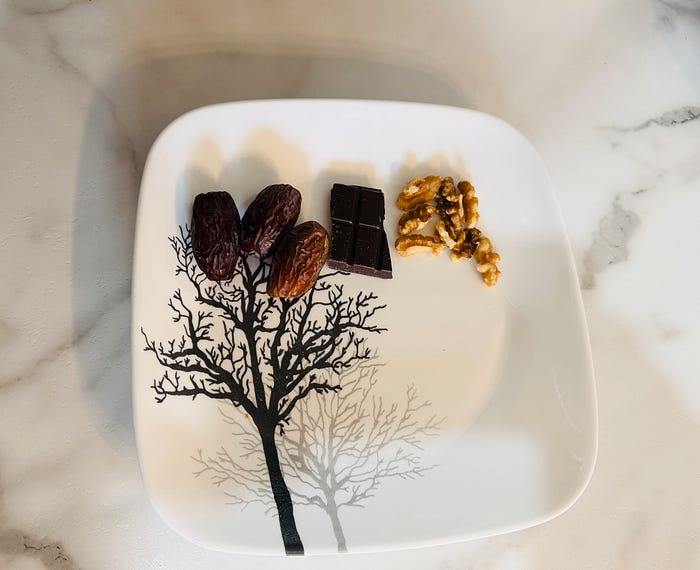
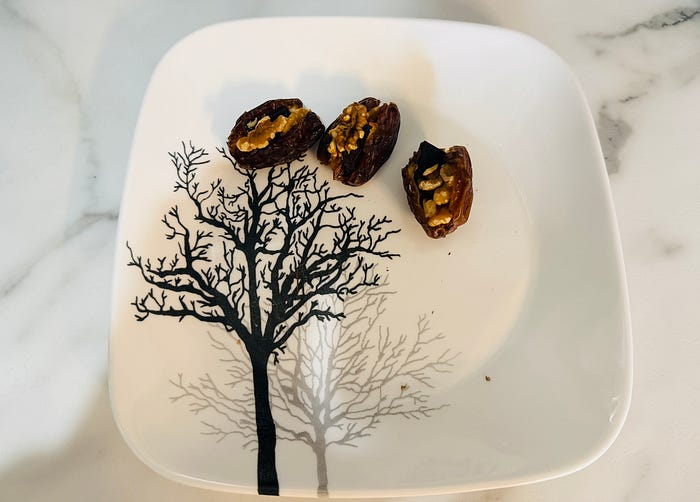
Plus, I also added dark roast black coffee. It's like an instant energy booster. Before asking any question, would it work, etc, I highly recommend giving it a try.
Week 1: Adjusting
Beginning is the hardest part, I must say the first few days were… foggy.
Ironically, I felt worse before I felt better. I thought it was actually doing the opposite, following this diet, than sticking to my steak eggs. I still consume steak and eggs. I also believe there is no better breakfast than this one. But for the sake of the experiment, I stick to the plan.
Cutting out sugar (Completely) and dairy (Sometimes 1–2 a week, I do consume milk tea, cereal, etc) left me cranky on day 2.
My body craved instant energy, but my meals were more stable and slow-burning.
By Day 4, though, something shifted, but pretty slowly.
I woke up without my alarm.
Bonus: Tiny Experiment to boost energy as soon as you are up
Do 5 squats
Do 1–5 pushups
Do 1–5 lunges
And do a plank
I had energy before coffee.
And best of all, no afternoon crash.
I started falling asleep faster. I was going to bed at max at 9 pm.
My focus sessions (tracked with a Pomodoro timer) jumped from 4 to 7 per day.
I wasn't just eating better. It was actually helping to improve my life.
Week 2: Less hungry
I didn't expect this.
I was less hungry, even though my meals weren't much bigger.
My blood sugar was pretty stable all day.
I stopped thinking about food between meals.
This freed up a weird amount of mental space.
Normally, I'd wrestle with:
"Should I have another snack?"
"Do I need more caffeine?"
"Why am I so distracted right now?
Tip
Put your phone in another room or buy a phone lock (it looks like a box) to keep your phone inside while working deeply.
And my workdays suddenly got longer without feeling like a slog.
I started writing more (this article is the proof), creating faster, and feeling more present in conversations.
My anxiety even dropped a few notches.
There was this strange new feeling. It could be due to discipline, but nutrition plays a pivotal role.
Week 3
By now, mental clarity had become my new baseline.
But what surprised me was how my body caught up to my mind.
I crushed a long run without checking my pace every two minutes. Another point is that I am a pretty active guy. I do long walks pretty much every day and also try my best to hit the gym 3–5 times a week.
I was sleeping like a rock, even before this experiment I do prirotize my sleep 7–8 hours solid sleep hours.
And while I wasn't counting calories, I'd lost 3 pounds without trying.
(no Sugar+ no carbs, perhaps?)
I hadn't touched refined sugar or dairy for 30 days, without a single binge craving.
Not because I'm super-disciplined.
But because I truly didn't want it.
It felt too costly to give up this mental shift, then keep going.
Week 4:
Week 4 hit during a crazy week at work, although I work from home, but sometimes it gets crazy busy. I also do side projects, but I am happy I have 100% control over whether to decline or take a project.
Tight deadlines
Unexpected meetings
And a looming presentation, I wish there were an option for leaders, when you are done, just go and do what's important, then go through the whole presentation.
What it used to do
- Late-night snacking, especially pizza or a burger
- Coffee overload, that's inevitable during long meetings
But something was different.
Instead of reaching for sugar or takeout, I doubled down on my "brain plate."
Thanks to developing this habit to prepare in advance.
Tip: Never ever go to a meeting or the grocery store on an empty stomach.
- More leafy greens.
- Extra blueberries, anti-oxidant
Some people prefer sardines, but I don't like them either. They're smelly. A couple of decades ago, in a small town somewhere in North America, I used to work in a local pizza store. Here, the homemade sardine toppings were so famous. As an employee, I had to do it, but since then, I haven't enjoyed it anymore.
Following the mind diet, I finally got through the week with less stress than usual.
More importantly, I didn't lose momentum at all. It's because I have done so many 30-day challenges in the past.
What I Learned from 30 Days of Brain Food
This challenge totally rewired my relationship with food in ways I didn't expect.
I have not missed the dates, dark chocolate, and walnuts combination since then.
1. I observed that eating for your brain is more motivating than eating for your body
I've always struggled with the "diet" mentality, restriction, guilt, failure cycles, and, most of the time, super boring foods.
But eating to boost focus and energy at the same time was a next-level thing.
I was looking forward to enjoying the next meal.
2. Sugar
I am glad I don't consume too much sugar, but during these 30 days, I literally did not consume at all. I might say a bit, but mostly I stayed away from he sugar.
Within days of cutting it out, my taste buds recalibrated. Even if you don't follow a 30-day challenge, within two weeks, you will feel different.
The fruit tasted (fresh) way better. And I love fruits.
Coffee and sugar provide an energy boost, but it's not lasting.
Brain food gives you consistency in the long run.
And consistency is paramount to get all the benefits.
3. No need to chase perfection
I ate out three times, that's it. I also enjoyed 1–2 healthy snacks throughout the day.
But I stuck to the principles 80–90% of the time, and that was enough to feel the difference from week 3.
5. Healthy meals don't need to be complicated
I repeated the same meals often. As I said earlier, I don't mind eating the same food again nd again if it's delicious and also healthy.
But they were balanced and really good for the brain.
Two things
Less decision fatigue
Means more clarity
Would I Keep Going?
Short answer: yes
But not rigidly. I love to enjoy life. I don't think I will totally stop eating pizza or steak+eggs. But I will prefer brain food throughout the week, then enjoy it on the weekend.
I'll keep the MIND diet as much as I can, but I am not going to punish myself to just stick to the brain diet. Life is more than 30-day challenges or following strict diets.
However, I'll be more conscious of sugar, dairy products, and, of course, processed foods.
The biggest gift this challenge will give you is the feeling.
That rare, clean, crystal-clear mental state of mind, no fog, where everything flows and nothing feels forced.
No supplement, app, or productivity hack I've tried can match what food alone did in 30 days.
And I don't want to give that up.
Thinking About Trying It? Here you go
If you want to try your own 30-day brain food challenge, here's what I recommend:
Focus on 3–4 POWER foods:
Start with what's easy to get:
- Blueberries (Try fresh if they are cheap, lol, I buy wild frozen)
- Spinach, kale, etc.
- Eggs (free range)
- Salmon or any kind of fresh fish
- Extra virgin olive oil (Don't cook in EVOO, just use as dressing) Cook in butter (unsalted, grass-fed)
Most important → Keep it SIMPLE!
Say NO to sugar + dairy
You don't need to be perfect.
Just stay consistent enough to notice the difference.
Track your mind, not your macros.
Journal how you feel:
- Energy (1–10)
- Focus
- Sleep quality
- Mood
Final Thoughts
I've completed many 30-day challenges, ranging from cold showers to 10,000 steps, matcha mornings, and digital detoxes, over the past few years.
But this one?
This one gave me the clearest return on the most important thing in life, and that is your brain.
If you've ever felt foggy by mid-afternoon… Here's the solution.
Or relied on coffee to get through every task…
Or struggled to find a healthy way to eat, especially to feel healthy…
Try feeding your brain first.
It just might transform everything else.
Thanks for reading! Don't forget to follow me on LinkedIn, X, Instagram, and Threads, or support me over at Substack.
As a new reader, please check my holistic health, productivity, and well-being stories reflecting my reviews, observations, and 30+ days of experiments (29 completed so far) to build a sustainable, healthy lifestyle.
I also write about the general philosophy of life. For your convenience, here are the links.
Mental Health/Brain Damage, Hiking, Cofee (New Research), Technology, Healthy Lifestyle, Life Lessons, Productivity, Learning, Money
I'm building a community of like-minded people, and I'd love for you to be part of it. Sign up below!