January 15, 2025
Oreshnik’s 36 Hypersonic Hits, Linearity Enigma Explained
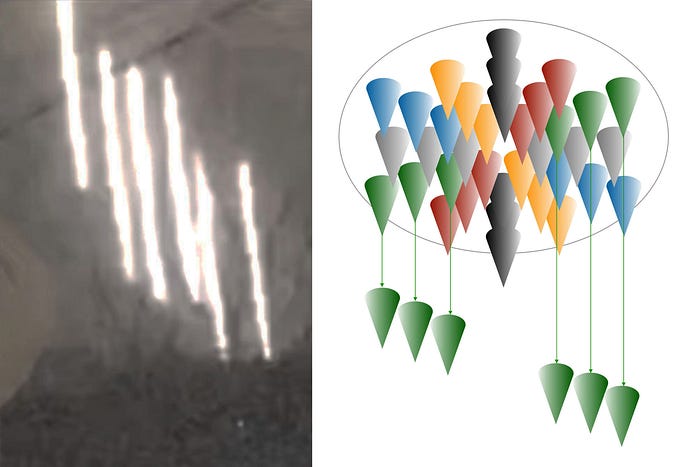
On November 21, 2024, the Russian Federation attacked the Ukrainian city of Dnipro with the Oreshnik Intermediate Range Ballistic Missile…

Dumitru Popescu
11 min read
- 1 I. The Oreshnik's MIRV features a completely new design.
- 2 II. The Oreshnik didn't release 6 Reentry Vehicles (RVs), but 36
- 3 III. The six RVs from the six hit sequences came down in a linear pattern
- 4 IV. I don't think the RVs we saw in the Dnipro attack are nuclear capable at all
- 5 V. The RVs didn't contain explosives. They didn't have to.
On November 21, 2024, the Russian Federation attacked the Ukrainian city of Dnipro with the Oreshnik Intermediate Range Ballistic Missile (IRBM).
It was the first time in history that an IRBM attacked a target from a populated area during a conflict.
Although this type of missile is primarily designed to deliver nuclear warheads, the Dnipro attack was a conventional one. What was most shocking, however, was the number of projectiles that hit the target. No less than 36 hypersonic projectiles.
The mainstream media explained to everyone how Russia's new missile works, but that was far from the truth.
After the Oreshnik IRBM attack, there was a lot of speculation about the vehicle's warhead. This is justified, of course, because for the first time we see in action a strike with 36 hypersonic projectiles from a single ballistic missile.
The Main Intelligence Directorate of the Ministry of Defense of Ukraine confirmed that the Oreshnik missile "had six warheads, each with six submunitions. This information was then disseminated to the world media and cited by agencies such as Reuters, BBC, Associated Press, etc. Reuters even showed renders of a 6-unit MIRV releasing 6 reentry vehicles, implying that these 6 units would then release another 6-unit submunition.
I think they were under the pressure of events and rushed to give the public an explanation about the new type of missile.
I'm going to explain why I have a different view on the matter, based on my experience in designing and manufacturing the A1 anti-ballistic missile interceptor, which is designed to combat the very ballistic missiles like the Oreshnik.
Based on available information, including extremely valuable attack footage, I drew six conclusions:
I. The Oreshnik's MIRV features a completely new design.
In the traditional sense, a Multiple Independently-targetable Reentry Vehicle, or MIRV, is a system carried by large ballistic missiles that contains multiple Reentry Vehicles (RVs). The RVs are typically armed with nuclear warheads and are capable of hitting a single or multiple targets.
In the case of the Oreshnik, we've seen a MIRV capable of six hits, which is not unusual, as there are other ballistic missiles in the world designed to do this. But things change significantly when we count the number of projectiles associated with those six hits. While in the case of "traditional" MIRVs, each hit is delivered by a single RV, in the case of the Oreshnik, each hit was delivered by a cluster of no less than six projectiles. This means that the target was hit 36 times. This is unprecedented.
II. The Oreshnik didn't release 6 Reentry Vehicles (RVs), but 36
Based on the graphics published by Reuters regarding the Russian missile's MIRV, it was concluded that the 36 projectiles that hit the target were submunitions from 6 Reentry Vehicles released from the MIRV bus. So, the assumption is that at some point during the RVs descent to the target, these 6 Reentry Vehicles each released six projectiles to hit the target. In my opinion, this assumption is not correct.
Below I'll explain why I think the scenario of Oreshnik releasing six RVs, which in turn released submunitions, makes no sense:
-
An RV is a solid piece of hardware with a structure made of ablative material that can withstand the extreme heat generated by aerodynamic friction. The ablative material has a similar function to that of spacecraft heat shields. The exception here is that the pick level of thermal stress to which the ablative material is subjected is higher than in the case of spacecraft. Therefore, making an RV capable of releasing submunitions through its structure would pose serious engineering challenges because the ablative material surrounding the vehicle is a fairly solid piece of hardware.
-
Once an RV is released, it uses thrusters to spin along its longitudinal axis to provide attitude stabilization as it descends from space to the target. This RV spin would have caused the submunition to disperse in a spiral pattern if released laterally, or to form a long trail behind the RV if released from the rear of the vehicle. Neither of these patterns were recorded in the case of the Dnipro attack.
-
Russian President Vladimir Putin claimed in a public appearance that the missile was traveling at Mach 10, a value later confirmed by the Ukrainian military, which stated that the projectiles hit the target at Mach 11. Submunition dispersion at these extremely high speeds would affect the attitude, trajectory, and velocity of the RV and subsequently the attitude, trajectory, and velocity of the submunition, resulting in a loss of velocity.
-
On the other hand, submunition dispersion from a Reentry Vehicle outside the atmosphere would make no sense, since there's no need to have an RV with protective ablative material carrying submunition in the first place.
-
If there were RVs releasing submunitions, there would have been debris from those items on the ground, which was not reported. What was reported instead was debris from the MIRV bus.
So these are the reasons why I believe the media reports make no sense. What I believe is that all those 36 projectiles were actually released directly from the MIRV bus. Now there's another discussion. Can we say that the Oreshnik has a 36-unit MIRV, which means that those 36 RVs (projectiles) are independently targetable? We didn't see any evidence of that. What we saw instead was a MIRV with the capability to engage 6 targets and to deliver strikes with 6 RVs (projectiles) on each target. That is what I believe the Oreshnik's MIRV is capable of.
III. The six RVs from the six hit sequences came down in a linear pattern
The linear pattern of the RVs was clearly visible in most of the hits, while in a few of them this linearity was not so clearly visible.

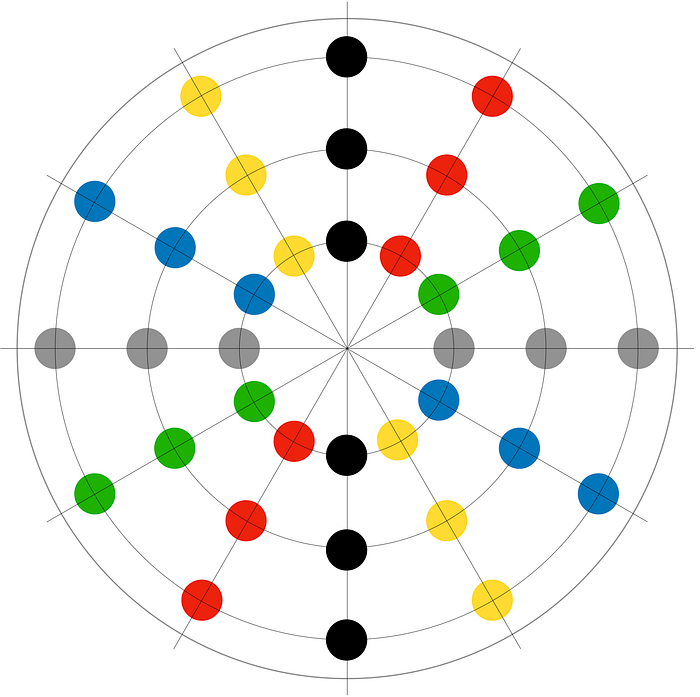
Based on this, we can draw some conclusions about the geometric arrangement of the RVs on the MIRV bus and the RV release sequence, as follows: The RVs were fired in six sequences, each sequence involving the firing of six RVs; Based on the linearity of the RVs pattern when hitting the target, we can safely assume that the RVs were also released from the MIRV bus in a linear pattern. This is because the RVs don't have the ability to maneuver (except for roll spin for attitude stabilization) after the MIRV bus release, so they came down in the same position relative to each other as they were released from the bus; I attempted to analyze the placement of various RV configurations aboard the Oreshnik. I've started with the most basic linear configuration, as we can see below:

This configuration, with a release pattern using one row after another (like the green row first, the blue row second, the black row third, and so on) would explain the linearity configuration of each RV row hit. But there are two things that made me think twice about this configuration. The first has to do with the fact that in some hits we clearly saw the linearity of the RVs configuration (like hit #6), while in other hits (like hit #4) we didn't see it very clearly. So my obvious question was: why was there this inconsistency in the width of the RV rows? Why weren't we seeing six similar rows of the same width? Why in some rows did the RVs have a significant amount of space between them, and in other rows the RVs appeared to be significantly closer together? And again, no, the RVs can't maneuver once they are released from the MIRV bus. The second thing that made me think that this configuration might not be right has to do with the fact that in this case the release of one row after the other would be asymmetrical and would require the MIRV bus to substantially compensate for the induced instability. So, based on these two considerations, I concluded that this configuration could only be correct if the MIRV bus performed a spin movement (desired or not) during the release, which would mean that the camera from the ground would have been able to record the apparent discrepancy in the RVs distance between the hits.
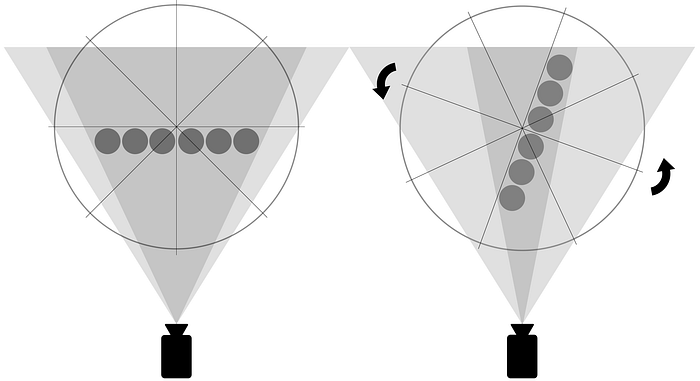
Since I don't really believe that the MIRV bus was subjected to any rolling motion (desired or not) during the RVs release, I looked at another configuration that would explain the inconsistency in the RV row width, as well as provide a more symmetrical release of RVs from the MIRV bus. So I studied this second configuration, which seems to answer both of these considerations, as we can see below:

We can also see that the RVs come down with the one from the right of the row first. This could mean that there is a delay in the release from the bus when the RVs form a single row. Most likely, this is used to reduce the need for sudden attitude compensation in the MIRV bus, as well as to reduce the risk of the RVs hitting each other during release.

This configuration, with a release pattern that uses one row after another (such as the blue row first, the yellow row second, the red row third, and so on), would explain the apparent inconsistency in the width of the RV rows recorded during the attack.
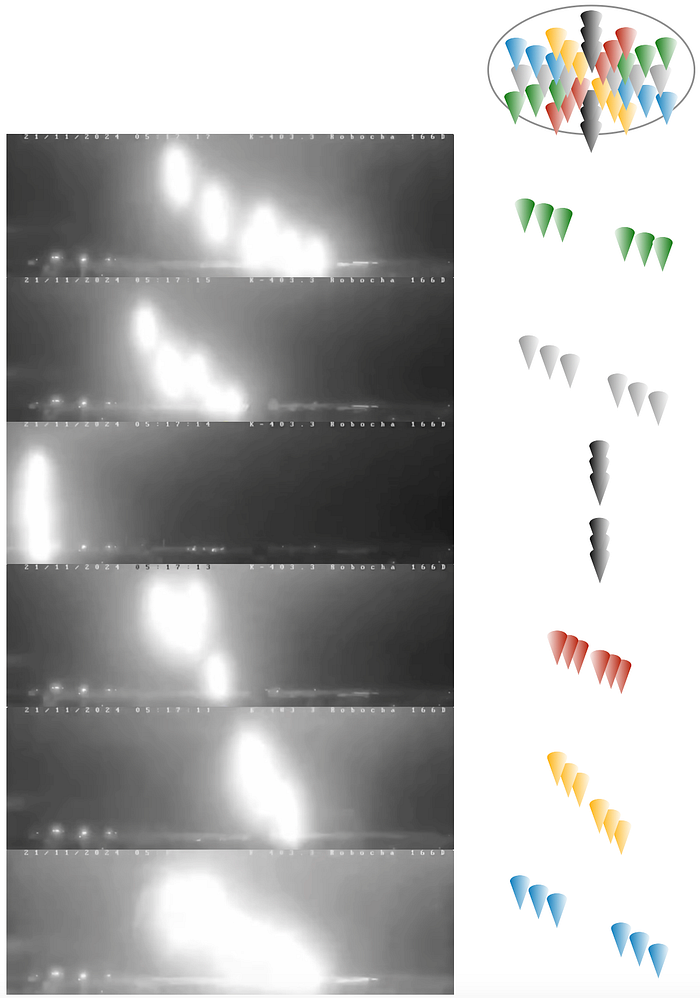
In fact, this configuration seems much more consistent with what we saw during the attack, and I'll analyze it further below.
Now, another question has to do with the dispersion that was recorded between each of the row attacks on the same target. Why did this happen? Why not all the rows hit on the same point? First of all, the dispersion recorded in the Oreshnik case is apparently consistent with the distance recorded between the RVs released by various ICBMs such as the Peacekeeper and Minuteman. So, nothing unusual in this case and very consistent with similar cases.
IV. I don't think the RVs we saw in the Dnipro attack are nuclear capable at all
The Oreshnik missile is based on the RS-26 Rubezh missile, which in turn is based on the RS-24 Yars missile. It seems that all these missiles share a lot of hardware, and the rocket stages may even be similar. In fact, it is reported that the Rubezh missile is actually a Yars missile that is missing an upper stage, which reduces the missile's range and classifies it as an IRBM instead of an ICBM as in the case of the Yars. The vast majority of sources give a first stage diameter of 2m and a diameter of 1.6m for the upper stages, including the nose cone. This means that the MIRV bus should be about 1.6m in diameter. Based on this, we can conclude that the RVs used in the Dnipro attack were close to 18cm in diameter. Based on the reported payload of the Rubezh missile of about 1000kg, we can also conclude that each RV has a weight of about 30kg. With a maximum diameter of about 18cm and a weight of about 30kg, it is highly unlikely that a nuclear bomb could be accommodated in such a small RV. Taking into account the considerable thickness of the RV ablative material, which could be between 1–2cm, this means that the available diameter is even smaller than 18cm. Let's compare the Oreshnik missile's estimated RV data with the Minuteman Mark 12A RV carried by the Minuteman III ICBM. The Mark 12A has a diameter of 54cm and an estimated total weight of 320kg, giving a load of 140g/cm2. The Oreshnik RV has an estimated diameter of 18cm and a weight of 30kg, which would give a load of 118kg/cm2. This means that the Oreshnik's RV would be inherently slower than the Minuteman's during the impact phase. This leads me to conclude that the Oreshnik's RV may actually have a significantly smaller diameter than 18cm.
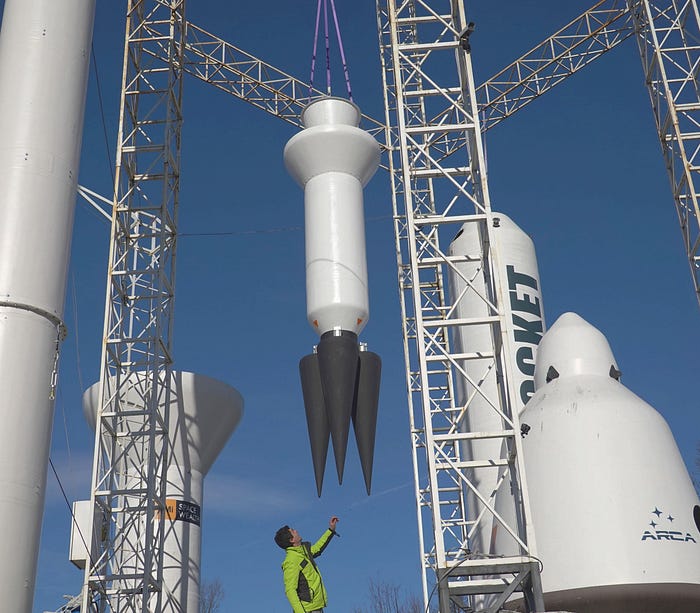
In this case, with RV's of about 10cm diameter, we can talk about loads in the range of 380g/cm2, which would make the Oreshnik RV capable of a higher impact velocity than the one fired by the Minuteman III. In fact, we can definitely assume that the Oreshnik RVs could actually be tungsten projectiles. This approach could in fact have similar characteristics to the proposed US "Rods from God" program. Assuming this highly probable theory and the proposed 10cm diameter for the RV as well as the tungsten option, I can conclude that the Oreshnik's RV (if conical) could have a length of 60cm, with the proportions shown below:

Now, another question is why have there been no reports of the RV's debris? Well, the tungsten RV's could very well be buried deep in the ground. I know exactly what I am talking about. It took my team 1 hour to bury a couple of lead rods that were used as ballast for a rocket launch and dropped from an altitude of about 100 meters.
V. The RVs didn't contain explosives. They didn't have to.
It was reported, and it was clear from the recorded footage, that the RVs didn't contain explosives and that they only hit the target kinetically. Let's do some math. Assuming an impact speed of Mach 10, which is about 3,400 m/s at sea level, and an RV weight of about 30 kg, we get an impact energy of about 173,400 kJ, which is about 40 kg of TNT. So if an inert RV would release the equivalent of 40kg of TNT on impact, and the weight of an RV was estimated to be 30kg including the structure, it means that the available mass for a potential explosive charge would be drastically low. Therefore, mounting an explosive charge on the RV could be redundant, as the impact energy of the RV is significantly higher compared to an explosive charge mounted on the RV. This was probably the thinking of the Russian engineers.
VI. Not really a MIRV, more like a MICRV
So, based on the MIRV definition and the above conclusions, the Oreshnik did not deliver a MIRV to the target, but a Multiple Independently-targetable Clustered Reentry Vehicle (MICRV). Don't look for this term online, because I just made it up. But I think it's a good short description of what we saw in the Dnipro attack. A weapon system capable of delivering Multiple Independently-targetable Cluster Reentry Vehicles (MICRV).
Conclusions
- All 36 RVs were fired directly from the MIRV bus, not as submunitions from 6 RVs as reported by the media;
- The Oreshnik is capable of engaging 6 targets and hitting each target with 6 RVs;
- All 36 RVs (projectiles) were arranged radially on the MIRV bus;
- The RVs (projectiles) we saw in the Dnipro attack are significantly smaller than those equipped with nuclear warheads and therefore not nuclear-capable, with diameters that I estimate between 10–18cm;
- The Oreshnik RVs (projectiles) could actually be tungsten structures;
- The Oreshnik RVs (projectiles) could be buried in the ground at significant depths, making them difficult to access;
- The Oreshnik uses a new type of MIRV, which I prefer to call Multiple Independently-targetable Cluster Reentry Vehicles (MICRV).
On the same topic: NATO Officials Were Dead Wrong, I Was Right
https://medium.com/ecorocket-commercial/nato-officials-were-dead-wrong-i-was-right-75b18d299fdf
HOME | ArcaSpace ArcaSpace is a research non-profit which develops cutting-edge technologies for space exploration, aeronautics and…
HOME | Dumitru Popescu Dumitru Popescu is an entrepreneur and designer, the founder of ArcaSpace, creator of EcoRocket, ArcaBoard, AirStrato
#ArcaSpace #MIRV #Oreshnik #ICBM #Missile #BallisticMissile #Ukraine #Russia #Technology