

It's 2025.
Hard sales don't work anymore.
With increased competition and social media — where every customer has a speakerphone — there is only one way to be successful (and have longevity) as a business, as a brand:
Be authentic and build trust.
This applies to everyone from multi-million-dollar brands to beginning freelancers.
How? By telling an authentic and powerful backstory for your "brand."
That means sharing who you are, where you've come from, and where you are going.
A well-written and compelling backstory humanizes your brand and differentiates you from the competition. It bears a little of your soul and your personality.
Most importantly, it draws customers in and gives them an emotional reason to buy your products or services.
And emotions are powerful drivers of action.
"Brands are built around stories. And stories of identity — who we are, where we've come from — are the most effective stories of all. This storytelling is a powerful way to bring brands to life." — Bill Dauphinais
Stories are how we make sense of the world
Stories appeal to us on an emotional level, because our brains are wired to respond to them.
Think about the world we live in: We've been hearing them since the day we were born. They permeate every aspect of our lives, including the world of business and branding.
According to Seth Godin, people choose brands based on the way they make them feel, so crafting a compelling origin story that resonates with your target market is the key to success.
So, the question is: how can you create a compelling story for your brand that wins fans?
Thankfully, good storytelling isn't random
Scholars of "story" and mythology, such as Joseph Campbell, observed that most mythologies from around the world contain the same archetypal story structure, with the same basic emotional beats and character arc.
Campbell called this "monomyth" or template structure: The Hero's Journey.
At its very basic level, it involves: a character who is faced with a problem they need to work to overcome before life returns to normal, or to a better life than before.
The key point is this: Stories that work seem to have a repeatable formula.
The entertainment industry has long understood this. Most Movies and TV shows, if examined, will reveal some variation of the same basic story structure — yet people keep coming back for more.
The good news is that you can use the key elements that work to tell your brand's story.
The Easy 4-Step Formula
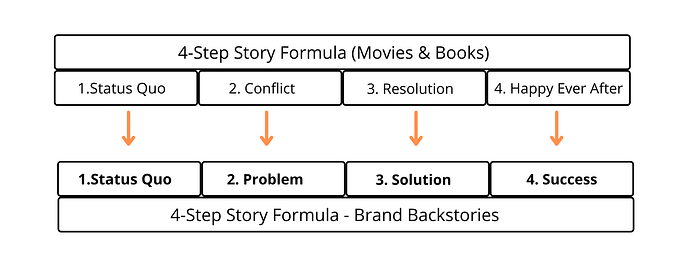
A basic stripped-down version of the most common story structure, which has proven to work, contains 4 steps:
Status Quo => Conflict => Resolution => Happy Ever After
To make this structure more suited to telling a compelling brand backstory, I've slightly modified the name of each stage in the graphic below:
Step 1: Status Quo
The Status Quo describes the situation before the problem.
In telling the story of how your business/brand came to be, this step will introduce the protagonist or character (you/your brand/the business) and describe what life was like before The Problem arose that led to the motivation to start "your thing."
Step 2: The Problem
As mentioned before, good stories are about a character overcoming a problem. In traditional storytelling in movies and books, this step is called the "Conflict" and it's what draws people in emotionally and keeps their attention.
In Step 2 of your brand's story, you want to introduce and describe the problem/adversity/difficult circumstances that disturbed the Status Quo.
Some examples include:
- Business: You were dissatisfied and frustrated with an existing product/service.
- Freelancer: You weren't happy with your job. You felt like you had more to offer clients creatively, but your role was holding you back.
Step 3: The Solution
Step 3 is when the character finds out how (often a lightbulb moment) to solve the problem. Usually, this is a moment of inspiration, the turning point when they decide to create a new and better product or service and embark on the journey to do so; when they decide to try and solve a problem they encounter; when they decide to leave their job and live a life more suited to their dreams and values.
Step 4: Success
The last step is Success— it's when things work out. In movies, it's the "happily ever after."
For your story, it might be:
- The successful creation of a product or service that people love and that successfully solves a problem.
- You are successfully helping more clients than ever as a freelancer while living your dream life.
Most compelling brand backstories that reach customers on an emotional level will have these 4 steps. Some will go into greater detail than others, or change the order a little, but all 4 steps are usually present.
Authenticity is the best marketing of all. It builds trust, and trust drives revenue.
A Note on being authentic: Great stories are true stories. People value your story when it's human, warts and all. Therefore, authenticity is the best marketing of all. It builds trust, and trust drives revenue.
Here's a Hypothetical Example
Brand: A Candy Company Startup
- Step 1 — Status Quo: You are a parent. Your kids like candy. You give them a treat every Friday after school. It is something they look forward to, and something you enjoy doing.
- Step 2— Problem: As you learn more about health and nutrition, you start to feel bad about buying the candy at the store because it has lots of additives and chemical sweeteners. Yet, you don't want to deprive your kids of their treat.
- Step 3— Solution: You realize that you can probably make a similar-tasting, healthier alternative at home in your kitchen. You buy all the ingredients and give it a go. You make many mistakes, but eventually, after lots of trial and error, you nail the recipe.
- Step 4 — Success: Your kids love it. You start sharing your homemade candy with the neighbors' kids — and they also love it. Parents start asking you for more, and soon start offering to buy them from you. You decide to give it a name and start selling it locally. Word spreads around your local community, and two years later, you are in 5000 stores across the country — helping to keep kids healthier.
Here are two real-life examples
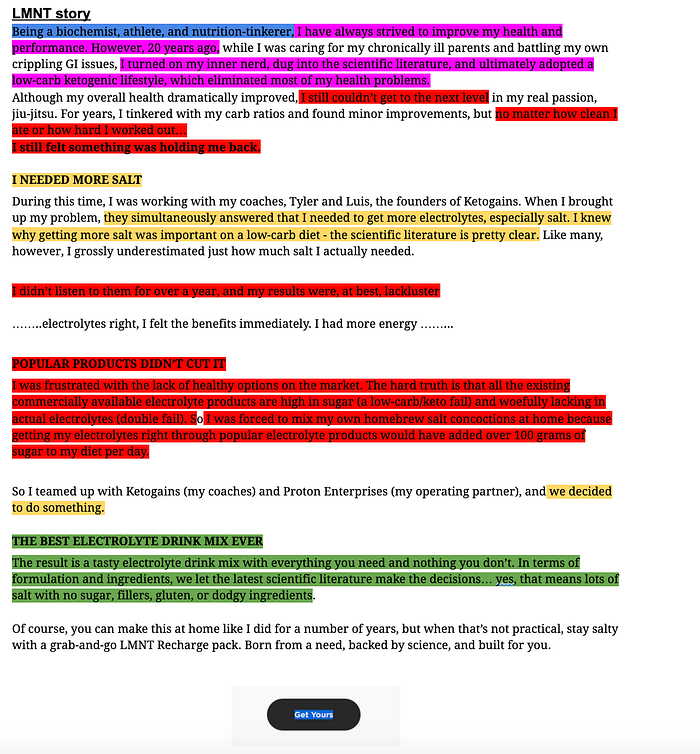
Here's my interpretation of these 4-steps effectively used in origin stories by two successful brands today: LMNT Electrolytes and TOMS shoes
I've used color-coded highlights to identity the 4 steps in each brand backstory.
Example #1: LMNT Electrolytes
LMNT is an electrolyte product aimed at health-conscious active consumers. Their backstory draws us in as we naturally empathize with the founder on his journey trying to reach optimal performance.

Example #2: TOMS Shoes
TOMS shoe company has an emotionally engaging backstory that explains the origins of its unique social benefit One-to-One model.
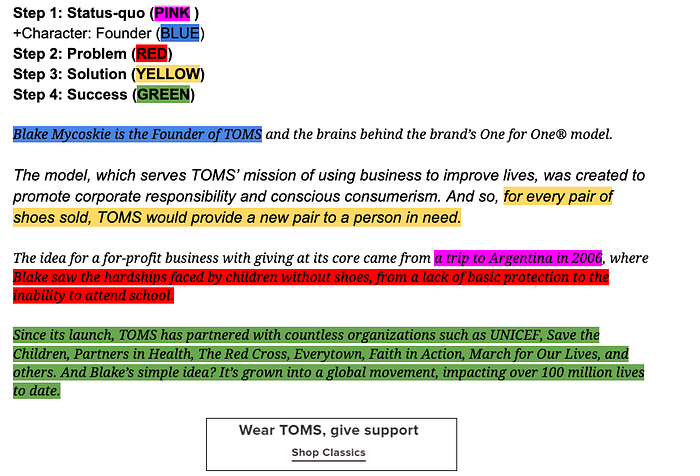
It is also important at the end of your authentic and compelling backstory that you include a Call-To-Action.
Stop Selling, Start Telling (Conclusion)
In the world of online commerce and the ever-growing freelance and gig economy, everyone who has an online presence is their own "brand."
Ads don't work as well as they used to, so what brands need is a compelling origin story that communicates their values and hits home emotionally.
It isn't just a branding exercise; it's the new model of how to succeed.
Stories cut through the noise and make an impression on customers in a way raw information never will.
Your origin story is probably your most underrated marketing tool.
And before you ask… yes … your story is interesting — so go out there and share it.
Want more marketing tips and tricks? Subscribe to the Better Marketing newsletter The Marketing Memo here.