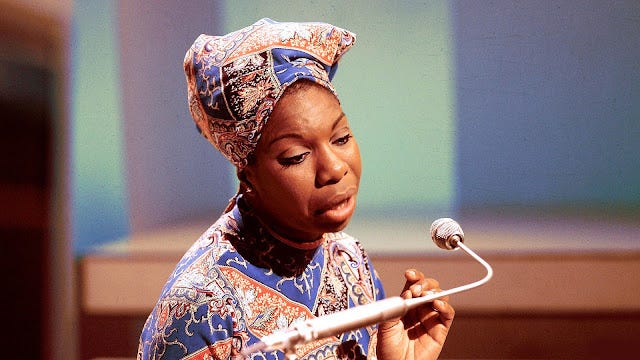

For many, Tryon, NC native Nina Simone was the voice of the Civil Rights Movement. A playlist of the most significant songs of the 1960s protest movement would have to include Simone's "Four Women" (1966), "I Wish I Knew How It Would Feel to be Free", (composed and initially recorded by fellow North Carolinian Dr. Billy Taylor), and "Mississippi Goddam" (1964), a song for which Simone was "blacklisted" in ways that the Dixie Chicks would appreciate four decades later. "I Wish I Knew How It Would Feel to be Free" was every bit a defining anthem of the period, as was Bob Dylan's 'Blowin' in the Wind" and Sam Cooke's 'A Change is Gonna Come." Yet the song that perhaps most resonates fifty years later, is a song that Simone recorded just as she began to recede from public view, and after many of the watershed moments of the Black Freedom movement had passed.
I first heard "Young, Gifted and Black" as a four-year-old sitting in my parents' Bronx apartment and have vivid memories of rehearsing the song with classmates in preparation for our Head Start graduation. I most remember our emphasis on the refrain "that's where it's at" and we were not alone. In her book Princess Noire: The Tumultuous Reign of Nina Simone, Nadine Cohodas writes that Simone first debuted the song at a Jazz festival at Morgan State College, an HBCU in Baltimore, and that upon hearing the song, "the students leapt to their feet, applauding the last line: 'To be young, gifted, and black — that's where it's at'." (228)
'Young, Gifted and Black" was inspired by Simone's late friend, the playwright and activist Lorraine Hansberry, who is often credited with bringing Simone into the Civil Rights Movement. In May of 1964, several months before her death, Hansberry addressed a group of high school creative writers, and in her remarks implored them to be "Young, Gifted, and Black". After her death, Hansberry's ex-husband collected some of Hansberry's unpublished writings and adapted them into the stage play To Be Young, Gifted and Black: The World of Lorraine Hansberry, which ran on Broadway during the 1968–1969 season.
Inspired by her friend's words, Simone collaborated with her longtime musical director Weldon Irvine to create the song. Released as a single in late 1969, and later included on Simone's live album Black Gold (recorded at the Philharmonic Hall), "Young, Gifted and Black" was Simone's most successful single in a decade and her last single to reach the Pop and Soul/R&B charts. When Simone performed the song on Sesame Street in 1972 "Young, Gifted and Black" was destined to become an interesting footnote to an impactful public life.
Yet, for the generations of folk who did not grow up at a time when Simone was a public presence and her music was no longer in vogue on Black radio, "Young, Gifted and Black" was a lifeline to her genius. The song's brilliance is in its ability to speak across generations. As Shana Redmond notes in her book Anthem: Social Movements and the Sound of Solidarity in the African Diaspora, "'Young, Gifted and Black' acknowledged the past even as it forecast the promises of the future." (192) The affirmation was immediate, starting with some of Simone's younger contemporaries like Donny Hathaway and Aretha Franklin, who recorded versions of the song in 1969 and 1972 respectively, and a string of Reggae styled versions of the song by Bob Andy and Marcia Griffiths (a future member of Bob Marley's I-Threes), The Heptones and a young relatively unknown vocalist named Elton John, all recorded in 1970.
Hathaway incorporated his version of the song in his live shows, and a version of the song that he performed at The Troubadour in 1972, that later appears on the posthumously released In Performance (1980), is a testament to how the song lived among Black audiences at witnessed by the call-and-response that Hathaway's performance inspires. Franklin was reticent to record the song at first, and asked Simone for her blessing to record it. Like so many of Franklin's covers, she brought a new spirit to the song, contributing a Gospel-styled introduction that featured her distinct piano playing.
Franklin's version has resonated, particularly, with the Hip-hop Generation as it was featured prominently in a scene from the late John Singleton's Higher Learning (1994) and has been sampled by the late Heavy D ("Yes, Yes, Y'all) and North Carolina rapper Rapsody, who features Franklin's version on the title track of her Grammy nominated album Laila's Wisdom. But as North Carolina Music Hall Of Fame inductee Big Daddy Kane suggests with his 1989 song "Young, Gifted and Black", later covered by Jay Z, it was the very idea of being "Young Gifted and Black" that inspired so many generations.
As bassist Meshell Ndegeocello, told the Los Angeles Times, on the occasion of Simone's death, "There is no telling how many lives she touched with the simple affirmation of the beauty of being 'Young, Gifted and Black.' I know she touched mine." Shana Redmond adds, "By 1971, Black men and women had an anthem to reflect their circumstances and announce a new era of cultural pride and political determination." (192) In a career that was marked by so many sacrifices, Simone's final, and perhaps most significant gift, was a simple reminder to the generations that came behind her "to be young, gifted, and Black."