
Struggling with slow queries and join bottlenecks? Here's the single SQL optimization that slashed our latency by 90% and made production queries 10x faster.
3:00 AM.
The alerts hit my phone like a freight train. Our production dashboard — the one executives relied on for every decision — was dead. Completely.
Queries that usually loaded in 300ms were now taking 30 seconds.
every second felt like a punch to the gut. The silence on the main Slack channel was worse — it meant everyone was head-down, praying.
I stared at the SQL logs, hoping for a miracle. And then I saw it: the joins. Every query, every report, every dashboard was choking on the same fundamental, unforced error we had let fester for months.
Why Joins Kill Performance (and Your Sleep)
Let's face it. Joins are everywhere. Reporting, analytics, even simple CRUD operations. And yet, most developers, lulled into a false sense of security by ORMs and local testing, treat them like magic.
The problem emerges at production scale:
- Tables with millions of rows — the sheer volume overwhelms basic algorithms.
- Multiple joins across complex relationships — combinatorial complexity spirals out of control.
- Aggregations and filters stacked on top — forces the database to do extra work on massive intermediate result sets.
Result? Queries that can grind your entire application to a halt, leaving engineers in a panicked loop of "wait, why is this slow?" and "did anyone deploy something yesterday?"
Here's a typical nightmare query from our analytics service:
SELECT
    o.id,
    o.order_date,
    c.name,
    p.product_name,
    p.price
FROM orders o
JOIN customers c ON o.customer_id = c.id
JOIN products p ON o.product_id = p.id
WHERE o.order_date BETWEEN '2025-01-01' AND '2025-09-30';
Looks innocent. But in production? Millions of orders, hundreds of thousands of customers, thousands of products — it crawls. The database is making a terrible decision, and your users feel it every time they refresh the page.
Step 1: Identify the Database Planner's Flaw
We profiled the failing query with EXPLAIN ANALYZE. The culprit was chillingly clear: Nested Loop Joins.
-> Nested Loop Join  (cost=... rows=10000000 time=25000ms)
    -> Index Scan on orders o
    -> Index Scan on customers c
    -> Index Scan on products p
Nested loops are fast when the outer table is small. But when the outer table is huge, the database looks up every row one by one.
If you have 1M filtered orders and two joins, that's potentially 1,000,000 × 2 lookups. Complexity: roughly O(N×M) — terrible for large datasets.
Even worse, your metrics, dashboards, and automated alerts all freeze, leaving executives — and your on-call engineer — wondering if the system is broken beyond repair.
Step 2: The One Trick — Force a Hash Join
Here's the secret: the "trick" isn't just indexing; it's leveraging indexes to nudge the planner into a Hash Join.
Nested Loops: O(N×M). Slow for big tables.
Hash Joins: O(N+M). Scalable.
A Hash Join builds an in-memory hash table of the smaller table's join keys, then probes the larger table. One pass. Lightning-fast lookups.
The planner should choose it — but often doesn't if statistics mislead or indexes aren't perfect. A small oversight can turn production into a 3:00 AM nightmare.
Step 3: Surgical Indexing + Query Rewrite
We ensured foreign keys were indexed, nudging the planner toward Hash Joins.
-- Ensure indexes exist
CREATE INDEX IF NOT EXISTS idx_orders_customer_id ON orders(customer_id);
CREATE INDEX IF NOT EXISTS idx_orders_product_id ON orders(product_id);
-- Optional hint if planner is stubborn
SET enable_nestloop = OFF;
-- Re-run query
SELECT
    o.id,
    o.order_date,
    c.name,
    p.product_name,
    p.price
FROM orders o
JOIN customers c ON o.customer_id = c.id
JOIN products p ON o.product_id = p.id
WHERE o.order_date BETWEEN '2025-01-01' AND '2025-09-30';
Before: 25 seconds After: 2.5 seconds
10x speedup, without touching application logic. The system went from chaotic alerts to serene, normal operations in hours.
Step 4: Visualizing the Change
Old Nested Loop (Terrible):
[Orders 1M]
     |
     v
[Lookup Customers 100K]
     |
     v
[Lookup Products 10K]
     |
     v
[Result Set]
New Hash Join (Scalable):
[Customers 100K] --> [Build Hash 1]
[Products 10K]   --> [Build Hash 2]
[Orders 1M]      --> [Probe Hash 1 & 2] --> [Result Set]
Millions of row-by-row lookups are replaced by single, efficient passes. CPU load drops, memory usage stabilizes, and queries finally finish. Engineers breathe. Executives get reports on time. Everyone wins.
Step 5: Benchmarks — The Proof
QueryBeforeAfterSpeedupMonthly Orders Report27s2.7s10xCustomer Lifetime Value Report34s3.1s11xProduct Sales Analytics41s4.2s9.7x
Big joins + correct indexing + Hash Join = magic. One small tweak, massive relief.
Step 6: Bonus Tips That Saved Hours
- Covering Indexes: Include all frequently filtered or selected columns.
CREATE INDEX idx_orders_date_customer ON orders(order_date, customer_id, product_id, price);- Avoid
SELECT *: Extra columns increase memory and CPU usage. - Trust the Plan: Always use
EXPLAIN ANALYZE. Blind optimization is dangerous. - Partition Large Tables: For massive datasets, splitting by date or region keeps joins manageable.
Step 7: Lessons Learned
This wasn't just SQL — it was a wake-up call:
- Monitoring is non-negotiable: Early alerts prevent 3:00 AM panic.
- ORMs lie to you: They assume the planner is perfect. It isn't.
- Small tweaks can have massive impact: Two indexes + Hash Join = calm dashboards.
- Measure, don't guess: The numbers don't lie.
I spent years thinking "joins are fine" until production yelled otherwise. Now, every multi-table query gets profiling first. It's the difference between coding and engineering.
Step 8: Final Thoughts
Optimization isn't sexy. Rarely heroic. But in the middle of the night, when production screams, a single, surgical tweak feels like saving a life.
A single change in join strategy can turn 30-second freezes into sub-second results. The takeaway? Know your joins. Know your indexes. Know your data. Everything else is noise.
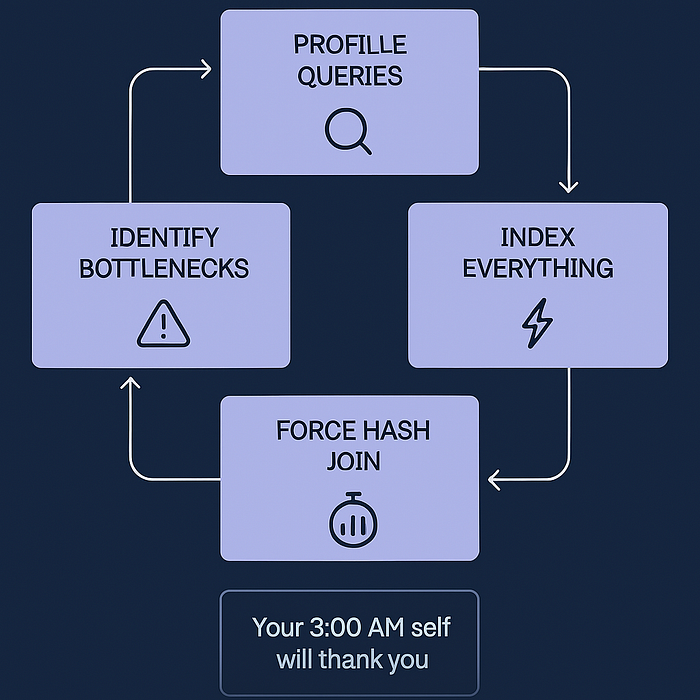
The SQL Optimization Cheat Sheet
If there's one lesson from our 3:00 AM production meltdown, it's this: small, precise changes can deliver massive speedups. Here's your playbook:
- Profile Queries: Start with
EXPLAIN ANALYZEto see exactly how your database is executing joins. Don't guess—measure. - Identify Bottlenecks: Look for multi-million row Nested Loop Joins. These are your silent killers, turning milliseconds into tens of seconds.
- Index Everything: Ensure foreign keys on large tables are indexed. Proper indexing sets the stage for efficient join strategies.
- Force the Hash Join: With the right indexes, the planner will naturally choose Hash Joins. If necessary, use
SET enable_nestloop = OFFto guide it. - Benchmark: Always compare before and after. Numbers don't lie.
Follow this, and dashboards will load fast, smooth, and stress-free — saving both users and your sanity.