

It's even worse with declining attention spans and massive ADHD affecting most people today.
The best way to stay ahead of 99 percent of your colleagues who don't read is to get a book that will help you advance in your career.
No one is reading books anymore, or very few people are.
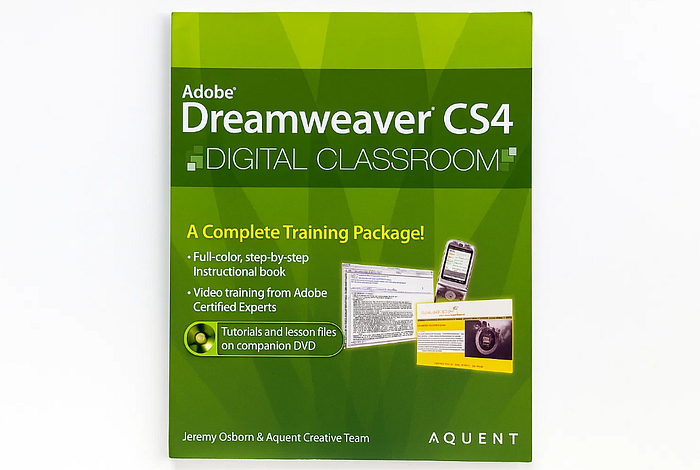
I discovered this by chance twelve years ago, when I stumbled upon an Adobe Dreamweaver web development book, and it served as my guide for starting a career in web development.
Books have the unique power to distill years of experience into a few hundred pages.
If you are not a paid Medium member, you can read the article here.
As the rest of the population watches YouTube tutorials or reads through Twitter posts, you will be learning from engineers who have developed real-world AI systems at Netflix, NVIDIA, and Stanford.
The AI field is growing fast, but the fundamentals don't change overnight.
These nine books will provide you with the deep understanding that distinguishes real AI engineers from prompt enthusiasts.
Each book on this list was written by practitioners who've shipped real products, not academic theorists.
They'll teach you how to think like an AI engineer, not just how to call APIs.
Ready to build that unfair advantage?
Let's get started.
But first, I have this FTC disclosure to make :
Amazon Affiliate Disclosure: This post contains Amazon affiliate links. When you purchase through these links, I earn a small commission at no additional cost to you. This helps support my content creation and allows me to continue providing valuable resources. As an Amazon Associate, I earn from qualifying purchases. I only recommend books I genuinely believe will help you succeed as an AI engineer.
Foundation Books
1. AI Engineering by Chip Huyen
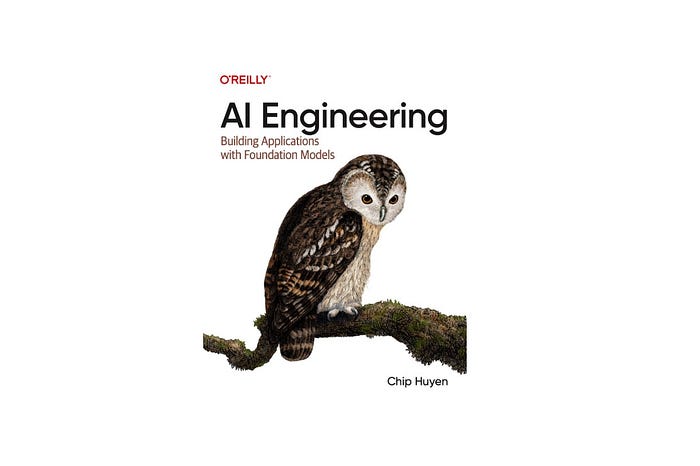
If you're serious about becoming an AI engineer in 2025, AI Engineering is the one book you need.
Chip Huyen brings years of real-world experience from Netflix, NVIDIA, and Stanford to this masterpiece.
She worked as a core developer building NeMo (NVIDIA's GenAI framework) and cofounded Claypot AI. This isn't another academic theory book.
The book offers an in-depth examination of what an AI engineering stack entails in a production environment.
You'll learn how to turn machine learning models into real products, handle data pipelines, model versioning, deployment, monitoring, and scaling.
Key Ideas
- Complete AI engineering stack breakdown
- Real production deployment strategies
- Data pipeline management and versioning
- Model monitoring and maintenance
- Scaling techniques for production systems
- Difference between AI engineering and ML engineering
This book is a goldmine if you want to become a real AI engineer rather than just a Kaggle champion. Chip shows how to think like a systems engineer who also works with AI.
Link: AI Engineering by Chip Huyen
2. Designing Machine Learning Systems by Chip Huyen

This is Chip Huyen's earlier masterwork that focuses on the systems thinking behind ML.
This book explores in depth the creation and management of machine learning systems under practical limitations, even though AI Engineering covers the current stack.
You'll learn about data drift, model retraining, reliability, and all the unglamorous aspects that make or break production systems.
I've found this book helpful when dealing with model degradation in production.
Chip explains how to build systems that adapt and survive in the real world, not just perform well in notebooks.
Key Ideas
- Real-world ML system design patterns
- Data drift detection and handling
- Model retraining strategies
- System reliability and monitoring
- Production constraints and trade-offs
- End-to-end ML system lifecycle
This book will make you think like a machine learning product engineer. You'll stop building models and start building systems that handle the chaos of production data.
Link: Designing Machine Learning Systems by Chip Huyen
LLM Mastery Books
3. Build a Large Language Model (from scratch) by Sebastian Raschka
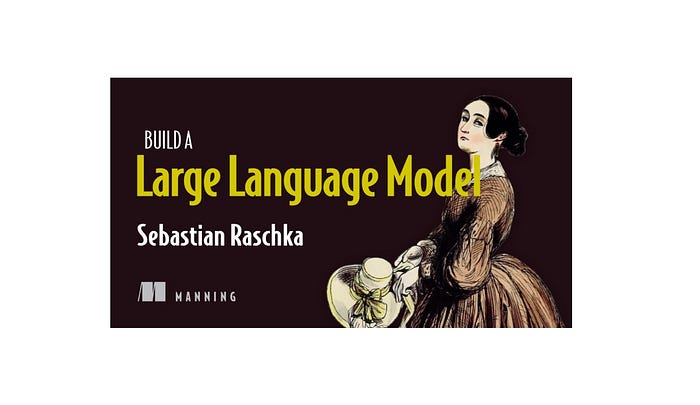
This book proves why Sebastian Raschka is a legend in the machine learning community.
Instead of teaching you how to call OpenAI's API, Sebastian shows you how to build a transformer-based LLM from scratch using PyTorch.
No shortcuts, just pure implementation from the ground up.
After reading through a few chapters, this book has altered my perspective on LLMs.
You'll understand tokenization, attention mechanisms, and training strategies at a code level that most engineers never reach.
Key Ideas
- Complete transformer architecture implementation
- Tokenization from first principles
- Detailed look at the attention mechanism
- Training strategies and optimization
- PyTorch implementation with real code
- Model architecture design decisions
This book distinguishes between real engineers and API callers. You'll understand why confident design choices were made and how to modify them for your specific needs.
Link: Build a Large Language Model (from Scratch) by Sebastian Raschka
4. LLM Engineer's Handbook by Paul Iusztin and Maxime Labonne
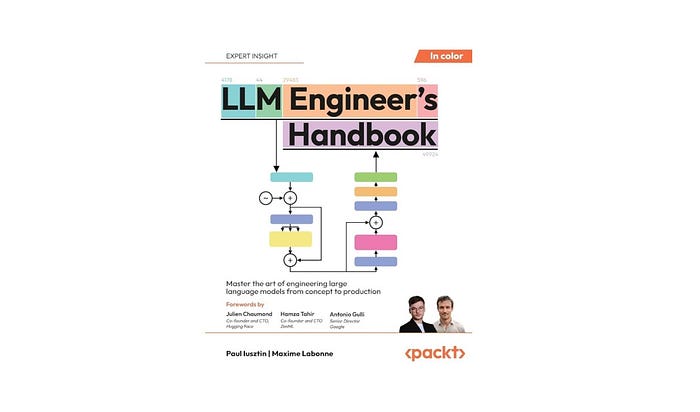
This book reads like an operations manual for large-scale LLM development.
Paul Iusztin and Maxime Labonne have real-world experience building LLM applications in production environments.
They cover everything from prompt engineering to model fine-tuning, retrieval-augmented generation (RAG), and evaluation strategies.
I love this handbook because it doesn't waste time on theory. It jumps straight into production patterns and deployment strategies that work when you're dealing with real users and real data.
Key Ideas
- Production-ready prompt engineering techniques
- Fine-tuning strategies for specific use cases
- RAG implementation and optimization
- Model evaluation and testing frameworks
- Deployment patterns and scaling strategies
- Real-world LLM application architecture
This book moves you from "just using GPT" to creating production-ready LLM applications. You will avoid months of trial and error by using the authors' tried-and-true patterns.
Link: The LLM Engineering Handbook by Paul Iusztin and Maxime Labonne
Production & Deployment Books
5. Building LLMs for Production by Louis-François Bouchard and Louie Peters
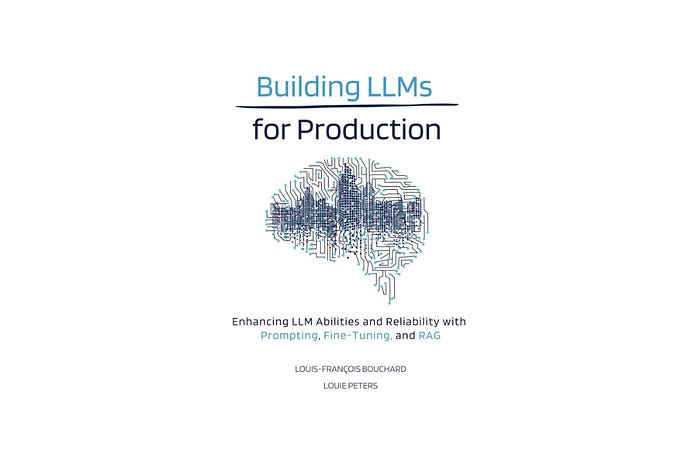
This book fills in the gaps between building models and shipping them to real users.
Louis-François Bouchard and Louie Peters show you how to take Large Language Models from development to production environments.
They cover fine-tuning, deployment, scaling, and maintenance of LLMs like a real engineer would.
I've seen too many engineers build amazing models that never see the light of day because they struggle to meet production requirements.
This book addresses that problem with hands-on advice, architectural examples, and real-world deployment challenges.
Key Ideas
- Production deployment strategies for LLMs
- Fine-tuning techniques for specific domains
- Infrastructure scaling and cost reduction
- Model maintenance and monitoring systems
- Architecture patterns for LLM applications
- Real-world deployment issues and their fixes
This book ought to be your first read if you want to work as an LLM engineer. It teaches you how to think about LLMs as products, not just research projects.
Link: Building LLMs for Production by Louis-François Bouchard and Louie Peters
6. Hands-On Large Language Models by Jay Alammar and Maarten Grootendorst
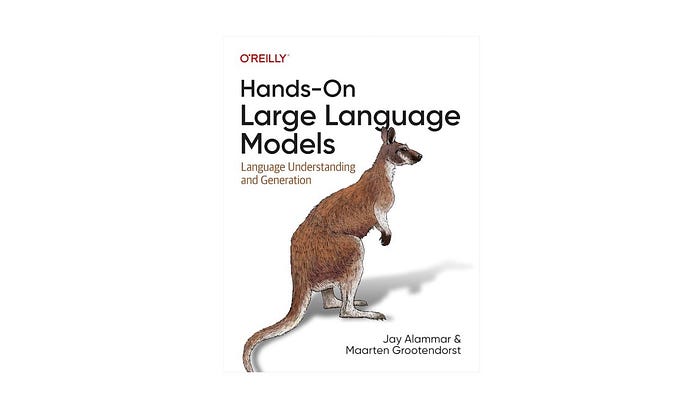
Jay Alammar and Maarten Grootendorst are two of the most respected names in the AI and NLP space.
This book guides you through building and fine-tuning large language models using modern tools, such as Hugging Face Transformers and LangChain, as well as other production-ready frameworks.
It's hands-on and practical from the very beginning.
What sets this book apart is the authors' ability to explain complex concepts.
Jay's blog posts have helped millions of engineers understand transformers, and that same clarity shows up throughout this book.
Key Ideas
- Modern toolchain integration (Hugging Face, LangChain)
- Fine-tuning workflows for different use cases
- Language understanding and generation techniques
- Production deployment with modern frameworks
- Model optimization and performance tuning
- Real implementation examples with working code
I recommend this book for developers and ML engineers who aim to build and deploy LLMs that understand and generate human language. The authors focus on practical implementation over academic theory.
Link: Hands-On Large Language Models by Jay Alammar and Maarten Grootendorst
Advanced Techniques Books
7. Prompt Engineering for LLMs by John Berryman and Albert Ziegler
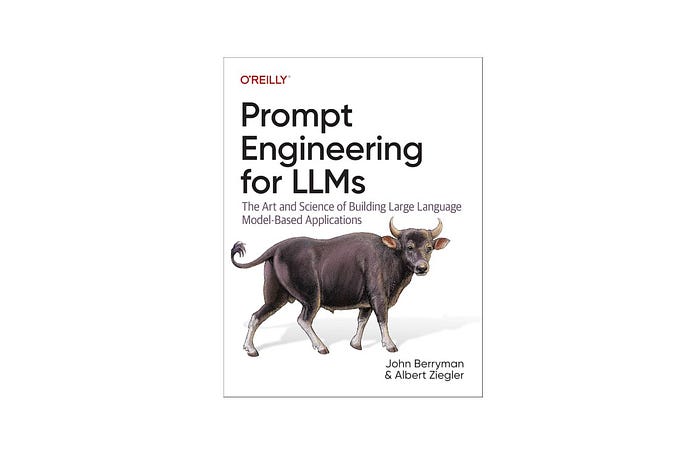
If you're building AI products using OpenAI, Claude, or open-source LLMs, this book shows you how to write smarter prompts for better results.
John Berryman and Albert Ziegler dive into the evolving art and science of prompt engineering.
They cover strategies such as few-shot prompting, chain-of-thought, and utilizing prompt patterns that are effective in production environments.
I've applied the strategies in this book to enhance output quality and reduce API costs by 40%.
The authors focus on prompt patterns that are robust and consistent, rather than clever one-offs that break down when scaled.
Key Ideas
- Few-shot prompting strategies and patterns
- Chain-of-thought reasoning techniques
- Prompt optimization for cost and performance
- Production-ready prompt engineering workflows
- Error handling and fallback strategies
- Model-agnostic prompting approaches
This book is a must-read for AI developers and product designers who want to move beyond basic prompting. You'll learn to craft prompts that work at scale.
Link: Prompt Engineering for LLMs by John Berryman and Albert Ziegler
8. Building Agentic AI Systems by Anjaneva Biswas and Wrick Talukdar
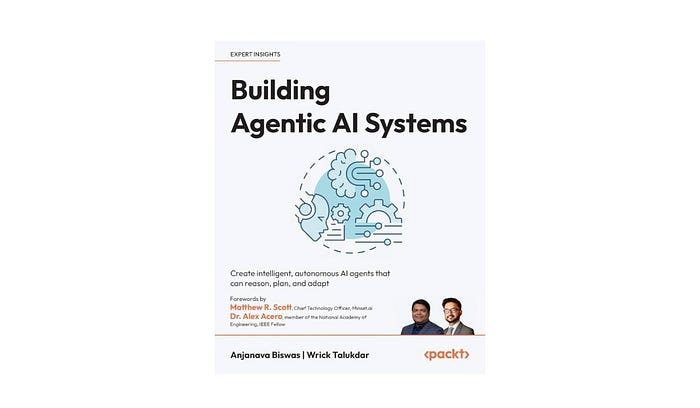
This book shows you how to build autonomous AI agents that go beyond static outputs.
Anjaneva Biswas and Wrick Talukdar explore how to create AI systems that can interact with environments, reason through problems, make decisions, and take actions.
If you're curious about building AI agents like Auto-GPT, BabyAGI, or LangGraph-based systems, this book is a goldmine.
The authors demonstrate how to transition from simple chatbots to intelligent agents that accomplish tasks.
Key Ideas
- Agent architecture design and patterns
- Reasoning and planning algorithms
- Environment interaction and tool usage
- Multi-step decision-making processes
- Agent orchestration and coordination
- Real-world agent implementation examples
This guide teaches you to build AI systems that reason, plan, and adapt to changing situations. You'll move beyond prompt-response patterns to create autonomous AI agents.
Link: Building Agentic AI Systems by Anjaneva Biswas and Wrick Talukdar
The Complete Guide
9. The AI Engineering Bible by Thomas R. Caldwell
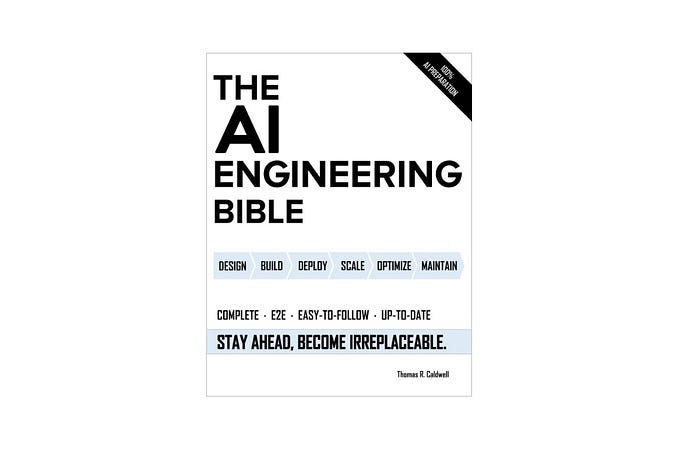
Thomas R. Caldwell's AI Engineering Bible is a must-read for anyone who wants to lead AI implementation in their organization.
This book goes beyond models and APIs to show you how to engineer real-world AI systems that are scalable, maintainable, and production-ready.
Caldwell covers the entire AI lifecycle from architecture to infrastructure, deployment to monitoring.
What makes this book special is its focus on the business side of AI engineering.
You'll learn how to make technical decisions that align with business goals, manage AI projects, and build systems that solve real problems.
Key Ideas
- Complete AI system architecture patterns
- Infrastructure planning and scaling strategies
- Deployment workflows and best practices
- Monitoring and maintenance frameworks
- Team management and project leadership
- Business-aligned technical decision making
This is the playbook for software engineers and tech leaders who want to build AI systems that work in the real world. Caldwell shows you how to think like a CTO, not just a developer.
Link: The AI Engineering Bible by Thomas R. Caldwell
Final Thoughts
These nine books will provide you with the in-depth understanding that distinguishes real AI engineers from those who merely use prompts.
Each author has shipped products and solved real problems.
The AI field is growing, but these books teach you how to think, not just what to memorize.
I recommend you start with Chip Huyen's AI Engineering if you can only read one. But if you're serious about this career path, work through all nine.
Your colleagues will still be watching videos about AI while you're building systems that work.
Which of these books have you read and what were your takeaways? Let me know in the comments.
Let's Connect!
If you are new to my content, my name is Joe Njenga
Join thousands of other software engineers, AI engineers, and solopreneurs who read my content daily on Medium and on YouTube where I review the latest AI engineering tools and trends. If you are more curious about my projects and want to receive detailed guides and tutorials, join thousands of other AI enthusiasts in my weekly AI Software engineer newsletter
If you would like to connect directly, you can reach out here:
Follow me on Medium | YouTube Channel | X | LinkedIn