
Artificial Intelligence (AI), once deemed futuristic, is now a driving force behind industries ranging from healthcare to entertainment. However, keeping up with AI's buzzwords, especially terms like LLMs (Large Language Models), GANs (Generative Adversarial Networks), and Diffusion Models, can feel overwhelming — even for tech-savvy professionals and students.
This comprehensive guide breaks down these concepts, explores their real-world applications, and explains why they matter, whether you're a machine learning student, an AI enthusiast, or a seasoned tech professional eager to deepen your understanding.
What Are Large Language Models (LLMs)?
LLMs are one of the most impactful innovations in modern AI. These models, such as OpenAI's GPT-4, are trained to understand and generate human-like language. They rely on deep learning architectures like transformers that enable them to process and predict text accurately.
How Do LLMs Work?
At their core, LLMs analyze massive amounts of textual data — ranging from books and research papers to online conversations. For example, GPT-4 was trained on over 570 gigabytes of textual data. Identifying relationships between words predicts what comes next in a sequence based on the context.
An LLM like GPT-4 can do tasks such as:
- Generating contextually relevant content.
- Translating languages.
- Summarizing articles or simplifying technical details.
Example in Action:
Customer service tools powered by LLMs often replace traditional chatbots, allowing businesses to deliver nuanced responses to customer queries. Tools like ChatGPT, powered by GPT-4, are widely adopted for automating content or code generation for developers.
Challenges and Limitations
Even with advancements, LLMs aren't immune to challenges. They sometimes hallucinate, generating inaccurate responses with confidence. Additionally, computational training costs are staggering. OpenAI reportedly spent up to $100 million to train GPT-4, underscoring the resource intensity of developing these models.
What Are Generative Adversarial Networks (GANs)?
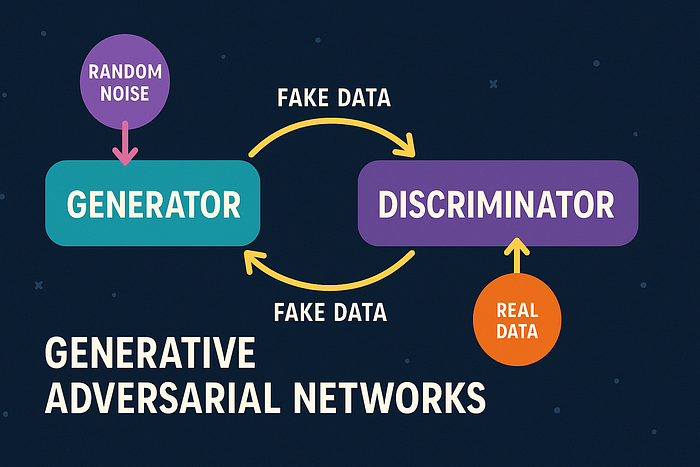
GANs are among the pioneering models for generative AI. First introduced by Ian Goodfellow in 2014, GANs consist of two neural networks, the generator and the discriminator, that "compete" with one another.
How GANs Work
- Generator: Creates synthetic data (e.g., images, audio, text).
- Discriminator: Evaluates whether the generated data is real or fake compared to actual data.
This "adversarial" process helps GANs refine their outputs over time. Each iteration makes the synthetic results increasingly indistinguishable from real-world reference data.
Real-World Applications of GANs
- Image Generation: GANs drive tools like DALL-E or DeepArt, transforming written prompts into vivid images.
- Data Augmentation: Used in medical research to generate synthetic yet accurate data for underrepresented diseases.
- Super-Resolution Imaging: GANs enhance image resolution, making them invaluable for cinematography and digital preservation.
Example in Action:
Nvidia's GauGAN tool lets artists create photorealistic landscapes by simply sketching basic outlines.
Challenges with GANs
- Mode Collapse: Sometimes, the generator gets stuck producing limited types of outputs rather than diverse ones.
- Training Complexity: Tweaking hyperparameters for GANs is notoriously complex. A small change can destabilize training.
What Are Diffusion Models?
Diffusion Models are a newer class of generative models, rapidly gaining traction for their exceptional performance in generating high-quality outputs. Rather than competing adversarially, like GANs, they progressively transform simple noise into structured, detailed data, mimicking real-world patterns.
How Diffusion Models Work
These models rely on a two-phase process:
- Forward Diffusion: Adds noise to data, effectively destroying it in stages (e.g., blurring an image).
- Reverse Diffusion: Learns to reconstruct the data step-by-step from the noise.
Researchers have found that diffusion models can create sharper outputs than GANs, especially in situations requiring extensive detail.
Applications of Diffusion Models
- Image Generation: Tools like Stable Diffusion and OpenAI's DALL-E 2 rely heavily on diffusion to create stunning images.
- Molecular Design: They are revolutionizing biochemistry by generating molecular structures optimized for pharmaceutical development.
- Text-to-Image Synthesis: Paired with text embeddings, models like Imagen allow users to create precise visuals from descriptive prompts.
Example in Action:
Stable Diffusion gained traction with artists creating hyperrealistic and surreal art pieces without requiring extensive manual design skills.
Why Are Diffusion Models Gaining Popularity?
Diffusion models offer higher control over data generation processes, ensuring better output fidelity. Unlike GANs, which can struggle with specific details, diffusion-based processes excel in representing intricate patterns.
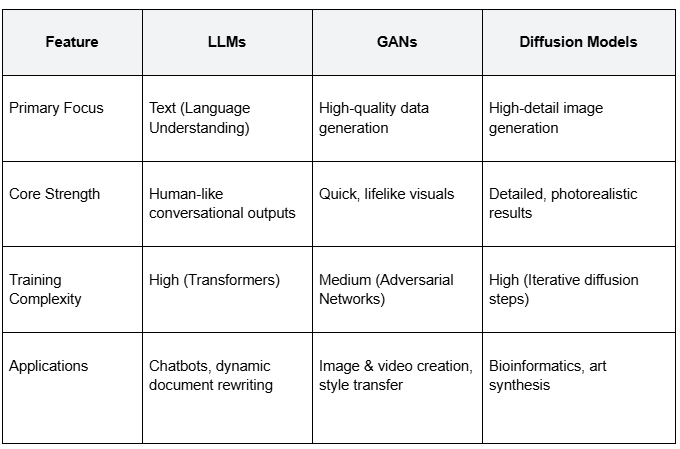
Comparing LLMs, GANs, and Diffusion Models
Why These Models Matter for the Future of AI
Industry Impact
Experts predict the global AI market will reach $1.59 trillion by 2030, and innovations in LLMs, GANs, and Diffusion Models are pivotal drivers. Companies like OpenAI, Nvidia, and DeepMind are pushing boundaries with these technologies, promising content creation, customization, and personalization innovations.
Ethical and Social Considerations
Despite their potential, these models raise ethical concerns. GANs and diffusion models, for instance, have been involved in generating deepfakes, while LLMs risk misuse in spreading misinformation. Striking a balance between leveraging these technologies and mitigating their risks will define the next era of AI development.
Final Thoughts on the Role of Generative and Predictive AI
From chatbots capable of replacing traditional customer service to generative art tools democratizing creative expression, LLMs, GANs, and Diffusion Models are reshaping the modern tech landscape. Understanding these AI systems equips professionals and students with the tools to create impactful solutions and prepares them for an exciting future where technology complements human ingenuity.
Are you looking to explore tools that harness the power of these models? Familiarize yourself with platforms like Jasper for text generation or Stable Diffusion for image creation.