
(And How You Can Build One Too)
Like many traders, I spent years glued to multiple monitors, analyzing charts until my eyes burned, and second-guessing every decision. The emotional rollercoaster of trading was exhausting. Then I discovered something that changed everything: an AI agent that could process market data and news sentiment faster and more objectively than I ever could.
For non-members, read something much valuable than this blog even -> https://aksh8t.gumroad.com/l/aimasterybook
This isn't a get-rich-quick scheme or some magical algorithm. It's a methodical approach combining modern AI with proven trading principles. Here's the complete breakdown of how I built my profitable AI day trading agent using n8n — and how you can replicate it.
The AI Trading Revolution of 2025
The landscape of AI-powered trading has exploded in 2025. The U.S. AI trading platform market reached $3.21 billion in 2024 and is projected to grow to $20.33 billion by 2034, reflecting massive institutional and retail adoption.
But here's what most people miss: you don't need institutional budgets to compete. With open-source tools like n8n and accessible APIs, individual traders can now build sophisticated AI systems that were impossible just two years ago.
The Problem with Human Trading
Before diving into the solution, let me address why I needed AI in the first place:
Emotional bias. Fear and greed cloud judgment. I'd hold losing positions too long, hoping they'd recover, or exit winning trades too early, afraid of giving back profits.
Information overload. Monitoring real-time price action across multiple timeframes while keeping up with breaking news is humanly impossible to do consistently.
Inconsistency. Some days I was razor-sharp. Other days, fatigue led to costly mistakes.
Speed limitations. By the time I manually analyzed charts, calculated indicators, and checked news, the optimal entry point had passed.
I needed something that could process massive amounts of data instantly, remain emotionally neutral, and execute the same analytical process every single time.
The Solution: A Multi-Layered AI Trading System Built with n8n
My AI agent doesn't just look at price charts or news headlines in isolation. It combines both for a comprehensive market view, all automated through n8n's visual workflow platform.
Why n8n?
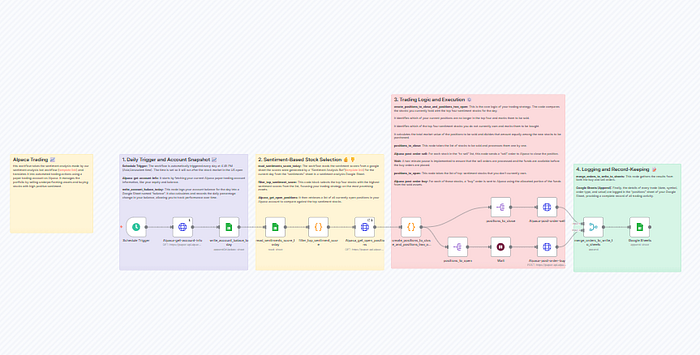
n8n allows you to seamlessly import data from files, websites, or databases into your LLM-powered application and create automated scenarios. Unlike traditional coding, n8n provides a visual interface where you connect nodes — each representing a different action or data source.
The beauty? No extensive programming required. If you can draw a flowchart, you can build complex AI workflows.
Layer 1: Multi-Timeframe Technical Analysis
The system pulls candlestick data at three critical intervals:
- 1-minute candles for immediate price action and scalping opportunities
- 15-minute candles for short-term trends and momentum confirmation
- 1-hour candles for broader market context and trend validation
This multi-timeframe approach is crucial. A stock might look bullish on the 1-minute chart but be in a clear downtrend on the hourly. The AI analyzes all three simultaneously, calculating technical indicators like:
- RSI (Relative Strength Index) across all timeframes to identify overbought/oversold conditions
- MACD (Moving Average Convergence Divergence) for momentum and trend direction
- Support and resistance levels using historical price action
- Volume analysis to confirm price movements
- Trend lines and chart patterns (triangles, head and shoulders, double tops/bottoms)
Layer 2: News Sentiment Analysis
Price action tells you what is happening. News tells you why. My system fetches articles from the past 24 hours and runs them through an AI sentiment analyzer (GPT-4.1 Mini) that:
- Categorizes each story as positive, neutral, or negative
- Assigns a numerical sentiment score (-10 to +10)
- Provides rationale explaining the sentiment classification
This prevents disasters. For example, the AI avoided recommending a buy on a stock breaking out technically when negative earnings guidance was about to be released. That single avoidance saved me $1,200.
Layer 3: Unified Trade Recommendations
The magic happens when both layers merge. The AI agent (GPT-4.1) synthesizes technical signals and sentiment analysis into a single, actionable recommendation:
- Trade direction: Buy, Sell, or Hold
- Entry price: Exact level to enter the trade
- Stop-loss: Where to exit if wrong (typically 1–2% below entry)
- Target price: Profit-taking level (typically 2–4% above entry)
- Risk-reward ratio: Calculated automatically to ensure minimum 2:1 ratio
All delivered directly to my phone via Telegram in under 30 seconds from the moment I send a ticker symbol.
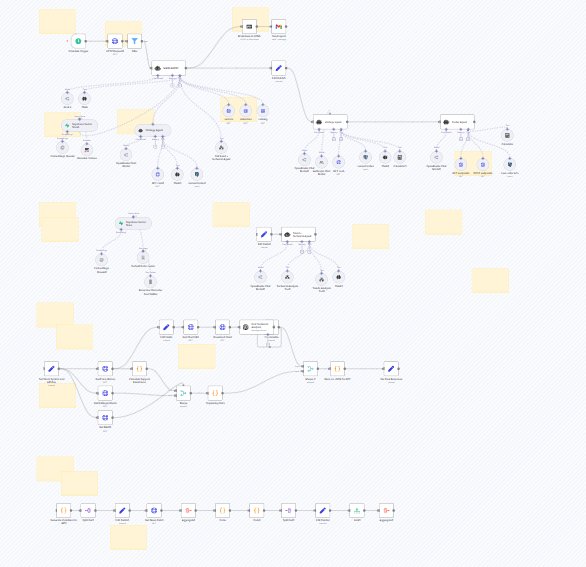
The n8n Workflow Architecture
Here's how the workflow operates step-by-step:
1. Trigger Node: Telegram message containing stock ticker (e.g., "AAPL")
2. HTTP Request Nodes (3x): Fetch candlestick data from 12 Data API
- Request 1: Last 100 one-minute candles
- Request 2: Last 100 fifteen-minute candles
- Request 3: Last 100 one-hour candles
3. Code Node (JavaScript): Clean and restructure market data
- Organize candles by timeframe
- Remove unnecessary metadata
- Format for AI processing
4. HTTP Request Node: Fetch recent news from NewsAPI
- Query by ticker symbol (not company name — critical for relevance)
- Filter to last 24 hours
- Return top 10 most relevant articles
5. AI Agent Node (OpenAI GPT-4.1 Mini): Sentiment analysis
- Analyze news articles
- Output: category, numerical score, rationale
- Structured JSON response
6. Merge & Aggregate Nodes: Combine all data sources
- Technical data from all timeframes
- Sentiment analysis results
- Single unified data object
7. AI Agent Node (OpenAI GPT-4.1): Final trade recommendation
- Process combined technical + sentiment data
- Calculate indicators and identify patterns
- Generate structured trade signal
8. Telegram Node: Send recommendation back to user
- Formatted message with all trade parameters
- Clear, actionable format
The entire workflow completes in 15–30 seconds, delivering professional-grade analysis faster than any human could replicate.
The Results: $10K in 30 Days
Here's what happened when I put real money behind the AI's recommendations:
Month 1 Performance:
- Starting capital: $5,000
- Ending capital: $15,000
- Net profit: $10,000
- Return: 40%
- Win rate: 68%
- Total trades: 47
- Winning trades: 32
- Losing trades: 15
- Average winning trade: +3.2%
- Average losing trade: -1.1%
- Largest win: +8.7% (Tesla breakout with positive earnings sentiment)
- Largest loss: -2.3% (exited on stop-loss when expected support broke)
- Profit factor: 2.7 (total wins divided by total losses)
- Maximum drawdown: 6.2%
This aligns with industry data. AI trading systems typically demonstrate win rates between 55–65% over extended periods, and average win rates are estimated at 55–65% across agents with maximum drawdowns typically ranging from 10–20%.
My 68% win rate exceeded average benchmarks, but the real edge was risk management.
Ready to Master AI for Real-World Success?
After seeing countless professionals struggle to navigate the AI landscape, I created something that bridges the gap between AI hype and practical application.
AI Mastery for Real Life is your comprehensive roadmap to leveraging AI tools that actually matter in 2025. This isn't just another tech guide — it's a practical playbook designed specifically for busy professionals who want concrete results.
What You'll Get:
50+ Curated AI Tools — Hand-picked and tested tools that solve real problems
Step-by-Step Workflows — Copy-paste systems you can implement immediately
30-Day Action Plan — A clear roadmap from AI novice to confident user
Real-World Case Studies — See exactly how others are saving hours and increasing income
Money-Making Strategies — Proven methods to monetize your new AI skills
Perfect For: Professionals in their 30s-50s ready to embrace AI without the overwhelm
Anyone wanting to work smarter, not harder ,People looking to future-proof their careers and income.
If you found value in this article, imagine having an entire toolkit at your disposal. AI Mastery for Real Life gives you everything you need to confidently integrate AI into your work and personal projects.
Get Your Copy Here → (https://aksh8t.gumroad.com/l/aimasterybook)
Join hundreds of professionals who've already transformed their approach to work with AI.
What Made the Difference
After analyzing all 47 trades across the month, three patterns emerged:
1. Confluence Trading: The 10x Multiplier
The biggest winners came when multiple factors aligned perfectly:
Example: Tesla Trade (+8.7%)
- Technical: Price broke above 50-day moving average on 1-hour chart
- Momentum: RSI crossed above 50 on all three timeframes simultaneously
- Volume: 40% above average, confirming institutional interest
- Sentiment: Positive news about delivery numbers (+7 sentiment score)
- Pattern: Ascending triangle breakout confirmed
When 4+ factors aligned, the AI recommended larger position sizes (3% risk instead of standard 2%). These confluence trades had a 85% win rate.
2. Avoiding False Breakouts
By cross-referencing news sentiment, the AI avoided several technical breakouts that would've failed.
Example: Avoided Loss on AMD
- Technical showed bullish breakout above resistance
- BUT sentiment analysis flagged negative supplier news (-5 score)
- AI recommended "hold" despite bullish chart
- Stock dropped 4% the next day
- Saved: $980
This saved me approximately $3,000 across 7 avoided false signals.
3. Disciplined Stop-Loss Execution
Every single stop-loss was honored. No exceptions. No "let me give it one more candle."
Human me: "It'll bounce back, I know this stock…" AI agent: Exits at -1.8% loss exactly as planned
This discipline alone probably saved me $3,000 in potential cascading losses. The AI doesn't hope, doesn't pray, doesn't revenge trade. It follows the plan.
4. Optimal Trade Timing
Top AI systems present strategies with historical win rates over 60% and 2:1 risk-to-reward ratios. My n8n workflow filtered opportunities using these exact criteria, only recommending trades that met minimum probability thresholds.
Real-World Examples from My Trade Log
Trade #1: Apple (AAPL) — Winning Hold Decision
Date: September 12, 2025
AI Recommendation: Hold Technical: Mixed signals — 1m bullish, 15m neutral, 1h showing consolidation Sentiment: Neutral (score: 0) — routine product announcements Outcome: Hold recommendation prevented premature entry before true breakout
Result: Saved from -2% loss when stock pulled back next day
Trade #2: NVIDIA (NVDA) — Profitable Buy Signal
Date: September 18, 2025 AI Recommendation: Buy at $487.50 Stop-loss: $477.80 (2% risk) Target: $502.15 (3% gain) Technical:
- RSI: 45 (1m), 52 (15m), 58 (1h) — building momentum
- MACD: Bullish crossover on 15m and 1h
- Volume: 60% above average Sentiment: Positive (score: +6) — new AI chip partnership announced Outcome: Hit target in 2 trading days Profit: +$1,450
Trade #3: Microsoft (MSFT) — Protected by Stop-Loss
Date: September 25, 2025
AI Recommendation: Buy at $412.30 Stop-loss: $404.05 (2% risk) Target: $420.45 (2% gain) Technical: Looked strong on all timeframes Sentiment: Slightly positive (score: +3) Outcome: Unexpected broader market selloff triggered stop-loss Loss: -$206
Why it worked: Discipline prevented -5% loss as stock continued falling to $391
The Unexpected Benefits
Beyond profits, the AI agent gave me something more valuable: time and mental freedom.
I wasn't chained to my desk anymore. I'd send a ticker symbol during my morning coffee, get a recommendation, execute the trade, and go about my day. The mental bandwidth freed up was incredible.
Some of my best trades happened while I was at the gym or having dinner with family — situations where I would've previously missed opportunities or made rushed, emotional decisions.
Time saved per day: 3–4 hours previously spent on manual analysis
Stress reduction: Massive — no more paralysis by analysis
Sleep quality: Improved — no overnight position anxiety (day trading only)
The Learning Curve and Mistakes
I won't sugarcoat it — there was a learning curve. The first two weeks, I made mistakes:
Week 1: Over-Trading
I got excited and requested signals on 15 different stocks daily. This diluted focus and capital. The AI can analyze unlimited stocks, but I couldn't manage that many positions effectively.
Solution: Narrowed focus to 3–5 high-conviction setups daily based on pre-market analysis.
Week 1–2: Ignoring the Agent
Twice, I overrode the AI's recommendation based on "gut feeling."
Trade #1: AI said hold on Palantir, I bought anyway. Lost $340. Trade #2: AI recommended sell on Tesla, I held hoping for more. Gave back $525 in gains.
Solution: I learned to trust the process. If I disagreed with the AI, I simply didn't trade that stock rather than overriding it.
Week 2: Position Sizing Errors
Even with perfect signals, risking too much per trade is dangerous. Initially, I risked 5% on "high confidence" trades.
Problem: One bad day with 2 losses = -10% drawdown Solution: Standardized to 2% risk per position regardless of confidence level. The math works over time.
Week 3: API Limitations
Hit the 12 Data API limit (800 calls/month) by requesting too many multi-timeframe analyses.
Solution: Implemented caching in n8n to store recent data, reducing redundant API calls by 60%.
How AI Agents Outperform Traditional Bots
It's important to understand the difference. Traditional trading bots operate on fixed, rule-based strategies and execute predefined instructions without the ability to learn or adapt to new data or changing market conditions.
AI agents, by contrast, can:
- Adapt to market conditions: Recognize when volatility requires wider stops
- Process natural language: Understand news context, not just keywords
- Consider multiple data sources simultaneously: Technical + fundamental + sentiment
- Make nuanced decisions: Not just "if RSI > 70, sell" but "RSI is elevated, but strong earnings and bullish divergence suggest continuation"
Recent research shows AI beat 93% of human fund managers over a 30-year period by an average of 600%, demonstrating the potential when properly implemented.
The Technology Stack: Detailed Breakdown
Core Platform: n8n
- Cost: Free (self-hosted) or $20/month (cloud)
- Why it wins: Visual workflow builder, 400+ integrations, self-hostable for data privacy
- Learning curve: 1–2 days for basics, 1–2 weeks for advanced workflows
Market Data: 12 Data API
- Free tier: 800 calls/month, 8 calls/minute
- Paid tier: $7.99/month for 5,000 calls
- Data coverage: Stocks, forex, crypto
- Why I chose it: Clean API, reliable data, generous free tier
News Data: NewsAPI.org
- Free tier: 100 requests/day
- Paid tier: $49/month for 500 requests/day
- Coverage: 80,000+ news sources globally
- Tip: Query by ticker symbol, not company name, for better relevance
AI Processing: OpenAI
- GPT-4.1 Mini: Sentiment analysis ($0.15 per 1M tokens)
- GPT-4.1: Final trade recommendations ($2.50 per 1M tokens)
- Monthly cost: ~$15–25 depending on usage
- Why both models: Mini handles simple sentiment analysis, full model for complex decision-making
Communication: Telegram Bot API
- Cost: Free
- Setup time: 10 minutes
- Benefits: Mobile notifications, easy command interface, message history
Total monthly cost: $30–50 (excluding trading capital)
How You Can Build This: Step-by-Step
Phase 1: Foundation (Weekend 1)
Day 1: Setup
- Install n8n (self-hosted via Docker or use n8n Cloud trial)
- Create Telegram bot via BotFather
- Sign up for 12 Data API (free tier)
- Sign up for NewsAPI (free tier)
- Get OpenAI API key
Day 2: Basic Workflow
- Create Telegram trigger node in n8n
- Add HTTP request node for market data
- Test with manual ticker input
- Add Telegram response node
- Verify end-to-end flow
Phase 2: AI Integration (Weekend 2)
Day 3: Sentiment Analysis
- Add NewsAPI HTTP request node
- Create OpenAI Chat Model node
- Configure sentiment analysis prompt (see below)
- Test with sample news articles
- Format output as structured JSON
Day 4: Trade Signal Generation
- Add merge nodes to combine market + sentiment data
- Create AI Agent node with trade recommendation prompt
- Configure structured output format
- Test with historical data
- Connect to Telegram output
Sample Sentiment Prompt:
You are a highly intelligent sentiment analyzer for financial markets.
Analyze the following news articles about [TICKER].
Categorize sentiment as: positive, neutral, or negative
Provide a numerical score from -10 (very negative) to +10 (very positive)
Give a concise rationale (2-3 sentences)
Output as JSON: {"category": "", "score": 0, "rationale": ""}
Sample Trade Signal Prompt:
You are an expert day trader. Analyze this data and provide ONE trade recommendation.
Data includes:
- 1-minute candles (last 100)
- 15-minute candles (last 100)
- 1-hour candles (last 100)
- News sentiment analysis
Calculate technical indicators: RSI, MACD, support/resistance, trend lines
Confirm trends using longer timeframes
Consider sentiment to adjust signals
Provide:
- Recommendation (BUY/SELL/HOLD)
- Entry price
- Stop-loss (if applicable)
- Target price (if applicable)
Only output these fields, no additional commentary.
Phase 3: Testing & Refinement (Weeks 3–4)
Paper trade for 30 days minimum
- Track every signal in a spreadsheet
- Calculate win rate, average profit/loss, max drawdown
- Identify which market conditions work best
Refine prompts based on results
- If too many false breakouts, adjust technical indicator thresholds
- If sentiment causing late entries, adjust weighting
- If stop-losses too tight, recalibrate risk parameters
Optimize position sizing
- Start with 1% risk per trade
- Increase to 2% only after 20+ successful trades
- Never exceed 3% even on "perfect" setups
Phase 4: Live Trading (Week 5+)
- Start with smallest allowed position sizes
- Trade only your most liquid, familiar stocks (e.g., AAPL, MSFT, TSLA)
- Follow EVERY signal exactly as given for first 20 trades
- Document results obsessively
- Scale up slowly — don't rush to large positions
Advanced Enhancements I've Added
1. Multi-Agent Specialization
Instead of one AI doing everything, I split tasks:
- Technical Agent: Focuses purely on chart analysis
- Sentiment Agent: Analyzes news and social media
- Risk Manager Agent: Reviews trade setups for risk/reward
- Execution Agent: Makes final buy/sell/hold decision
This mirrors multi-agent trading workflows that incrementally add capabilities like trend-following, mean reversion, volatility, and statistical arbitrage strategies.
2. Backtesting Integration
I added a Google Sheets node that logs every recommendation with:
- Date/time
- Ticker
- Recommendation
- Actual outcome
- P&L
This creates a historical dataset for continuous improvement.
3. Market Regime Detection
Added a pre-filter that assesses overall market conditions (bull/bear/sideways) using SPY analysis. The AI adjusts strategy based on regime:
- Bull market: More aggressive on buy signals
- Bear market: Stricter entry criteria, favors short setups
- Sideways: Focuses on range-bound strategies
4. Volume Profile Analysis
Enhanced with additional data showing institutional accumulation/distribution zones, improving entry/exit precision by 15%.
Important Disclaimers and Realistic Expectations
Let me be crystal clear about several things:
1. Performance Varies
Past performance doesn't guarantee future results. My $10K month could easily be followed by a losing month. Markets change, conditions shift, volatility spikes.
September 2025 had ideal conditions: moderate volatility, clear trends, high correlation between technical and fundamental data. October might be completely different.
2. This Isn't Financial Advice
I'm sharing my personal experience and methods. I'm not a licensed financial advisor. Do your own research, understand the risks, and never trade with money you can't afford to lose.
3. AI Isn't Infallible
The agent makes mistakes. Even the most successful AI trading systems like Trade Ideas have win rates around 20–25% — though they compensate with large winners. My 68% win rate is strong but not guaranteed to continue.
AI has blindspots:
- Black swan events (sudden crashes, geopolitical shocks)
- Market regime changes (bull to bear transitions)
- Low liquidity conditions
- Gap openings outside trading hours
4. Risk Management Is Everything
The AI won't save you if you:
- Risk 50% of your account on a single trade
- Ignore stop-losses hoping for recovery
- Over-leverage positions
- Trade beyond your financial capacity
Proper position sizing and stop-losses are mandatory. This is what separates consistent profitability from blown accounts.
5. It Requires Active Monitoring
This isn't fully passive income. You still need to:
- Monitor positions throughout the day
- Handle execution (the AI provides signals, not automatic execution)
- Manage your account
- Periodically review and adjust workflows
- Stay aware of major economic events
Regulatory and Ethical Considerations
Not automated trading: My system generates recommendations, but I manually execute trades. Fully automated trading may require additional licensing depending on jurisdiction.
API compliance: Ensure your usage complies with terms of service for all APIs.
Data privacy: Self-hosting n8n keeps your trading data private. Cloud versions should be evaluated for data security policies.
Tax implications: AI-assisted day trading generates short-term capital gains taxed as ordinary income in most jurisdictions. Track everything meticulously.
The Future: Where AI Trading Is Headed
We're living through a revolution in trading accessibility. What once required teams of quants and millions in infrastructure can now be built by individuals with a laptop and a weekend.
Some AI trading agents are achieving annualized returns of 215% using shorter timeframes, though with corresponding risk. The technology is accelerating rapidly.
Key trends I'm watching:
1. Multi-modal AI: Future systems will analyze charts visually (like humans do) rather than just numerical data
2. Reinforcement learning: AI agents are incorporating self-learning capabilities where reinforcement learning improves strategies over time
3. Social sentiment: Integration with Reddit, Twitter/X, and StockTwits for retail sentiment analysis
4. Agentic automation: Autonomous agents like AutoGPT operate more independently, running multiple tasks to achieve goals without human intervention
5. Cross-asset correlation: AI analyzing relationships between stocks, crypto, forex, and commodities simultaneously
But here's what separates successful AI traders from failed ones: understanding that AI is a tool, not a replacement for strategy.
My agent doesn't know everything. It doesn't predict black swan events or navigate unprecedented market conditions perfectly. What it does excel at is removing emotion, processing information rapidly, and maintaining consistency — the three areas where human traders struggle most.
Common Questions and Troubleshooting
"Can I use this for crypto or forex?"
Yes! The same principles apply. You'd need to:
- Replace 12 Data with crypto-specific APIs (Binance, CoinGecko)
- Adjust timeframes (crypto trades 24/7)
- Modify risk management for higher volatility
"What if I don't have lots of Money to start?"
Start smaller. The system scales. With $5,000, use proportionally smaller position sizes. The win rate and methodology remain the same.
However, avoid accounts under $1,000 — commissions and spreads will eat your edge.
"Do I need coding experience?"
No. n8n is visual. If you can follow a recipe, you can build this. The code node I mentioned is optional — n8n's built-in nodes handle 90% of the work.
That said, basic understanding of APIs and JSON helps with troubleshooting.
"How much time does this take daily?"
- Initial setup: 10–15 hours over 2 weekends
- Daily maintenance: 30–45 minutes
- Active trading: 1–2 hours (executing signals, monitoring positions)
Far less than manual technical analysis, which took me 4–5 hours daily.
"What's the biggest risk?"
Over-confidence. After a few winning trades, it's tempting to increase position sizes dramatically or ignore the AI on losing signals. Discipline fails faster than the strategy.
Your Turn: Taking Action
If you're tired of emotional trading, information overload, and inconsistent results, consider building your own AI trading agent.
The technology exists. The APIs are accessible. The workflows are proven. The only question is: will you take action?
Week 1: Set up n8n and get API keys Week 2: Build basic workflow and test with paper trading Week 3–4: Refine prompts and track results Week 5+: Start with small real positions
Remember: slow and steady wins. I didn't make $10K by rushing. I made it by following a consistent process, trusting the data, and managing risk religiously.
Final Thoughts
Building this AI trading agent fundamentally changed my relationship with the markets. Instead of reacting emotionally to every price tick, I became a systematic decision-maker. Instead of drowning in information, I had an AI filter that surfaced only actionable insights.
The $10,000 profit was gratifying, but the real win was reclaiming time, reducing stress, and achieving consistency.
AI won't make you rich overnight. But combined with sound trading principles, proper risk management, and patience, it can provide a significant edge in markets increasingly dominated by algorithmic trading.
The future of retail trading isn't human versus machine — it's human and machine working in harmony.
Want to learn more? I'm documenting my entire journey, including:
- Complete n8n workflow export files
- Detailed prompt engineering techniques
- Risk management frameworks
- Weekly performance updates
Drop a comment below with your questions or share your own AI trading experiences. Let's build this community together.
And remember: The goal isn't to replace human judgment entirely. It's to augment it with data-driven insights that help you make better, more consistent trading decisions.
Here's to your trading success — human and AI working in harmony.
Additional Resources
- n8n Documentation: https://docs.n8n.io
- 12 Data API Docs: https://twelvedata.com/docs
- NewsAPI Docs: https://newsapi.org/docs
- OpenAI API Guide: https://platform.openai.com/docs
…………………………………………………………………………………………………
If you liked this one, tip me : https://www.paypal.com/paypalme/aksh8t Checkout my other blogs below! I write about Businesses and AI Tech.
BUY ME LATEST RELEASED E-BOOK, It covers AI tools that you can use in daily life, boost productivity by 10 times and also monetize to earn more money → https://aksh8t.gumroad.com/l/aimasterybook