
In the history of war, securing land has always meant bleeding for it. Trenches are paid for in blood. Even the most advanced armies pay the price in casualties. Soldiers go to the battlefield, artillery finds them, and they die.
At the end of 2025, the Ukrainian army broke this rule. In eastern Kharkiv Oblast, Ukrainian forces held a frontline for 45 consecutive days without a single soldier on the battlefield — thanks to a metallic robotic machine. It marked the birth of a new, intelligent way of fighting a land war.
The robot was positioned along a rough treeline in eastern Kharkiv Oblast, a place Ukrainian soldiers had come to call the "Suicide Strip." At first, Russian drones dominated the sky in this area and successfully blocked all movement.
By the end of October 2025, the 3rd Army Corps made a bold decision. The command made a decision that was difficult to imagine three years ago. They left the trenches to save their soldiers but they left something behind. A ghost.
In late November 2025, under cover of dense fog and electronic silence, a small unit known as NC13 moved into position. NC13 was Ukraine's first dedicated robotic strike company, a formation built not around men, but around machines.
They deployed a DevDroid TW 12.7.
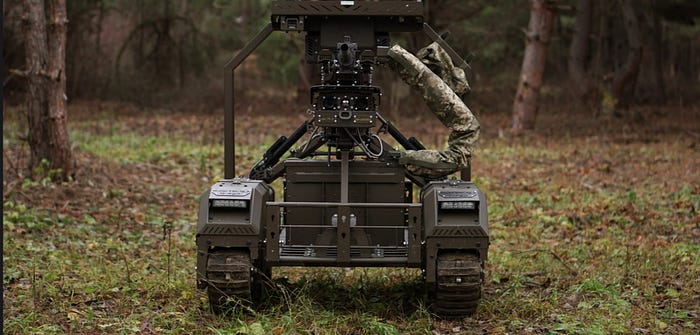
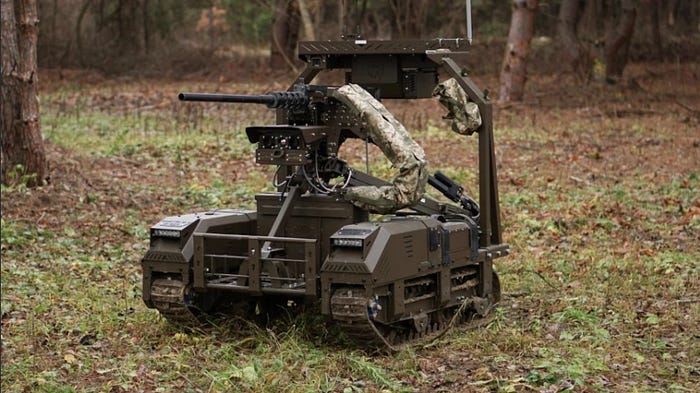
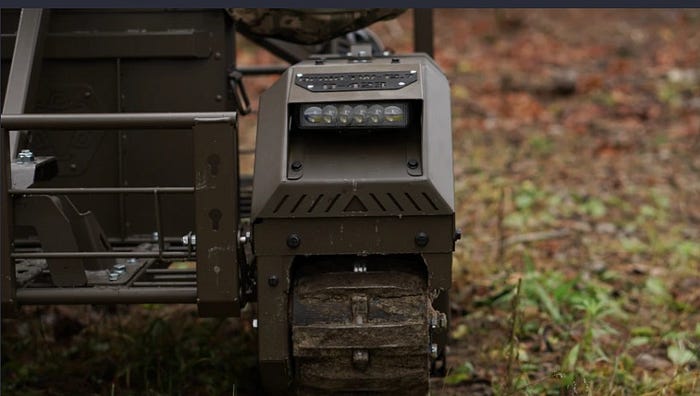
The platform itself was unremarkable at first glance. Low profile. Tracked. Armored just enough to survive shrapnel. But mounted on top was a 12.7mm M2 Browning machine gun, the same heavy weapon that has anchored defensive positions for generations.
The difference was the trigger.
The robot was dug into a reinforced burrow, camouflaged and hardened. Control was established through a layered communications setup using Starlink as the backbone, supplemented by local LTE relays. The operator was not nearby. He was more than 15 kilometers away, inside a reinforced bunker. From late November until January 15, 2026, the DevDroid lived alone in the trench.
Every 48 hours, the position was resupplied by a Baba Yaga heavy hexacopter. Flying pre-programmed GPS routes at night, the drone hovered meters above the trench and lowered a 150-kilogram magnetic pod.
Inside were two things that mattered. Power and ammunition.
The robot performed a hot-swap of its battery and reloaded pre-belted 12.7mm ammunition in under five minutes. No human ever entered the kill zone. The entire process occurred in darkness, silence, and precision.
The Russian 20th Combined Arms Army launched seven separate infantry assaults against the treeline.
Each followed the same pattern. Artillery preparation. FPV reconnaissance. Infantry pus
Each ended the same way.
Unlike human defenders, the DevDroid did not flinch under shelling. When artillery struck, it lowered its profile and waited. The moment the barrage lifted, thermal AI sensors reacquired targets instantly.
Russian assault troops charged a trench that did not break, tire, or panic. They were met with machine precision, belt after belt of fire, delivered without emotion.
To ensure the enemy believed they were fighting humans, NC13 introduced deception.
Operators occasionally broadcast recordings of human voices through the robot's external speakers. The machine was repositioned between three prepared foxholes, creating the illusion of a rotating squad. From Russian drone feeds, it looked like disciplined infantry holding under pressure.
There were no men there.
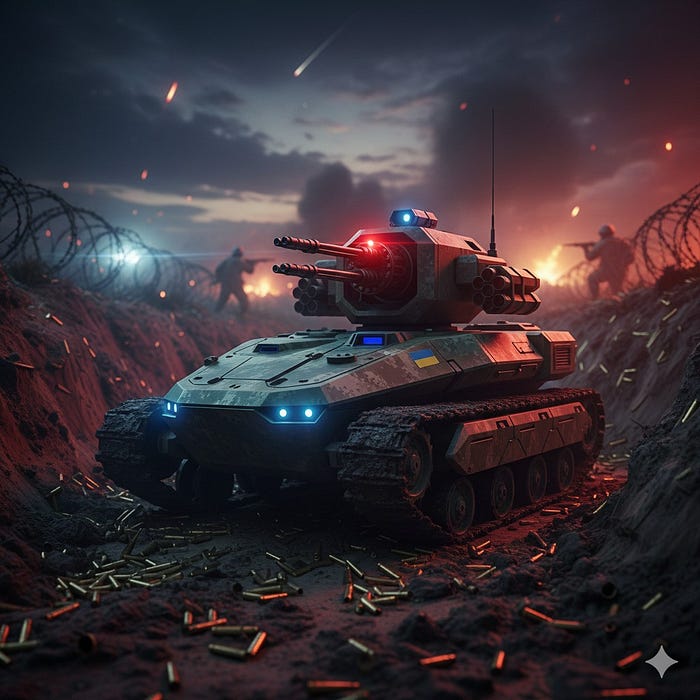
On January 15, 2026, the Russians committed heavily. Armored vehicles advanced. Thermobaric rounds were fired into the treeline. The position was finally overwhelmed.
When Russian storming groups jumped into the trench, they expected bodies.
They found none.
Only thousands of spent 12.7mm brass casings and the charred remains of a robotic chassis that had fired until its last belt ran dry.
For 45 days, they had been fighting a machine.
A direct comparison tells the story more clearly than rhetoric ever could.
A human infantry squad can typically hold such a position for three to five days before rotation. Casualty projections hover around 40 percent. Logistics are constant. Morale degrades. Suppression matters.
The DevDroid held for 45 continuous days.
At an operational cost estimated around $2,000 per mission cycle, the machine consumed nearly five times the ammunition of a human squad and delivered uninterrupted firepower the entire time.
By January 2026, both the Atlantic Council and the Ukrainian Ministry of Defense were openly referencing the operation as a doctrinal turning point.
Ukraine faces a documented 20 percent shortage in frontline infantry. This single engagement demonstrated that 15,000 robotic systems, a stated 2025 production target, could replace approximately 150,000 soldiers in static defensive roles.
For 45 days, the Russian army fought something it could not intimidate, exhaust, or terrify. They believed they were breaking human defenders, grinding morale down through fire and fear.
Instead, they were wearing down mass-produced steel.
The implications reach far beyond Ukraine. The tank once replaced cavalry. This replaces the trench.
And it does so without blood.
For 45 days, the Russian army fought a ghost. They charged into a wall of lead, thinking they were breaking the spirit of Ukrainian men, only to find they were merely denting a piece of mass-produced steel.