
When I was first coming out, I wanted, more than anything, to know other transmasculine people. This was a matter of survival — I was facing a new set of obstacles, and I needed guidance from other people who had faced them. It was also just a human need for rest and companionship. I had spent my entire life feeling different. For once, I wanted to be near people who were different in the same way.
Like any intense desire, this one had the power to overcome my common sense. I did make some new friends, and I got closer to the ones I already had, and this was great for me. But some of the trans guys I first wound up knowing were not so great, and it is them I want to talk to you about now.
I don't entirely know how I found these guys, except that they made themselves easy to find. They wrote and posted a lot about the Challenges of Being Trans Masc, and those were the challenges I was facing. Several made a big deal about being feminists; I, too, make a big deal about being a feminist, so that was attractive. Not every trans person made me feel welcome, when I came out. Some went out of their way to make me feel unwelcome. These guys were usually pretty nice.
Correction: They were nice to me. Because what I noticed — slowly, then all at once — was that every single one of them had a pattern of going absolutely nuclear on trans women. At least once a month, there would be shouting, screaming, days-long social media dogpiles, over offenses that were increasingly minor and hard to figure out. Sometimes the woman in question actually had said something insensitive. More often, she'd just written "trans" without specifying "transfeminine," or made some eye-rolling comment about men (or, God forbid, specifically trans men), or she was better at describing trans women's experiences than other trans people's, which made sense, given that the experiences she was better at describing were her own.
Woman after woman that I knew got hit by these guys, and spent days locking her account and frantically trying to justify herself, often over nothing more than a misplaced word, often over less than that. I wanted to believe it was all just a big misunderstanding. I'd go to the women, try to apologize; I'd try to make positive, wholesome subtweets about solidarity, thinking that would get us all on the same page.
It didn't work. The pile-ons got worse, and bigger. The inciting incidents got increasingly minor. There are only so many times you can write to your female friends and say something like "I'm sorry for my buddy donglord247, I think he's just carrying a lot of trauma and maybe he didn't fully understand what you were saying" before you start to question your own role in that cycle. I mean: Would I ever apologize for a cis guy with this pattern of behavior? Would I ever tell some woman he'd dogpiled — cis or trans — that he was just "hurt" or "depressed" or "traumatized?" Or would I consider that an oppressive maneuver, nice-guy gaslighting, a way of pressuring that woman to prioritize her attacker's feelings over her own?
If this were a cis guy, I would be able to tell you that "trauma" is the universal human condition, that life is pretty fucking "traumatic" for everybody, and that yelling at girls is a choice, one you can't make without becoming an asshole. So why was it different when the other guy was trans?
In the wake of all this, I found myself with a surprising new sympathy for teenage boys who get radicalized by Reddit and men's-rights YouTubers. I had always felt contempt for arguments that framed those boys as victims — oh, noooo, I clicked the wrong link on the Internet and now I accidentally want to beat up women — and to a certain degree, I still do. You find the misogynist YouTube channel on accident, but you stay there on purpose. Nor do I mean that any of the transmascs I ran into were Andrew Tate levels of evil; for the most part, they were just annoying.
Still: I understood more about how radicalization worked, after knowing them. I could no longer believe that a cis-boy me would have been immune. Early transition was a remarkably vulnerable time. Worse, it was a time when I admitted that I was vulnerable; I had begun to agree, along with many a therapist, that what I truly needed were Strong Male Role Models. That craving for masculine guidance was so deep that I was willing to take it from nearly any guy who hung out his shingle, no matter how obviously flawed he was. This was especially true if he showed any familiarity with my core traumas. The excitement of meeting someone who might actually know what I was going through was powerful enough to overcome any hesitation.
Now, I'm back where I started: Anyone who advertises themselves as a "role model" for adults is suspect, particularly if it's "maleness" they claim to be selling. In the moment, operating on need and fear and shaky Bambi legs, that kind of skepticism didn't feel like something I could afford. If it was this way for me, someone who came out in his late thirties, I have to imagine that the Trans Men's Rights crew is all the more irresistible to younger trans guys online, many of whom are literally teenagers.
So it's begun to feel important to have this conversation, because no-one had it with me, at least not in so many words. No-one wants to say anything, because it's embarrassing, and it makes you look bad in front of cis people, and other trans people will yell at you whether you're right or wrong — some will yell harder if you're right, in fact — but you should know: There are bad corners of the online Trans Masc Community. You will know you've hit one when your Twitter feed starts to look like this scene in Say Anything, complete with the world-weary twelve-year-old who is actually probably thirty-four and waiting for the T to kick in:
Now that I've said all that, I will say something I expect to be even less popular: I actually do think it is a little different when you're a trans guy. It's not better. It's not more excusable. Harassing women online is never a positive use of energy. But there are certain specific traumas going into all this, which are causing it to manifest in particular and predictable ways.
A note: In what's to come, I use "transmasculine" and "trans man" in ways that may make the terms seem interchangeable. They aren't, but my understanding is heavily informed by my own experience, which is on the border of both — that is, "non-binary" is probably the most correct way to see me, but "man" is also a perfectly reasonable way to see me, and it doesn't require me to give a 45-minute PowerPoint presentation on my gender every time I meet someone. I also say "trans woman" a lot rather than "transfeminine" — both groups are subject to transmisogyny, but the victims of this particular pattern are usually women, as far as I'm aware.
"Transmasculine" is a broad spectrum, and any broad-strokes accounting will leave things, and people, out. I can never understand everything that you're going through. If I ever tell you that I can, I am probably trying to get something, and you shouldn't trust me. I understand pain, though. Maybe starting there, from pain — which is real; admirable or not, pain is always real — is a way to figure out where things are going wrong.
Back in 2009, Elena Rose blew my mind with a blog post on growing up trans. She asked readers to imagine a little girl abandoned among boys — still a little girl, still feminine in an instinctive way that her peers pick up on, but expected to participate constantly in the sorts of all-male spaces where femininity is violently punished. 2009 is a very long time ago, and in conversation, Rose told me she'd write that post differently now, so I am to blame for any out-of-date language or concepts. Still: That post did a lot for me, in terms of helping me conceptualize other trans people's experiences, so I'm going to try to present this problem for you in similar terms.
So: Imagine a little boy. Now, imagine that he is told he is worse than all other boys — that he is smaller, weaker, stupider, lesser, that he is not welcome to play the other boys' games, that he can never be good at the things other boys do, that his only role is to serve the other boys, to take care of them. He's instructed that his subservience needs to be encoded on his body, that he needs to give the world some visible signal that he does not consider himself an equal to other boys, or he will be punished. His subservience needs to be encoded in his behavior: He needs to learn to speak softly, to phrase statements as questions, to prioritize other people's feelings ahead of his own, or, again, he will be punished. The punishment will always come in the form of ridicule. It will often come in the form of a beating. As he gets older, he learns that there are worse punishments than just getting laughed at or hit.
When the boy enters puberty, he learns that the other boys expect to use him sexually — that this is his primary function, that all of his conditioning has been intended to prepare him for it, and that his pleasure and even his consent are unnecessary to this process. He may be attracted to other boys (I was) and confused by the fact that this thing he wanted has turned out to be mostly painful and degrading. He may be straight, in which case this constitutes an equally violent denial of self and agency. Regardless, sexual harassment and assault soon constitute the primary means by which he is disciplined. Every time he fucks up, steps out of line, offends his superiors — every time he behaves like a boy, which he cannot stop doing, because he is a boy — he opens a door with a rape on the other side.
It all sounds like some bizarre psychosexual Saw torture when you spell it out, and maybe it is; a lot of the things we regard as "normal" are violent when you look at them up close. My point is: It is hard to argue that this boy's abuse isn't transphobic. It's a violent process of policing his gender and punishing his gender non-conformity, a process which is so long and traumatizing and all-pervasive that by the end of it, even he may have a hard time knowing who he is. It's also hard to argue that it's not grounded in misogyny — the boy is being disciplined by being treated as a woman, which arises from the idea that women are inferior to men, and similar abuse also happens to women, both cis and trans.
It matters to see it this way; to hold both forms of harm in balance. To address the transphobia without addressing the misogyny gives rise to special pleading, to the idea that it's wrong to treat him that way because he's a boy. That's a deeply sexist framing, and it also happens not to be true. It's wrong to treat him that way because he's a person; it's wrong to treat people this way, no matter what gender they are.
I think a lot of transmasculine people worry about doing that special pleading. A lot of us are afraid of taking the last chopper out of Womanhood and leaving friends behind. This fear is exacerbated by the fact that many of us, myself included, really have been accused of betraying the sisterhood, caving to internalized misogyny, depriving the world of a Strong Female Role Model or a gender non-conforming woman. Transmasculine folks who feel this pressure often stress that they feel solidarity with the cis girls they grew up with, whose suffering they witnessed and shared, even though they know that most cis women don't extend solidarity to them in kind.
That last paragraph is going to annoy a lot of people, especially because I specified cis women as the recipients of that conflicted solidarity. I'm getting there. What I'd like you to do is take a beat and try to see how it might be a logical response to the circumstances, even if it isn't good. People make sense to themselves, I find, even when they're making bad decisions. If you want to resolve a problem with someone, it helps to hear their story about who they are.
Another logical if not-great response — one I've had, and am trying to grow out of — is to place a lot of emphasis on being Not Like Cis Men. Again: Look back at the treatment I just described, the role that cis men have played in this boy's life overall. Do you think he likes men, generally speaking? Trusts them? Wants to be alone in groups of them, feels safe depending on them for survival? Do you think he looks at men who've terrorized and degraded him for his entire life and thinks, gosh, I want to be just like you? Because I don't. I don't care to be told that it's "self-hating" or "man-hating" to feel that way, either. Rightful anger at oppression or abuse is the opposite of self-hatred. Identifying one's oppressor, and working to change the system that gives him unjust power, is the opposite of bigotry. It is disingenuous, if not ultimately bigoted in itself, to conflate them.
I am a man; I am not a monster; I am not a man like you, because you think all men have to be monsters. This is not the same sentiment as all men are monsters — it's exactly the opposite, in fact — but it's easy to screw it up, to articulate it imperfectly, to just plain get confused. I have.
Both of these pressures — the desire not to abandon women; the desire not to be one of Those Men — lead to what we might call the Theyfab Problem. (And, yes, like a lot of non-binary people, I hate that word.) It makes sense for transmasculine people to aspire to solidarity with women, or to say we've experienced misogyny. It makes sense for us to be uncomfortable with normative masculinity. What does not make sense is for trans mascs to insist — and we sometimes do — that we have some unique insight into women's oppression, based on "female socialization" or being "AFAB," and that trans women somehow don't have it.
This is not just bad because it's talking over women about their experiences. It's not just bad because it nearly always leads to misgendering the trans woman in question. It's not even bad just because the argument is incoherent, though it is: "Childhood socialization" is a famously bad way to understand trans experiences, but it's also not a litmus test we apply to any other form of oppression. Someone who loses their vision at age sixty has the same need for disability accomodations as someone who has been blind from birth; whether you come out as gay in your forties, your twenties, or your teens, homophobia can kill you. I believe trans women when they say they experienced misogyny prior to coming out — I experienced homophobia before I knew I was queer, so it makes sense — but I don't think they should have to prove it in order to be taken seriously as women in the present day. Everyone who is impacted by misogyny is a stakeholder in the fight against sexist oppression.
The final reason this is bad — the one I feel most qualified to comment on, since it impacts me most directly — is that it leads transmasculine people to misgender themselves. The men and mascs who take part in this pattern almost always argue from an exaggerated position of weakness — casting themselves as "feminine" in the sense of small, picked-on, victimized, helpless — for the sake of making trans women look or feel bad.
More specifically, when trans mascs depict ourselves as hapless victims of our supposedly gentle and unthreatening "female socialization," we cast trans women as stronger and more threatening and more aggressive than they really are — we masculinize them, in order to feminize ourselves, with the very clear implication being that we are women and they are men and they are therefore Doing Sexism. We do this even though, in the very next breath, we will go back to declaring ourselves Not Women and saying that negative stereotypes of masculinity are offensive and harmful to us. It's having your cake and eating it too. It's being oppressed only when it suits you, and only in the way that confers immediate advantage. It — quite rightfully — seems to drive a lot of trans women up the fucking wall, and it is probably why trans men talking about their experiences of misogyny or coercive femininity are treated with distrust.
The trauma is real. The trauma matters. But when the trauma becomes primarily an excuse to treat women like shit, no-one can actually focus on it, much less heal from it, because it's eclipsed by all the harm being done.
Of course, many transmasculine people are terrified of realizing that they can cause harm — let alone sexist harm. Even as I speak, they are preparing to argue from weakness, stressing how small and powerless and persecuted and traumatized they are, how much they've suffered, how impossible it is that they could ever be a threat to anybody, and they will bully me right off the Internet if I don't admit that they are incapable of being bullies, they will kick my ass so hard if I don't admit they're harmless little baby angels right now.
This, in itself, is evidence of what I'm talking about. The guys who do this pretty clearly believe that admitting to having power — let alone a specific form of power they get from being masculine or a man — means seeing their worst nightmare in the mirror, erasing their own very real history of misogynist oppression, becoming identical to the men who've harmed them. They believe it means admitting that all men are monsters. The good news is that it doesn't mean that. The bad news is that no-one can seem to agree on what else it means.
A few more words on the argument from weakness, before we continue. Some people won't like what I have to say, no matter how I say it, but I want to nail this one point down before I move on.
I do think that some people are too quick to dismiss trans mascs' experiences of coercive femininity. I remember a woman scoffing at how I "imagined a woman's experience" of misogyny. The situation I was describing was something that had actually happened to me, and thus, did not require imagination. The woman in question probably congratulated herself for treating me the same way she would treat a "real" man. To me, though, that comment felt like someone complimenting me for how well I "imagine" my grandmother. She's not here any more, but I did know her pretty well, and for a long time.
Some people really do think my entire first 37 years of life evaporated the moment I took my first T shot and was replaced with, I don't know, memories of duck hunting, or football, or something. In order to "see me as a man," they need to see me as a straight, cis man, even when that doesn't make sense. This past I've described, this strange and violent boyhood, was my life; it wasn't great, but I survived it, and I'm proud of myself for doing that. I don't want to erase or forget it. I want you to see my survival when you see me.
It makes sense for the past to inform the present, in ways that go beyond oversimplified ideas of "male" and "female" socialization. Many trans mascs have been taught that expressing anger in a direct and honest way looks "masculine," and will get us punished; we have learned to be sideways and passive-aggressive in how we express our anger because it was the only way to spare ourselves extremely violent gender policing. But the argument from weakness doesn't make you harmless. In fact, it doesn't even make you different from abusive cis guys, because they do it all the time.
A story: In the early 2010s, when I was closeted and working as a feminist blogger, I got several emails from a man who claimed to have raped his ex-girlfriend. He now claimed to repent the rape, and he wanted me, the feminist, to tell him whether he should kill himself.
I never replied. The emails stopped years ago, which is the only reason I'm admitting that I saw them. Still, they left me rattled. I now believe that sending them was, itself, an abusive act. This man put me in a position where I would have to either (a) absolve him for the rape of a human being or (b) be responsible for the death of a different human being. Even refusing to answer him implicated me on some level. By presenting himself as exceptionally fragile, he was able to trap me in a psychologically violent game and ensure that I blamed myself for any outcome.
This wasn't a one-off. I don't think I'm the only one it happens to — Ijeoma Oluo's Mediocre ends with a similar story about a white man threatening to kill himself over Oluo's writing. I even got one of those emails while I was writing this piece:
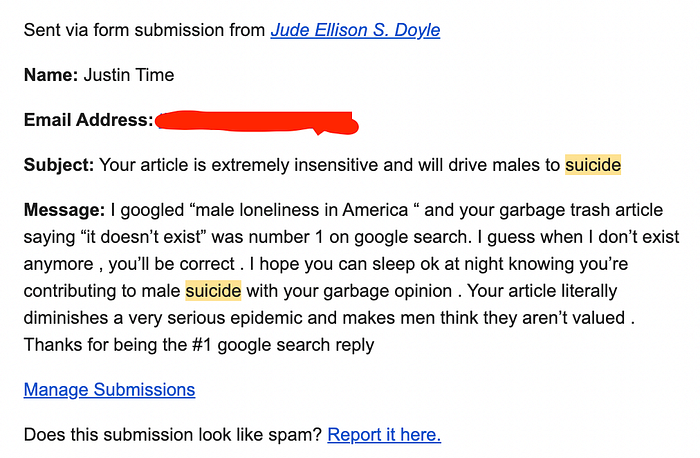
These guys are presenting themselves as small, weak, lonely, helpless, even oppressed (albeit by "misandry" or "reverse racism" rather than anything real). That still doesn't change the intent of the communication, which is to intimidate and punish someone for challenging them. It's just as possible to manipulate someone with exaggerated weakness as it is with blustering displays of strength. The specific tactic or tone of voice is not what matters: It's the underlying agenda of control.
So, no: Trans masc misogyny isn't ultimately different than cis men's. It's not some special thing that only we can do. In fact, it follows the same generational patterns as cis men's, something you'll notice if you read older books by trans masc authors. Prior to, say, 2005 or so, the problematic stuff by trans guys tends to express a more old-school, women-are-crazy, Andrea-Dworkin-wants-to-lock-men-up-in-breeding-cages, I-knew-I-was-a-man-when-I-broke-into-a-girl's-room-to-see-her-naked, testosterone-makes-me-want-to-rape-people kind of misogyny. (You think I'm exaggerating. I'm not. These are specific examples.) Nowadays, it's mostly sad-boy sensitive-soul bullshit. The fact that it's framed in the language of weakness doesn't make it any less harmful, the same way that Jonah Hill employing a therapist and using the word "boundaries" doesn't absolve him of forbidding his girlfriend to work or socialize with other men.
Just as anyone impacted by misogyny is a stakeholder in the fight against sexism, anyone in a patriarchy is potentially an agent of that patriarchy. Treating women like shit is treating women like shit, no matter who you are. When you give vent to all your frustrations by screaming at every trans woman who phrases something a little bit weirdly, that ultimately contributes to a system in which women are expected to serve as emotional shock absorbers for the people around them, sponges who quietly soak up all the pain in the room.
It's misogynist, and the fact that you may experience misogyny yourself doesn't change that. Cis women routinely do misogyny, not only to trans women, but to each other, as a way of blending in or enhancing their status within male-dominated systems. How could we possibly be immune?
Engaging conflict in a direct and open manner, rather than trying to manipulate and bully the other person, is not a matter of "masculine" versus "feminine." It's a matter of "honesty" versus "dishonesty." We would all do well to cultivate honesty in our conflicts, to tell other people what we need from them without employing force or manipulation to make sure we get it, especially when it comes to other trans and queer people. The respect we extend to other queer people is the respect we have for ourselves, and you cannot respect someone and manipulate them at the same time.
In her book The Sixth Extinction, science writer Elizabeth Kolbert describes a psychology experiment that took place at Harvard in 1949. Students were shown a deck of playing cards, one by one, and asked to name each card as they saw it. Unbeknownst to them, the deck included several non-standard cards, including a red six of spades and a black four of hearts. I'll quote Kolbert on its outcome:
When the cards went by rapidly, the students tended to overlook the incongruities; they would, for example, assert that the red six of spades was a six of hearts, or call the black four of hearts a four of spades. When the cards went by more slowly, they struggled to make sense of what they were seeing. Confronted with a red spade, some said it looked "purple" or "brown" or "rusty black." Others were completely flummoxed… "I can't make out the suit, whatever it is," [one student] exclaimed. "I don't know what color it is now or whether it's a spade or a heart. I'm not even sure now what a spade looks like! My God!"
When confronted with something as simple as a new card, these people were completely unable to see it — not because they felt it was morally wrong, but because they hadn't seen it before. That card didn't fit into their mental image of "card deck," and so their minds would contort into any shape that allowed them to deny its existence. I mean: What the fuck is "rusty black?" It's red, is what it is, but it was easier to invent a color that didn't exist than to see what was right in front of them.
"Transmasculine erasure," the dominant culture's seeming unwillingness or inability to grapple with the particulars of transmasculine existence, is partly a bigotry problem, but it may also be a "red six of spades" problem: If something falls too far outside of your established framework, you can't see what you're seeing. Trans people (at least in the United States) live within a Western, Christian, patriarchal gender binary that is pretty much engineered to make sure we don't exist. Understanding us in the terms of that system is impossible.
Even within trans communities, there's a tremendous amount of flailing and confusion around trans men's relationship to misogyny: How can someone be subject to sexism in some ways and benefit from sexism in other ways? How can someone be hurt by misogyny without being a woman, or fail to accrue full benefit from patriarchy despite being a man? (Most men don't accrue full benefit from patriarchy.) Maybe it's actually all about capitalism. Maybe there's some analogy to race. Maybe it wasn't actually misogyny — maybe it was some different thing, with a different name, that makes it different from what women go through. Maybe we're just imagining things. Maybe it wasn't that bad.
Maybe. Or maybe the six of spades is red this time. Maybe trans men are in a fairly unique position: The only group of men who spend some part of their lives being mistaken for cis women, and who are violently pressured to identify as cis women. That doesn't make us women. That makes us trans. The challenge is not to come up with some next-level theory that explains away the discrepancy, it's to come to terms with what we already know.
One framework I find particularly useful for this is Julia Serano's idea of "oppositional sexism." This term describes the belief that men and women are not only different, but opposites. If man is rational, woman is emotional; if man is violent, woman is nurturing; if man is active, woman is passive; if man is red, woman is blue, if man is up, woman is down, and so on, and so forth. This leads into the value judgments of what Serano calls "traditional sexism" — if man is good, woman is bad — but it's distinct, and informs our thinking on a level beyond conscious bias. The miscommunication driving so much intra-community trans discourse — the belief that if trans women did experience misogyny prior to coming out, then trans men did not experience misogyny, or vice versa — is oppositional sexism. No matter what the evidence says, on some level, we expect the two experiences to be opposed.
Masculine identities are traditionally constructed through oppositional sexism. Most identities are constructed through opposition, actually: I am gay because I am not straight, I am a top because I am not a bottom, I am a man because I am not a woman, etc. Obviously, this kind of thinking isn't great for people who are bi, or asexual, or vers, or non-binary; rejecting oppositional identity, taking apart neat binaries, is part of the project we refer to when we say "queer." But patriarchal masculinity, in particular, exists primarily as a deficit. It's never proven, and thus always has to be proved, usually by rejecting femininity and dominating "feminine" people.
No-one is ever actually a man. Everyone is always in the act of proving they're a man, first by dominating women and children, then by dominating other men, establishing higher and higher rungs of man-ness until at the end, presumably, the one Real Man in existence gets to be in charge of everyone and everything else.
No-one actually wins. It's all bullshit. But, importantly, it is a form of bullshit to which transmasculine people have relatively little recourse. We cannot build our identities around being the opposite of female, not least because every time we attempt to organize around "our issues," we find that those issues are shared by some other group, and more often than not, the people in that group are women.
If we want to organize around reproductive autonomy — abortion, freedom from pregnancy, freedom to take medical measures that could lower or eliminate our fertility — then we wind up sharing that space with cis women. If we want to organize around the discrimination we face for being trans — gender-based violence, discrimination, access to gender-affirming care — then we have to move in concert with trans women. If we want to talk about coercive femininity and the specific oppression of people deemed female or feminine, cis and trans women are stakeholders in that discussion. And, yes: If we want to face our ability to commit harm, or rewrite the societal script that conflates masculinity with domination, we have to work with cis men, many of whom are asking the same questions.
Again, don't get it twisted: Trans men are men, and transmasculine people, more generally, are not women. But trans men can't look at women and say I am the opposite of you. We also don't get to say that to cis men, my own insecurities notwithstanding. We are like cis women. We are like trans women. We are like cis men. We are a place where the interests of at least three different populations, all of whom are historically in conflict with each other, overlap. No wonder it gets confusing.
This is not a totally new dilemma. Much as I hate to be yet another white trans guy on the Internet trying to make an analogy to race, Gloria Anzaldua's Borderlands is devoted to the experience of living where two histories merge, where oppressed and oppressor can both live in the same place or even the same person — in Anzaldua's case, being a queer Chicana feminist living near the border that divides Texas from Mexico.
"It's not a comfortable place to live in, this place of contradictions. Hatred, anger and exploitation are the prominent features of this landscape," she wrote. "A borderland is a vague and undetermined place created by the emotional residue of an unnatural boundary. It is in a constant state of transition." Carrying and embodying at least two histories and two cultures, the oppressed and the oppressor, means carrying their conflict around inside you:
We don't identify with the Anglo-American cultural values and we don't totally identify with the Mexican cultural values. We are a synergy of two cultures with various degrees of Mexicanness and Angloness. I have so internalized the borderland conflict that I sometimes feel like one cancels out the other and we are zero, nothing, no one.
Living on a border can mean feeling connected to everything and everybody. It can also mean feeling like nothing and nobody, particularly when the dominant culture refuses to admit that you exist. I believe it is the underlying threat of zero-ness — that fear of being canceled out, rendered unthinkable and illegible — that drives much shitty trans masc behavior.
Again: I don't excuse the behavior. But every shitty habit started as a coping mechanism, and when you remember what you were originally trying to cope with, you can begin to meet that need in a better way. The red six of spades is a new card. Nobody really knows how to play it. I don't know; if I ever tell you I do, take me out back and shoot me. No-one who advertises himself as a Male Role Model is worth your time.
But you are not weak. You're an out trans person in the United States in 2023. You are, by default, stronger than most people. Take a look back at it — all the psychosexual Saw torture, all the bullshit you've survived — and realize that you actually did survive. You made it here. Nobody could stop you. If you can do that, you can come up with an answer, your own answer, and you can do it without taking your shit out on women.
The truth is that I still miss "transmasc community," or the idealized vision of it I had when I first came out. Writing this essay has surfaced grief and shame for me, not anger. I still don't know what it's like, that place of rest, that room filled with other people like me. I don't know why I was unwelcome. I don't know why I wasn't good enough or smart enough or hard-working enough to make myself useful. Social acceptance is a powerful motivator, which is why it's important to have rules about what you'll do to get it. One of my rules, for better or worse, is that I will not do to others what was done to me.
A new card makes new games possible. I don't know what the next game will be, but I am sick of this one. I am hoping someone else is getting sick of it, too, the script that divides the world into tyrants and victims, and tells us we can only ever be one or the other. I write this, as I write all things, in the hopes of reaching someone who is different in the same way.