
Vitamin D is everyone's favourite supplement. It's the thing that people just know is important. While it's hard to be sure, with a global market in the billions and a very cheap per-unit cost it's quite likely that vitamin D is the most taken pill globally. There are just so many people out there who take a daily dose.
Most of this is based on the idea of a deficiency, or the much vaguer concept of insufficiency. We have thresholds for what constitutes "too low" when it comes to many vitamins. For vitamin D, the common wisdom is that this level is set at 20ng/ml, with an additional concern for people with levels between 20–30ng/ml which is usually called insufficiency.
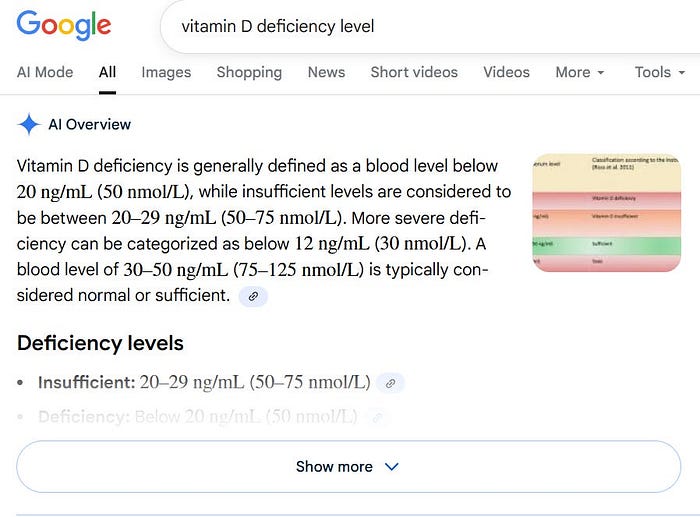
Even Google's AI agrees, and Google is never wrong.
The problem is, the entire idea of deficiencies are based on very weak evidence. With most conditions, we have a very strict and specific reason to set a threshold, but the basis for calling vitamin D levels of ❤0ng/ml too low is, and has always been, a bit vague. That's why in 2024, the US Endocrine Society updated their guidelines and no longer recommends using the term deficiency when it comes to vitamin D levels.
In other words, there's no such thing as a vitamin D deficiency. Or, at least, the entire idea that we should have a specific amount of vitamin D in our bloodstream is highly contested.
The Guidelines
The new Endocrine Society guidelines are very comprehensive, and have many facets. We will get to the recommendations for who should take a vitamin D supplement in the next installment. But the major, groundbreaking change in the recommendations is very important — they no longer recommend any specific cutoffs for vitamin D levels. They also recommend against testing anyone for vitamin D in their blood.
This is, to my knowledge, the first time a major non-psychiatric society has eliminated an entire disease category from their books. It's pretty remarkable.
To understand what has happened here, it's important to know the background. The guidelines for what constitutes deficiency and insufficiency for vitamin D levels were first published just over a decade ago in 2011. These guidelines from the Endocrine Society set the levels at <20ng/ml and 20–30ng/ml for deficiency and insufficiency, and they've been cited more than 15,000 times according to Google Scholar in the 14 years since.
They were, in a word, influential.
The complexity of vitamin D is that it interacts with many body systems. We've known for a long time that you need some vitamin D in your body to have adequate bone health — this is where rickets and osteomalacia come from — but the level you need for bone health is quite low. Most people will have adequate bone health with at least 12ng/ml in blood tests, and virtually everyone will be fine with at least 20ng/ml.
The problem is that there are lots of other conditions that vitamin D levels are associated with. Having low vitamin D puts you at a higher risk from cancer, heart disease, diabetes, and a whole host of other problems. These issues seem to disappear for people whose vitamin D is above the 30ng/ml level — or at least somewhere around there — which is where the guidelines in 2011 originally came from.
There's a bit more to the story involving serious conflicts of interest and quite a bit of potential malfeasance, but as a brief summary that's the situation as of 2011. We knew that low vitamin D was associated with a range of conditions, and that higher vitamin D levels seemed to prevent these problems. While you only needed a bit of the vitamin in your blood for your bones, higher levels seemed to be good for a whole range of other problems.
But then we started running trials to prove that this was true, and everything fell apart.
The Data
The new guidelines come with a fantastic editorial piece called "Vitamin D Insufficiency and Epistemic Humility: An Endocrine Society Guideline Communication". The piece goes into a great deal of detail about exactly how and why these recommendations were changed, and why the Society no longer endorses their previous recommendation.
A lot of it is very simple. We thought that vitamin D supplementation would prevent all sorts of problems. Then we ran massive, well-controlled clinical trials and it failed over and over again. The Women's Health Initiative randomized 36,000 people to either get vitamin D or a placebo — 20 years on, the results show no overall benefits. The D-HEALTH study randomized 21,000 people to either vitamin D or a placebo and similarly found no improvements in health even for those with low vitamin D levels at the start of the study. VITAL was another massive 25,000-person study looking at vitamin D and omega 3 supplements which found no benefits for any of their primary endpoints. Smaller trials which nevertheless included thousands of people have failed to find benefits for older adults, critically ill people with low vitamin D levels, otherwise healthy people with vitamin D < 30ng/ml, and a large range of other outcomes.
Vitamin D supplements have failed to show promise for virtually every condition that we have trialed them on. They didn't even improve bone health measurably in older women, one of the main things that we were very optimistic about seeing benefits for.
The point here is fairly simple. Relying on observational evidence is inherently tricky. There are so many ways that low vitamin D levels could be related to ill health that do not require vitamin D to be the causal agent. The vitamin is, after all, something our body makes itself given even a fairly small amount of sunlight. It's quite easy to imagine how having a low vitamin D level could be more of a marker for ill health than something requiring fixing through a medication.
And that's exactly what these trial results indicate. Observational evidence shows that vitamin D is associated with worse outcomes for many health conditions, but we can say that it is unlikely to cause those problems. If vitamin D was the causal agent, then supplementing it would fix the issues. We know that supplementing vitamin D does raise blood levels rapidly. But this rise in blood levels of vitamin D has no detectable impact on all of the things that we used to define a deficiency in the first place, like cancer, heart health etc.
To put it simply: there's no plausible reality where having a low vitamin D causes you to have a heart attack but a supplement which raises your vitamin D has no impact on your heart attack risk. If x causes y, then removing x removes y. If thunder storms make forest fires more likely, then fewer thunder storms…you get the idea.
Proponents of vitamin D supplementation will argue that this logic doesn't hold. The randomized trials, they say, have flaws! Every study conducted on the question is biased in some way which means we cannot accept any of the null findings as evidence.
Of course, this argument always falls apart rapidly when you look at the evidence these ideas rely on. Even the best study has limitations, but the studies showing no benefits for vitamin D supplements are extremely rigorous investigations. If you discard these, you're usually left with a mess of useless evidence that tells us very little about vitamin D supplements at all.
No More Deficiencies
Based on these trials, we can say with a fairly high degree of certainty that vitamin D levels between 20–30ng/ml are fine for most people. So insufficiency is not a useful term. But why has the Endocrine Society done away with the idea of a deficiency as well?
The answer is fairly simple — people are very different. In the absence of symptoms, some people can be fine with a vitamin D of 18ng/ml. Others will develop bone health issues at 22ng/ml. There's no specific number that makes sense to use as a marker for all people, which is what the Society means when they say epistemic humility. No one has a perfect answer to the question "what vitamin D level is healthy?", so the most scientific approach is to stop recommending that we use any cutoff at all. As I noted above, there's also no clinical benefit to giving supplements to people who have 'low' vitamin D levels anyway, so why bother with the tests?
Instead of testing people and giving them supplements when their vitamin D is below a certain level, the new guidelines recommend something much more interesting. They say that certain groups of people should always be recommended a supplement, and other groups should never get that recommendation. The groups that should get a supplement are:
- Pregnant people
- Adults aged 75 and over
- Children under 18 years of age
- People with prediabetes
The Endocrine Society "recommends against" the use of vitamin D supplementation for the other ~70% of the population.
In many ways, this is a great story about how science is supposed to work. The guidelines were initially adopted because of an interesting finding in observational research, and because vitamin D is pretty low-risk. After 14 years of overwhelmingly null findings, the guidelines changed to accept that supplementation is probably a waste of time for most people. That's exactly what is supposed to happen when the evidence changes!
The only problem remaining is those recommendations for supplementation. Is there really good evidence for pregnant people, older adults, children, and people with prediabetes to take a vitamin D supplement? Stay tuned for part 2 to find out.