
Grim Reminder: A Grim Historian is a reader-supported newsletter and depends on your 5$ donations to keep the most depressing politics and history in your inbox. Please consider becoming a paid subscriber or sharing with someone who loves misery.
The morning the Nazis came to Vinnitsa, Ukraine, the mothers knew before their sons did. They heard the whispers of pits appearing outside small towns, of families marching into fields and not returning, of mothers clutching their children until soldiers pried them apart like butchers choosing animals from a pen.
Some mothers tried to hide their children under floorboards or behind sacks of grain. Others pleaded. Most understood it was useless. You can't hide a child from a system that already decided they shouldn't exist.
By the time the Nazis came to Vinnitsa in July of 1941, the remaining Jews were marched to the outskirts, toward a trench already layered with bodies — neighbors, cousins, wives, daughters. Shoot. Fall. Shoot. Fall. The trench filled the way a trench fills during a flood — quickly, silently, unstoppably.
In town after town, the orders arrived like any bureaucratic directive. Rebekah Schmerler-Katz remembered being lined up in a cemetery on a mild May day, machine guns being set into position: "There was no sound, except for the birds chirping and here and there a cry of a baby." The world did not stop. It continued in the same key, unbothered by human catastrophe.
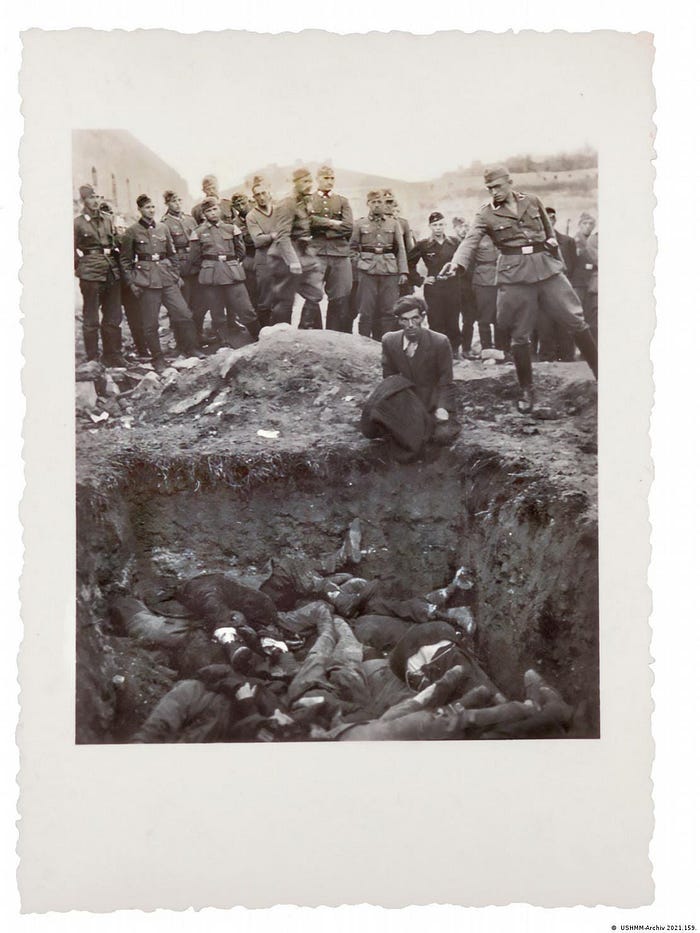
That's what makes the photograph so unbearable.
A Jewish man kneels at the edge of a pit already filled with bodies. His fists clenched. His eyes knowing his life is about to end. Behind him, a ring of SS men look on, almost bored. Their expressions are steady. Their posture relaxed. One leans forward with the mild curiosity of someone watching a demonstration. Another stands with his hands in his pockets. The shooter plants his feet, squares his shoulders, and raises his pistol with the practiced ease of a man carrying out an assigned task.
For nearly a century, historians could not identify the men in this photo, until now. In September 2025, with the help of AI, the identity of the shooter was revealed to be Jakobus Onnen, a school teacher and member of the Nazi SS party.
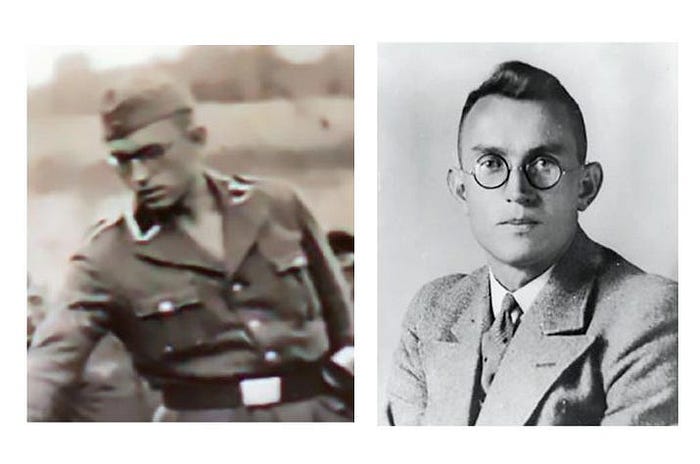
The identity of the man Onnen murdered, known as "The Last Jew in Vinnitsa," remains a mystery.
However, what AI can't solve is the underlying question of why. Why would ordinary men choose to extinguish lives on a gruesome order?
The photo holds no clues. Not a face shows reluctance. Or horror. Or pressure. Just the ease of people doing what they have come to see as normal.
This is what Hannah Arendt meant by the "banality of evil." Not that evil is dull, but that it becomes ordinary for the people who carry it out.
Just Following Orders
When the Nuremberg trials unfolded, Nazis claimed they were "just following orders," but the historical record would not cooperate. Mainly because there weren't any documented cases of German soldiers being severely punished for refusing to kill civilians. Those who refused orders were reassigned. Some teased. A few quietly respected. Not a single Nazi soldier was killed for disobedience.
Which means the horror in this photograph is not only in what is happening to the man on his knees.
It is in what is not happening to the men standing around him.
They didn't tremble. They were not coerced. They did not struggle with conscience. They were calm. Composed. Sometimes proud. They bragged and took photos, like this one, as war trophies.
That's not obedience; that's enthusiastic participation.
The "obedience myth" survives because it's a psychological air freshener. It makes the Holocaust smell like a tragic accident of human wiring instead of what it was: millions of individual choices, made by people who found brutality normal, rewarding, or at least more convenient than growing a spine. It's a storied myth perpetrators tell themselves to keep living with their own reflection.
"The experiment requires that you continue…"
For decades, the go-to framework for explaining horrors like Vinnitsa was psychologist Stanley Milgram's obedience experiments. You know the one: a Yale lab, a man in a lab coat, a shock machine. The subject is told by an authority figure to press a lever that releases a shock to an invisible person on the other side of the wall. The lever presser hears the stranger scream in pain through the wall. The screams grow louder with each pull of the lever. If the subject refuses, they get the same instructions: "The experiment requires that you continue…"
And so the pain continues.
Milgram concluded that ordinary people will commit extraordinary harm if told to do so by an authority figure. For decades, Milgram's experiments became the tidy, and reassuringly clinical folk-psychology explanation for the horrors of the Holocaust.
Until researchers unmasked the truth.
According to the archival autopsy in a recent paper, Milgram's volunteers weren't stand-ins for perpetrators at all. They were confused, misled, often suspicious, and repeatedly reassured that everything was safe. Many were "trembling wrecks," caught between the calm experimenter and the staged cries. Many participants resisted, questioned, stalled, or even walked out
More importantly, as is often the case with lab experiments, they don't always translate neatly into real life. Milgram revealed something about context, not cruelty: people can be manipulated into believing harm is both safe and legitimate if someone in a white coat says so. In other words, Milgram's experiments were a lesson about confusion, not conviction.
The psychological terrain of Vinnitsa is different. The Nazi normalized brutality long before a single order was spoken.
This is the psychological continuity that historians now track: first normalization, then participation, and lastly… enthusiasm. The normalization creeps in unannounced. Othered groups are portrayed as vermin, or, as Elon Musk called them, the "parasite class." Laws strip away rights and basic due process. Then comes the everyday erosion of empathy. Then participation — arrests, humiliations, roundups. And once people habituate to participation, violence becomes a way to belong to a fraternity. A way to bond. A way to prove oneself useful to the group.
This is why the obedience myth is so seductive. Because if obedience explains the Holocaust, then we are off the hook. We get to pretend evil is something done by people with no choices, not people who made the wrong ones.
Basically, Milgram's experiments became the perfect alibi — not for the Nazis, but for us.
Because the truth — that these men acted out of willingness, conviction, camaraderie, ideology, opportunity — forces a harder question: What would we do if the order came?
Which brings us to today.
We are once again living in a moment where unlawful orders are being openly rehearsed. A strongman issues threats of mass deportation without due process, domestic military deployment to states, and attacks on foreign nations without congressional approval. He suggests he alone is owed loyalty by the armed forces — not the Constitution.
And yet, every member of the U.S. military swears an oath not to a man but to a document. To a principle. To a republic. To the idea that orders must be lawful, and that unlawful orders must be refused. This is not a hypothetical detail in the Constitution. It is the hinge on which democracies live or die.
The Nazis had no such safeguard. Their oath was to Hitler personally. And even then, those who refused to kill civilians were not executed. They were reassigned. Given alternative duties. Allowed to step aside.
If refusal was possible under that regime, then obedience to unlawful orders in a democracy is not just a failure — it is a choice.
Which is why that photograph from Vinnitsa still matters.
It is a mirror held up to every soldier, every citizen, every institution that will be asked to decide between a person's life and the oil tycoon's greed. Between obedience and responsibility. Between participating and refusing.
The men in that photograph did not refuse.
The question now is: Will we?

Carlyn Beccia is an award-winning author and illustrator of 13 books. The Grim Historian is a reader-supported publication. To receive new posts and support my work, consider becoming a free or paid subscriber.