
One hundred thirty-eight thousand lines. One pull request.
"If we want to have a fighting chance of surviving the LLM-pocalypse, this code needs to find a dedicated owner or get deleted."
Jakub Kicinski, Linux networking maintainer, wrote that in his pull request message. Then he deleted it. All of it. Six entire subsystems. 138,000 lines of networking code that the world switched off years ago but the kernel kept compiling anyway.
On April 26, 2026, Linus Torvalds merged that pull request into Linux 7.1-rc1.
The first time in Linux history that AI-generated bug reports forced the removal of working software. Kicinski made it happen, and Linus approved for rc1 release; it ships to every server, phone, and embedded device running Linux within months. These protocols are permanently removed from the kernel.
What Kicinski Actually Deleted
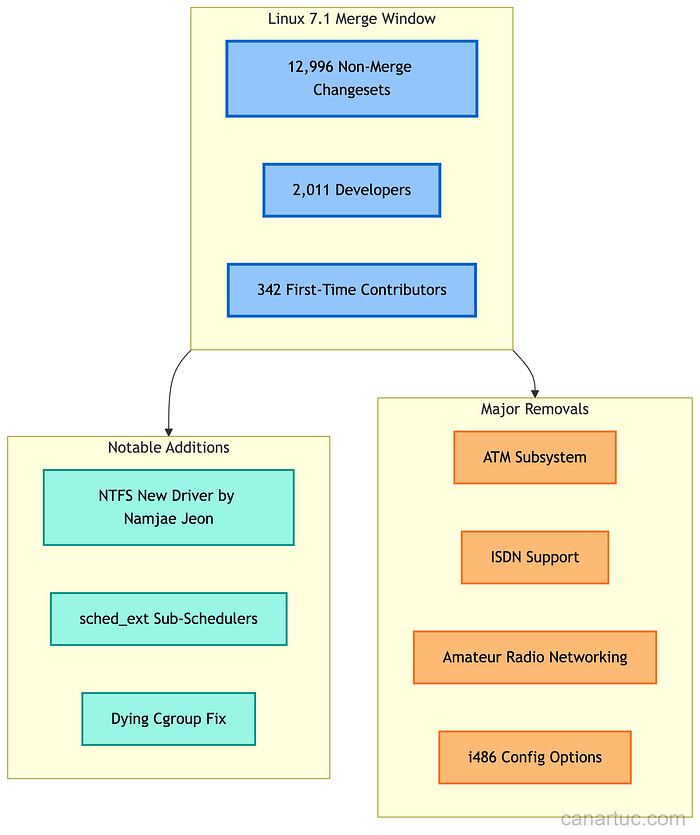
Over 138,000 lines were erased in a merge window that also brought 12,996 changesets from 2,011 developers, 342 of them first-timers. The explicit motivation for the deletions: AI-generated security bug reports are flooding maintainers with work on code that has no real users left.
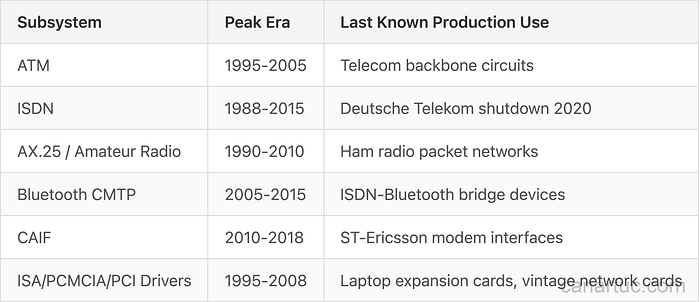
The networking subsystem removed ATM (Asynchronous Transfer Mode), AX.25, amateur radio networking, ISDN (Integrated Services Digital Network), Bluetooth CMTP (the bridge protocol between Bluetooth and ISDN), CAIF (Communication CPU to Application CPU Interface), and dozens of old ISA, PCMCIA, and PCI networking drivers.
ATM was already a relic when I was debugging VLAN (Virtual LAN) tagging issues in 2008 at a telecommunications company during my internship. ISDN was the protocol our office PBX (Private Branch Exchange) used before I ripped it out and replaced it with SIP (Session Initiation Protocol) trunks. These protocols didn't matter anymore, but a decade ago. The code stayed because every maintainer feared breaking a setup they could not see.
Removing working code costs effort. Someone has to audit dependencies, test regressions, update documentation, and shepherd the patch through review. If the old code is not hurting anything, the rational choice is to leave it alone.
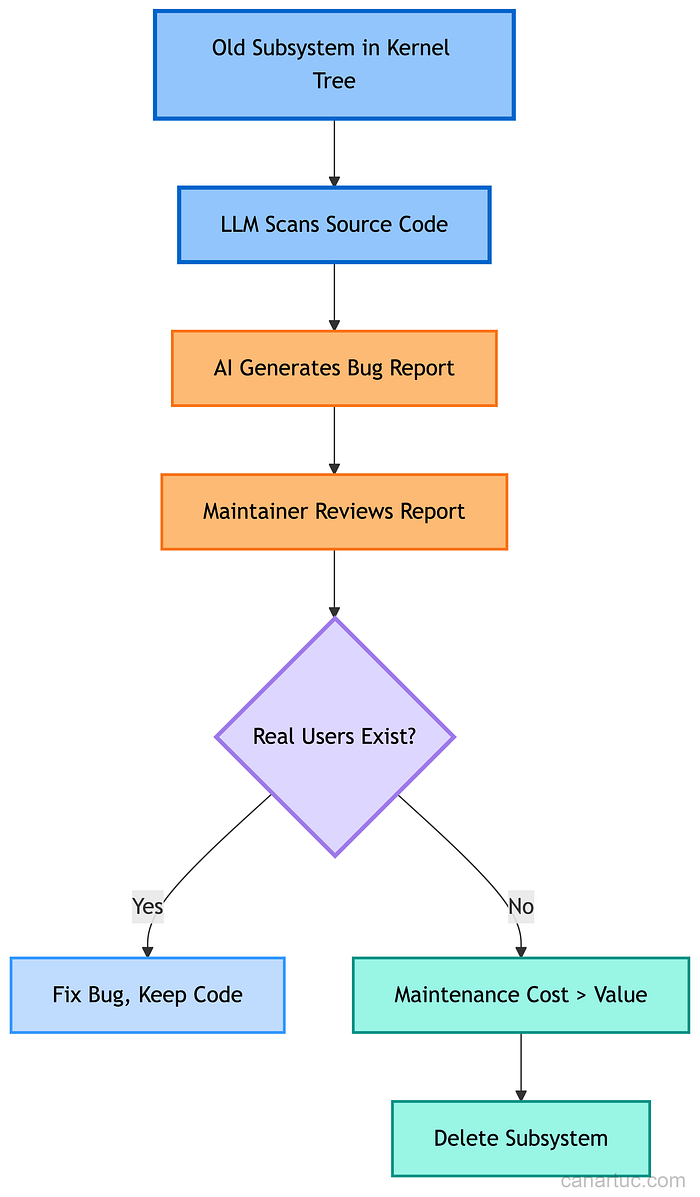
Then LLMs started reading the source tree and filing bug reports faster than maintainers could close them.
Since 2024, kernel maintainers have reported a sharp increase in bug reports generated by large language models (LLMs) scanning the source tree. It is always the same: an LLM reads old code, identifies a potential NULL pointer dereference or use-after-free condition, generates a formally correct but practically meaningless bug report, and emails it to the maintainer. Picture a smoke detector wired into an abandoned house, sending the fire department a new alarm every hour for a building that has been empty since 2015.
The maintainer now has to read the report, evaluate it, respond, and either fix a bug in code that has zero production users or explain why the report does not matter. Every report eats hours from a volunteer who has to verify the issue is real before dismissing it. Multiply that by dozens of reports against subsystems with zero active users.
A networking maintainer receiving a steady stream of LLM-generated reports against ATM code faces a choice: burn weekend hours every month maintaining a protocol any telecom company switched off, or delete the code.
They chose deletion.
Six Protocols the World Switched Off Years Ago
ATM was a networking protocol from the 1990s designed for telecoms to carry voice and data over the same infrastructure. Banks and telecom operators ran it for guaranteed quality-of-service circuits. By 2010, Ethernet had won. By 2020, finding a production ATM switch was like finding a working fax machine in the Valley.
ISDN carried phone calls over digital lines before DSL (Digital Subscriber Line) and fiber replaced it. As one of the last deprecations, Deutsche Telekom completed its All-IP migration in Germany by 2020, shutting down the ISDN network for good. The protocol was dead.
AX.25 and amateur radio networking served ham radio operators, enabling them to connect packet radio systems through the kernel. The community is small. Most modern amateur radio operators use dedicated hardware and software, not the Linux kernel networking stack.
Bluetooth CMTP provided a bridge between Bluetooth and ISDN telephony. With ISDN gone, CMTP had no purpose. CAIF was an ST-Ericsson interface for communication between the modem and host processors, and the hardware it supported has been discontinued for years.
If this story matters to you, clap, leave a comment, or share it. The maintainers who made this decision are volunteers protecting their own time.
Total: 138,161 lines removed in a single networking pull request by Jakub Kicinski.
AI Brings New Developers In and Forces Old Code Out
The same merge window that deleted 138,000 lines of dead code also welcomed 342 first-time kernel contributors. Each of them got their first patch accepted into the Linux kernel during the busiest merge window of 2026. Many almost certainly used AI coding assistants to navigate the codebase, draft initial patches, or work through the kernel's notoriously brutal submission process.
AI tools are pulling new contributors in and pushing old code out in the same release. The 342 new developers will write the kernel's next decade. The LLM-driven reports cleared the runway by making old subsystems too expensive to keep. It is the same calculation a landlord runs when property tax on an empty unit starts costing more than the rent it could ever earn.

7.1 Beyond the Deletions: i486 Farewell, NTFS Resurrection
The code removals dominated the conversation, but 7.1 brought other changes worth tracking.
Torvalds confirmed 7.1 is phasing out i486 processor support. The kernel deleted i486-specific configuration options. The actual code removal will follow in later releases, but the decision is made. The Intel 486 shipped in 1989. 37 years is a long run, even by kernel standards.
Somewhere in a university lab, a researcher is probably running Linux on a 486 for nostalgia. They have until the 7.2 or 7.3 merge window to freeze their kernel version.
The NTFS (New Technology File System) filesystem got a new driver by Namjae Jeon, a four-year modernization of the original read-only NTFS code that adds full write support and outperforms the existing ntfs3 driver. The sched_ext framework for pluggable CPU schedulers received new sub-schedulers. A fix for dying control groups (cgroups) addressed a long-standing resource cleanup issue.
The stable release is expected between June 7 and June 14, 2026, depending on whether the cycle wraps at RC7 or needs an extra week.
When Keeping Code Costs More Than Deleting It
Every codebase I have worked on in 20 years has had modules that compiled, passed tests, and served zero users. The rational move was always to leave them alone, because deleting code costs review time and carries regression risk. LLM-generated bug reports broke that logic for the kernel, and a security audit or a compliance review will break it for yours. Once maintaining dead code costs more than the value it delivers, the code goes.
Most organizations would never admit they deleted code because they were tired of answering AI-generated tickets. They would call it "modernization", "transformation," or "technical debt reduction" in a quarterly all-hands. The kernel did not bother.
If you found this useful, clap, comment, or share it with someone who works on open source. Maintainer burnout is everyone's problem.
Your Codebase Has Dead Code Too
The Linux kernel can afford to be public about this. It has the process, the governance, and the community to absorb a 138,000-line deletion without breaking anything. Your company almost certainly does not.
The same pressure is coming. If you run any open source project with code older than five years, LLMs are already reading it. The bug reports may not be arriving yet. They will. And when they do, you will face the same calculation the kernel maintainers faced: maintain dead code to satisfy automated reporters, or cut it.
I saw this play out on a smaller scale at a Munich insurance company and a Berlin fintech. A compliance audit surfaces 50,000 lines of code that have gone uncommitted for three years. The team spends two weeks proving the code is "safe" instead of spending two days deleting it. The kernel maintainers chose the two-day path.
Start auditing now. Identify the subsystems in your codebase with no active users, no recent commits, and no business justification. Cut them before the AI bug reporters force the decision.
The Linux kernel just showed everyone how to do it. No euphemisms. They said the code was dead, the AI reports were drowning volunteers, and they cut it.
When the LLM-generated bug reports start landing in your issue tracker, will your team know which code is worth defending and which code is worth deleting?