June 2, 2026
Billions of Computers Run His Editor. He Managed It for 32 Years.
A text editor on nearly every Unix-based computer on Earth helped fund an orphanage in Uganda. One man maintained it for 32 years, until…

Can Artuc
7 min read
A text editor on nearly every Unix-based computer on Earth helped fund an orphanage in Uganda. One man maintained it for 32 years, until the day he couldn't.
For more than three decades, there has been a text editor sitting on almost every Unix system on Earth.
Open a server in a data center anywhere in the World, a Raspberry Pi running in someone's garage, a brand-new Mac in a coffee shop… It is already there, installed before you arrive, the same program it was thirty years ago. Most developers have fallen into it by accident at least once, typed a few characters, realized they had no idea how to get out, and searched the web for how to quit.
One man decided what that editor was allowed to become, and he did it almost entirely alone. He had learned vi on Unix, bought an Amiga in 1988, and could not find a version that ran on the machine, so he built his own from a clone. He read the bug reports. He approved the patches, or he refused them. He held the only account, with the keys to the whole thing, and asked for nothing in return. If the editor saved you time, he wanted you to send a little money to a children's home in a Ugandan village.
For years, it worked. The editor spread into every corner of computing, and the donations kept reaching the village. Then a developer on the other side of the world sent in a patch that was not accepted… This refusal split the project he had guarded alone into two.
This is the story of the most widely installed editor on Earth, the one engineer who would not let anyone else hold the keys, and the morning those keys belonged to no one.
From an Amiga to Uganda
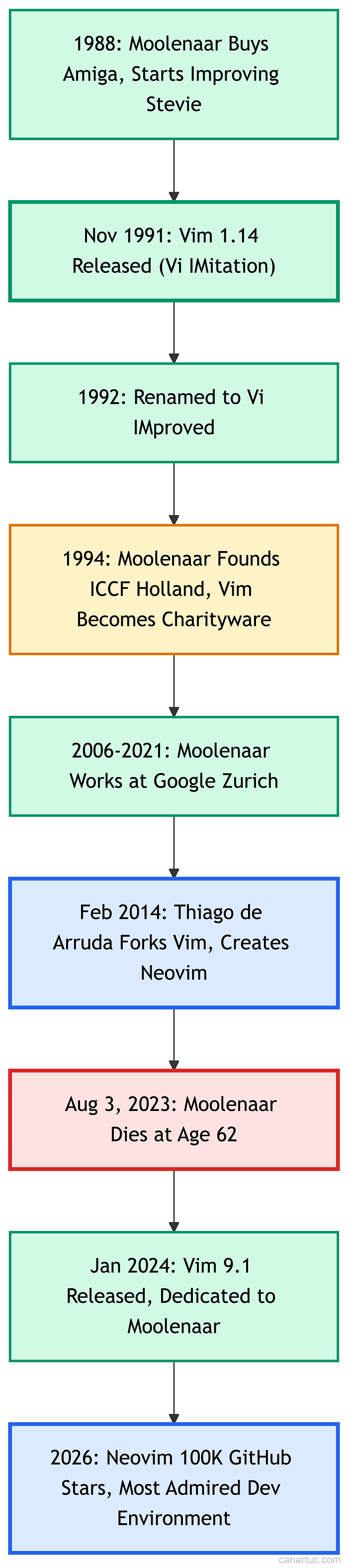
In 1988, Bram Moolenaar bought an Amiga computer. He had learned vi on Unix and wanted it on his new machine. vi had not been ported to the Amiga, so Moolenaar found the best available clone, a program called Stevie, and started improving it.
The first public release, version 1.14, came on November 2, 1991, distributed on Fred Fish Disk #591. He called it "Vi IMitation." In 1992, with version 1.22, the name changed to "Vi IMproved." The abbreviation stayed the same all these years: Vim.
Moolenaar had graduated from the Delft University of Technology in 1985 with a degree in electrical engineering. He was a Dutch engineer who liked things to work correctly. Vim reflected that personality: precise, configurable, and uncompromising about backward compatibility.
In 1994, Moolenaar traveled to Kibaale, Uganda, volunteering as a water and sanitation engineer at a children's center that cared for orphans whose parents had died of AIDS. He founded ICCF Holland, a non-governmental organization to support the center. Vim became charityware: the software was free, but Moolenaar asked users to donate to ICCF Holland.
Every Vim startup screen displayed the message. Millions of developers saw it. A text editor funded an orphanage in Uganda like a busker playing the greatest concert hall in the world and putting all the tips in a collection box for children.
From July 2006 to September 2021, Moolenaar worked at Google's Zurich office on Google Calendar. Part of his time was spent maintaining Vim. Google employed the creator of one of the most important developer tools that exists, and he worked on a calendar application.
The Patch He Rejected
In February 2014, Thiago de Arruda, a Brazilian developer, submitted a patch to Vim adding multi-threading support. Moolenaar rejected it. The patch was too large, too invasive, and did not align with Moolenaar's conservative approach to change.
De Arruda forked Vim.
He called it Neovim. He knew exactly what he wanted. The plan was to tear into Vim's source code and rebuild the editor from the inside out. That source was more than twenty years of work, much of it written by Moolenaar alone. The keystrokes you already knew would still work, but everything underneath would be new.
The new foundation was meant to do the things Moolenaar's Vim could not. Other programs could embed it and drive it. Vimscript, the aging and idiosyncratic language Vim plugins were written in, would give way to Lua, which was fast and already familiar to working developers. Heavy jobs would run in the background rather than freeze the screen. A terminal would live inside the editor itself. And it would finally understand the code on your screen the way the big commercial tools do, through the Language Server Protocol, instead of leaving every developer to wire that up on their own.
In March 2014, de Arruda launched a Bountysource campaign asking for 10,000. It raised over 33,000. The community was ready for what Moolenaar would not give them.
Moolenaar never fought back. He kept maintaining Vim the way he always had, as if the fork were none of his concern. He was watching it all the same. When Neovim added asynchronous support, he eventually built his own implementation into Vim. When Neovim made the case that Lua was the better extension language, he answered by inventing Vim9 script, a faster language he designed himself.
If this story matters to you, clap, leave a comment, or share it. Bram Moolenaar maintained your text editor for free while funding an orphanage.
Two editors, one ancestry. The original was maintained by one person who would not compromise. The fork was maintained by a community that wanted speed.
Vim Without Its Creator
On August 3, 2023, Bram Moolenaar died at the age of 62 from a medical condition that developed rapidly. His family announced it two days later in the Vim Google Group, and held the funeral on August 16 in Lisse, the Dutch town where he was born.
The immediate problem had nothing to do with code. He was the sole owner of the Vim GitHub account. Only he could set up roles for other maintainers. His family changed the permissions so the community could continue.
Christian Brabandt, a long-time contributor, became the lead maintainer. In January 2024, the team released Vim 9.1, dedicated to Moolenaar. The release included improvements to virtual text, smooth scrolling, and OpenVMS support.
Brabandt has since started adding changes that Moolenaar had been conservative about. Support for the XDG base directory specification, so Vim no longer clutters your home directory with configuration files. New maintainers joined: Yegappan Lakshmanan, Dominique Pellé, Doug Kearns, and others. Vim went from a one-person project to a team effort, something Moolenaar had never allowed during his lifetime. Brabandt presented "the new Vim project" at VimConf 2024 in November, discussing how the community kept Vim alive after its creator's death.
On February 14, 2026, the team released Vim 9.2. The release brought experimental Wayland support (the display protocol replacing X11), XDG Base Directory compliance, modernized defaults for HiDPI displays, new completion features, and an improved diff mode. The Wayland change has the deepest roots. X.Org once replaced XFree86; Wayland is now replacing X.Org; and a text editor that first shipped in 1991 is following the display layer into its next generation.
The project continues. Pull requests are reviewed every day, but Vim's character has changed.

The Community Splits Again
Bram Moolenaar resisted exactly one fork in his lifetime. That was Neovim, and the fight was over speed. In March 2026, the community he left behind split again, this time over a question he never lived to answer: Does code written by an AI model belong in Vim at all? The community gave three answers, and they do not agree with each other. Two groups said no and started their own forks of Vim, each one built to keep AI-generated code out. The maintainers of Vim itself said yes, with one rule: anyone submitting AI-generated code must disclose it.
On March 25, 2026, Drew DeVault published a post titled "A eulogy for Vim" and announced Vim Classic, a hard fork pinned to Vim 8.2.0148, the last commit before Vim9 script. He hosts it on his own sr.ht infrastructure. DeVault wrote that "a few years after Bram's passing, I find myself in another unusual moment of mourning: mourning Vim itself," and added, "I don't want to use software which has slop in it." He keeps the maintenance slow and quiet.
A second maintainer, who goes by NerdNextDoor, published EVi on Codeberg, a hard fork pinned to Vim 9.1.0 from January 2024, the last release before any AI-assisted commit reached upstream. The project's contribution rules state the position plainly: "Make it even clearer that we will NOT accept AI here."
Upstream Vim took the middle road. Its contribution guide now carries a "Using AI" section. A developer who pastes in code an AI model generated has to say so, and that code has to pass the same style checks every other patch passes, or the automated style test rejects it before a human ever reads it.
More Loved Than Used
Neovim now has approximately 100,000 GitHub stars. Vim has around 40,000. The fork has more than double the stars of the original.
In the Stack Overflow 2024 developer survey, Neovim recorded an 83% admiration rate, the highest among development environments. In 2025, it won the title for the fifth consecutive year. 14% of developers use Neovim specifically, and combined, Vim and Neovim usage accounts for 38.3% of all developers.
What He Left Behind
I have used Vim for my entire life. I remember when Neovim launched and the community split over whether forking was disrespectful to Moolenaar. It was not. It was the natural outcome of a project maintained by one person who valued stability over speed.
Moolenaar built Vim because he wanted vi on his Amiga. He maintained it for thirty-two years because people depended on it. He made it charityware because he had seen children in Uganda who needed help more than he needed money.
If you found this useful, clap, comment, or share it with someone who uses Vim or Neovim. They should know this story.
The startup screen still says it. Every time you open Vim, it asks you to help children in Kibaale, Uganda. Bram Moolenaar is gone, but his editor and his charity remain.
Neovim proved that the community was right about extensibility. Vim proved that Moolenaar was right about stability. Both editors are thriving.
That is Vim… That is open source… That is what one person can build in a lifetime while keeping eyes on orphans in Uganda, even after death.
Your contribution matters! Here is the map of possible actions you can take: