

Writing is resistance. Music is too. Since my beloved husband, Finn, died, Here Comes the Sun has become its own kind of anthem for me, along with any song that carries sunshine in its chords. They remind me that light always returns, even after the longest night. Writing is part of my healing, and my words may become a small light for another on their journey.
I have always written. As a Waldorf teacher my writing moved into plays for my classes, into long letters to parents, into the careful end-of-year reports that tried to capture the essence of each child. For years, that was most of my writing, practical and necessary, shaped for others.
In my twenties I wrote songs, but once I was teaching full-time and raising babies, even the music fell silent. Writing never disappeared, but my own voice slipped quietly to the background.
Then COVID arrived, and both songwriting and channel writing came rushing back. For the first time in years, words were not just functional, they were alive again, pouring through me like water through dry earth. But when Finn got sick, the words went quiet. I could not hold the weight of his illness and my voice at the same time.
After he died, the floodgates broke. Everything I had held back came pouring out, page after page of grief and memory. I filled more pages than I can count. Writing was no longer a choice, it was survival, the only way I knew how to breathe.
One of the first things I wrote was a letter at his grave. My tears were flowing so fast I could barely see the screen of my phone as I typed the words into my Notes app, my heart spilling out in jagged, unsteady questions:
Dear Finn,
I sit by your grave, wondering what it all means. Why did you die? Why did we meet? How did our hearts heal? How are our hearts still healing? Where are you now? How do I find you in my heart? What does it mean to have a human life? Why does pain and heartbreak make us more alive? Do you wish you were still here? Did you know you were going to go early? Do you still visit us? Do you still long for us? What does it feel like to be free? Am I doing this the way I am supposed to? How do I elevate you in my heart? How do I elevate my life? How do I weave you into my life purpose?
A Book Waiting to Be Written
Just before Finn's diagnosis, I traveled to Maui with three of my closest friends. These were the women who had once stood beside me when I packed up and fled my first marriage with nothing but two toddlers, a suitcase, and a port-a-crib. In Maui, held by their strength and love, I received a clear download: I am meant to write a book.
How many of us carry books inside us, waiting to be written? Beginning to write weekly, on the day of the sun, and for my beloved Sun, who now shines from the other side, is my way of honoring that call and committing to the process. They say that if we take one small step toward our dream, we will eventually get there. This is my step.
I could not have known then how quickly life would test that promise. Just three days after I returned home from Maui, (and my first trip without kids, in more than a decade) Finn went in for a routine colonoscopy and endoscopy because he had been having trouble swallowing. We thought it was something simple, something treatable. Instead, the doctors told us he had stage four esophageal and stomach cancer.
In that instant my whole world cracked open in an unimaginable way. It was as if the ground gave way beneath us. A dam burst inside me, flooding every corner of my life with fear and grief, sweeping away the ground I thought I was standing on.
What Healing Really Means
Some people write because they want to. Others write because they have to. I fall into the second camp. Words move through me, sometimes too easily. I have even experimented with channel writing, opening myself to whatever wants to pour through. It is like catching a train. If I do not leap onto the caboose, the thread disappears.
But here is the thing. Truth is not easy to tell. Especially in a world that never stops distracting us, dividing us, wearing us down. So how do we keep showing up? How do we stay grounded for ourselves, our families, our communities?
For me, it comes down to this: I want to be one of the helpers. I want to offer a flicker of light in someone else's darkness. To share what I have survived, not because I have it all figured out, but because I know what it feels like to be lost, to be broken, to be rebuilding from the ground up.
Healing is not a one-time event. It is not a straight line. Especially for those of us who grew up with trauma, and most of us did, in one form or another. Maybe your caregivers were not there in the ways you needed, and your young self, too small to understand, blamed you. That story became the lens you carried into adulthood.
Healing is not a one-time deal. Trauma reshapes the body and the nervous system, and it asks us to keep returning to the work of repair. As Bessel van der Kolk writes in The Body Keeps the Score, "Trauma is not the story of something that happened back then. It is the current imprint of that pain, horror, and fear living inside people."
Maybe you did this by staying hypervigilant, scanning every room before you even know you are doing it. Maybe by becoming the peacemaker, always smoothing things over so no one gets angry. Maybe by shutting down, disappearing into books, food, perfectionism. These strategies kept us safe then. But the body does not always know when the danger is gone. As adults, we keep replaying the same patterns, mistaking them for protection, when really they are holding us back from love, rest, and belonging.
But here is the hope: once we see the pattern, we can choose differently. Healing is possible. Not perfect, not fast, but possible.
Her Resistance
That is why I write. To name what is real. To keep choosing light, even when shutting down would be easier. To remind myself, and you, that we are not alone.
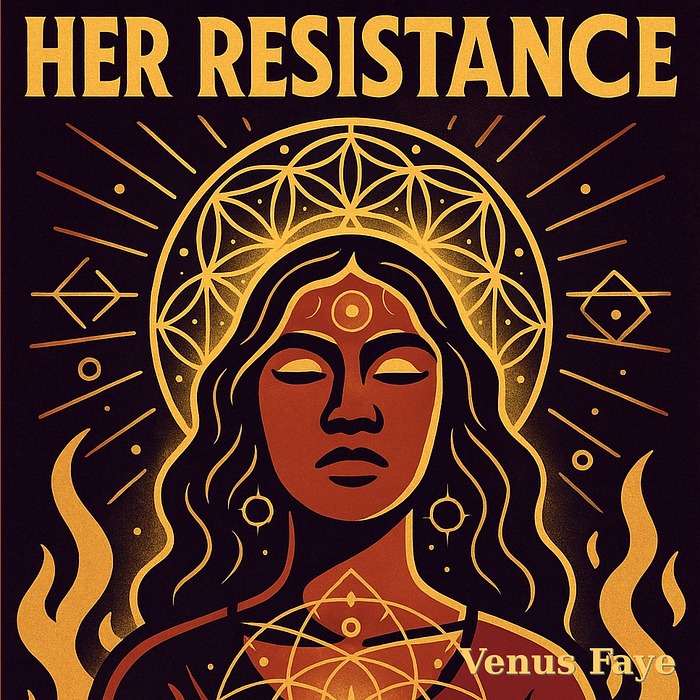
Sometimes my resistance shows up not just in words on a page, but in music. I wrote a song recently, called Her Resistance. I wrote it on election day as my own form of protest against hate-centered politics. The song has become both a feminist anthem and a personal life anthem. It was born from the ache of begging for love where there was none, and from the rising that came after.
Baby, it is time to rise above, begging on her knees, will you tell her please, where is the love?
She has nothing left to lose, a fight she cannot win. But she is at home in her skin. She can still sing the blues.
This chorus has become a compass for my life, a reminder that even when everything feels lost, there is still a way to rise. This is not just my story. This is all of us, refusing to disappear, refusing to silence ourselves.
So here I am, every Sunday, showing up. Writing as resistance. Singing when the silence would be easier. Naming what is real, even when it hurts. Because healing is not a straight line, and I am still learning how to carry both love and loss. Finn's sunlight, the songs I have loved, and the ones I am still writing, they remind me to rise. And maybe, in sharing my words, I can offer a small light, a flicker lit from within, for someone else's path as well.