

The second I feel the symptoms, I have to start moving. I am up, out of bed, running thoughtless errands — I'll buy two cartons of eggs even though I already have one in the fridge, I'll drop off $60 worth of dry cleaning when I could just toss the shirts in with the rest of the wash. I speed through a to-do list, and the adult-like nature of these chores makes me feel productive. Instead of 10,000 steps, I'll hit 20,000. When I am physically sick, and when I am mentally sick, I push myself to my absolute limit.
Productivity, I believe, is a cure for my illness.
I've struggled with depression for most of my life, and I've been in therapy for most of that time, too. My mom would drive me to my therapist a few towns over until I was old enough to drive myself. I got my first speeding ticket at 16-years-old, racing to therapy after spending too much time flirting with some senior boy outside the deli near school and losing track of the hours. When I moved to Western Massachusetts for college I had a new therapist. When I moved to the city after college I tried three new therapists before I found one I liked. New York City, of course, is full of therapists. Like dating, it can often take a long time to find the right fit. Options are plentiful. Luckily, my response to deep sadness is to move fast. I have never been so motivated and organized about seeking help than I am when I need it most. I am on an SSRI now, but as most clinically depressed people know, you still feel sad. The depression still comes around. My problems at age 10 are not my same problems at 32, though my reaction to them has always been the same. Do, do, do, do, do. More, more, more, more, more. Win, win, win.
Then came Kara*, my current therapist. My relationship with her is the longest with a mental health professional to date. I started seeing her in March 2017, and I came armed to our first appointment with my notebook, which I had productively, in depression, written down my goals, to-do lists, and various ways in which I could be better or do more. I was slumped over in my chair on the verge of tears, but at least my sadness was organized. I would simply start going down my list and my depression would readjust to its normal ("I don't like that word," Kara says) and livable state.
"Don't even shower," she said. "Just stew. As an experiment. Let's see what happens and how you end up feeling."
I showed up to that first appointment with Kara extremely lethargic and sluggish, but I was smug, too. I thought, she's going to tell me to do, do, do, more, more, more, and I'm going to tell you that I have already done, done, done, a lot, a lot, a lot. And I will win at therapy.
We talked for our scheduled 45 minutes. I told her about how sad I'd been feeling; miserable in my job, stale in my relationship, unhappy in my body, and sad in my mind, but that I had been doing a lot of work to rid myself of these feelings.
"I wake up every day and my mission is to go to bed feeling better and more productive," I told Kara.
"Does it work?" she asked.
"Well," I paused. "No. But eventually, it will."
She asked if I ever just laid in bed and stewed in my depression. No, I had not — I declared loudly and proudly. Laying in bed doing nothing and feeling sorry for myself was wrong and it was bad. I mean, right?
Kara didn't think so. She instructed me to try it. "Don't even shower," she said. "Just stew. As an experiment. Let's see what happens and how you end up feeling."
A few weeks later, I woke up feeling completely beat down and wanting to cry. All I wanted was to clean my house or reorganize my closet. Should I take the mini vacuum out and clean out my car? Should I take up running? What about the gym? What if I learned how to cook? Should I repot the plants? Bake cookies? Try pottery? Do more work?
I heard Kara's voice in my head.
Stay put and stew and see how it feels.
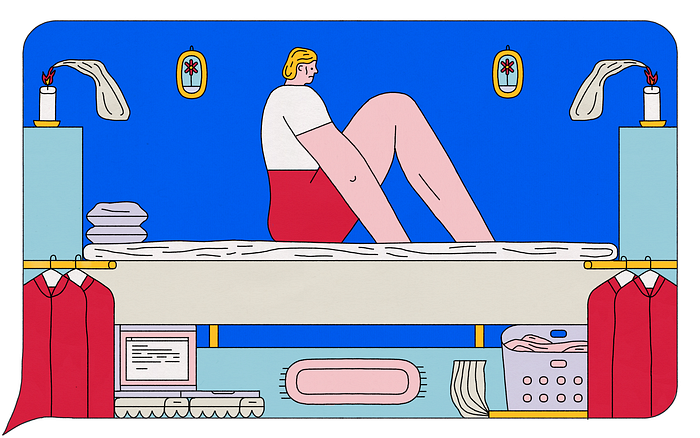
So I lay in bed; doctor's orders. I was crawling out of my skin. Even though I've seen every episode of Real Housewives of New Jersey, I watched all of season three again. It was a beautiful day outside, and my guilt for not going out and enjoying it was absolutely killing me. I felt worse as time went on. In my mind I thought: I'm unproductive. A failure. Wasting my time. Wasting my life! I cried from the sadness that was marinating inside of me for… ever. I cried over the discomfort of being chained to my bed. I looked at my clock, surely it's almost dinnertime, right? It was 1:34 p.m. More crying.
"It felt horrible," I tell Kara at my next appointment. "Horrible. It was not the right way to deal."
Kara says my obsession with being correctly depressed was something I needed to explore more in-depth. Was the productivity method really working for me, or was it simply a balm on my sadness? Was I giving myself the space to be sad? Was I conflating success with happiness?
The next time I was depressed, she wanted to know, would I allow myself to be? I did not have an answer that didn't feel like a lie.
Isn't the whole point of therapy to find coping mechanisms to stave off the depression? Yes, Kara assured me, at least in part. But the point of coping mechanisms is definitely not to pretend you're not sad by keeping yourself busy enough to forget it.
I am still learning this lesson, many years in. I still feel more depressed when I lay in bed and stew than when I fill my day with tasks to complete. But after being engulfed in sadness, as painful as it feels, I also come to therapy more prepared to talk about that specific sadness on that specific day, which Kara maintains is how we will get to the root.
Now when I stew, I allow the discomfort to pass. I move around in the world because it's something I like to do — not because it makes me feel like I'm besting my own feelings.