
You've been publishing blog posts consistently for months.
Traffic looks decent on paper.
But when you open your dashboard, the numbers that actually matter, signups, demo requests, qualified leads, refuse to move.
If that sounds familiar, you're not alone.
Here's the uncomfortable truth. Most content strategies don't drive growth. They drive traffic. And traffic without outcomes is just noise. It's the digital equivalent of handing out flyers at a busy intersection and calling it marketing.
The issue usually isn't effort. It's direction.
A lot of the advice marketing teams still follow is outdated. "Create valuable content" was revolutionary in 2015, today it brings little or no outcomes. Everyone is publishing. Everyone is optimizing for keywords. Everyone is following the same playbook.
The companies that see real results from content aren't creating more of it. They're being deliberate about what they create, why they create it, and how each piece connects to a real business outcome.
This post breaks down how to build a content strategy for organic growth that goes beyond vanity metrics. Not a content calendar. Not a list of blog ideas. A strategy that aligns SEO with customer intent and turns content into a system that compounds.
What "Organic Growth" Really Means in Content Marketing
Before we talk frameworks and tactics, let's get clear on what we mean by organic growth. Organic growth isn't traffic spikes from a viral post or a random tiktok trend. It's not chasing trends or trying to outsmart the algorithm. Those things feel good in the moment, but they rarely translate into sustainable results.
Real organic growth through content is about compounding momentum.
It's creating assets that continue to attract, educate, and convert the right people month after month, without you constantly feeding the machine. Here's what that looks like in practice.
- Qualified leads, not just clicks Not more people that just want to fill forms but people who fit your ideal customer profile, find you through search, consume your content, and raise their hand because they already see you as the solution.
- Authority and trust at scale When someone lands on your content, it should feel like you understand their problem deeply. Before they ever speak to sales, they should already trust your thinking.
- Support across the entire customer journey Your content shouldn't stop at top of funnel keywords. It needs to answer questions at every stage, from "what is this problem?" to "which solution is best for my use case?"
- Compound returns Unlike paid ads, good content gets stronger over time. It ranks higher, earns links, and keeps generating leads long after it's published.
Organic growth is not: SEO for the sake of SEO. Ranking for keywords that don't map to what you sell might inflate traffic numbers, but if visitors bounce because the content isn't relevant, you're wasting time and resources.
This is why SEO strategy and content strategy cannot be separate efforts. Keywords should reflect real customer needs. Content should move people closer to a decision, not just educate them in isolation.
Once you stop asking "what keywords can we rank for?" and start asking "what does our customer need to understand before they're ready to buy, and what are they searching when they feel that need?", everything changes.
That shift is where growth-focused content begins.
The Content Strategy Framework for Growth
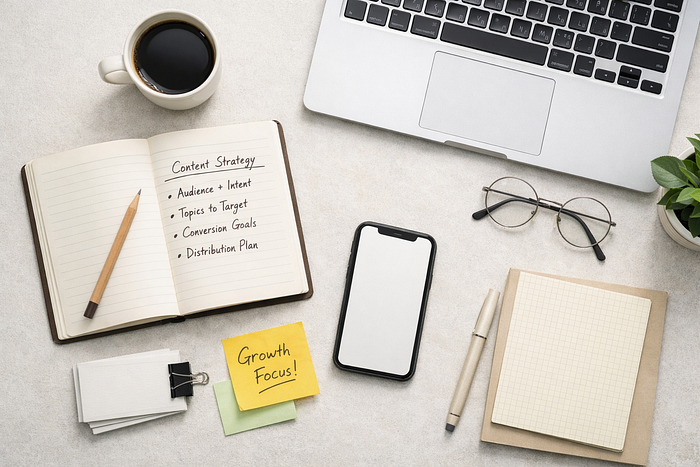
A real content strategy is not a publishing schedule. It's the logic behind your decisions. A growth-driven content strategy has four core components working together.
1. Audience and Intent Mapping
You can't grow toward an audience you don't understand.
Most teams do this step superficially. They define a persona, add a job title, and move on. That's not enough.
Go deeper.
Focus on psychographics.
What are your audience's real goals? What frustrates them about existing solutions? What misconceptions do they have? What objections stop them from buying? Then map content to intent across the journey.
- Problem-aware content: This addresses pain points before people know solutions exist. Think "how to" and "why does" searches at the awareness stage.
- Solution-aware content: This speaks to people comparing approaches. Comparisons, alternatives, category education.
- Product-aware content: This supports decision making. Case studies, ROI breakdowns, implementation guides.
The goal is continuity. Someone should be able to enter through a problem-aware post and naturally move toward a product-aware decision through your content. That's what separates a strategy from a collection of blog posts.
2. Strategic Topic Selection
This is where most content strategies fall apart. Teams optimize for volume, keyword difficulty, or what competitors are doing. Not strategic value.
If you're a startup or growing company, you can't afford that.
Filter topics through multiple lenses:
- Business relevance Does this topic connect to what you sell, or will it attract people who were never going to buy?
- Search opportunity Is there meaningful demand, and can you realistically compete?
- Conversion proximity How close is this topic to a buying decision? Broad trends get attention. Specific problems drive leads.
- Positioning and differentiation Does this topic let you shape how people think, or are you just repeating what already exists?
Score topics against these criteria. Prioritize the ones that align with all of them, even if the search volume looks smaller.
High-intent traffic beats high-volume traffic every time.
3. Content-to-Conversion Mapping
Traffic is not the goal. Conversion is.
That said, conversion doesn't always mean "buy now."
Different content serves different roles.
Top of funnel Turns readers into subscribers or followers. Newsletter signups, simple lead magnets, social follows.
Middle of funnel Turns interest into intent. Webinars, demos, toolkits, deeper resources.
Bottom of funnel Turns intent into action. Trials, consultations, purchases.
Every piece of content should have a primary conversion goal. Design the experience around that goal, from internal links to CTAs to depth of content.
This is the real difference between a content plan and a content strategy. One lists what you publish. The other explains why it exists.
4. Distribution and Amplification
Great content alone isn't enough. Organic growth requires a plan for discovery and amplification.
- That includes: On-site optimization through solid internal linking, technical SEO, and conversion-focused design.
- Strategic promotion where your audience already spends time, whether that's LinkedIn, newsletters, communities, or podcasts.
- Relationship building with creators, journalists, and operators who may reference your work over time.
- Repurposing strong content into multiple formats to extend its reach and lifespan.
Content compounds when it's designed to be found, shared, and cited. Think beyond publishing and ask how each piece earns attention over time.
Building a Content Pipeline That Sustains Growth
Strategy without execution goes nowhere. Execution without strategy wastes effort. This is where they meet.
- Start With a Content Audit
Before creating anything new, understand what you already have.
Most sites have hidden opportunities and unnecessary clutter.
Group your content into four buckets:
- High performers Content that ranks and converts. Update it, expand it, and strengthen internal links.
- Underperformers with potential Right topic, weak execution. Improve structure, clarity, depth, and CTAs. Strategic gaps Important topics you haven't covered well, or at all.
- Dead weight Content that never gained traction and doesn't align with your goals. Consolidate or remove it.
This audit becomes your roadmap
- Build Topic Clusters
Standalone posts are no longer enough.
Modern SEO works through topic authority.
Create pillar content around core topics central to your business. Then support it with cluster content that dives into specific subtopics, all internally linked.
Pillars establish authority.
Clusters capture specific, often higher-intent searches. Together, they help everything rank better and guide users naturally toward conversion.
This also mirrors how people actually learn. They start specific, zoom out, then decide.
- Set a Sustainable Rhythm
Publishing too much is one of the fastest ways to fail.
Quality compounds. Volume burns teams out.
One exceptional piece per month that ranks and converts beats four mediocre ones that disappear.
Choose a rhythm your team can sustain The goal is consistency with impact, not speed.
- Measure What Actually Matters
Not everything worth tracking matters equally.
Focus on metrics tied to outcomes, like: *Organic traffic to high-intent pages *Conversion rate by content type *Time from first visit to conversion *Content-assisted conversions *Rankings for strategic keywords
Review monthly.
Give content time to mature before judging it. Ninety days (90) is a reasonable minimum.
From Content Calendar to Growth Engine
The difference between content that "performs well" and content that drives real ROI is intention.
It's not about publishing more. It's about publishing with purpose.
When keyword research reflects real customer needs, when topic selection is tied to business goals, and when every piece of content is designed to move someone one step closer to action, content stops feeling like a cost center.
It becomes a growth engine.
The framework itself isn't complicated. Know your audience deeply. Choose topics strategically. Map content to conversions. Build a pipeline you can sustain.
Measure outcomes, not applause.
What makes this approach powerful is time. Content compounds. The work you do today keeps paying dividends months from now, quietly and consistently.
If you're tired of creating content that looks good in analytics but goes nowhere in reality, this is the shift that matters.
Build for growth, not noise.
Your future self will feel the difference when qualified leads start showing up, and keep showing up, long after the post is published.