

The Business of AI — This article originally appeared in The Drew Report — Your free guide to who is doing what to whom in the fast-developing world of artificial intelligence. For Founders, Business Leaders, and Career-minded individuals.
AI News To Know
In a week where an Indian TV station got its first AI-generated news anchor called 'Lisa,'and a CEO fired 90% of customer support staff because AI chatbot outperforms them.

Musicians Told 'Do Not Fear AI'
The CEO of the Recording Academy, Harvey Mason Jr., believes that artificial intelligence can enhance creativity in music rather than replace musicians.
He compares A.I. to essential musical instruments like flutes and drums. Mason Jr. acknowledges the both the positive and scary aspects of A.I. in music. While some artists fear their voices being replicated without consent, others like Grimes embrace the idea and demand royalties.
Mason Jr. hopes that A.I. will be recognized and awarded for its contribution to human creativity.

Was Stability AI Founder Duped?
The co-founder of Stability AI is suing the company and its CEO. He claims that he was tricked into selling his ownership stake in the company for only $100.
The co-founder, named Cyrus Hodes, says that the CEO convinced him that the company was worthless, but then later led a funding round that valued the company at $1 billion. Now, Stability AI is trying to raise even more money at a valuation of $4 billion.
If Hodes had kept his shares, they could be worth around $500 million.
The lawsuit was filed in San Francisco, and Stability AI has said that they will defend themselves. Stability AI is based in London and San Francisco and is known for its work in generative AI, particularly Stable Diffusion.
Hodes has been involved in AI projects for many years and had concerns about how the CEO was running the company, including using company funds for personal expenses.

Stability AI releases a sketch-to-image tool
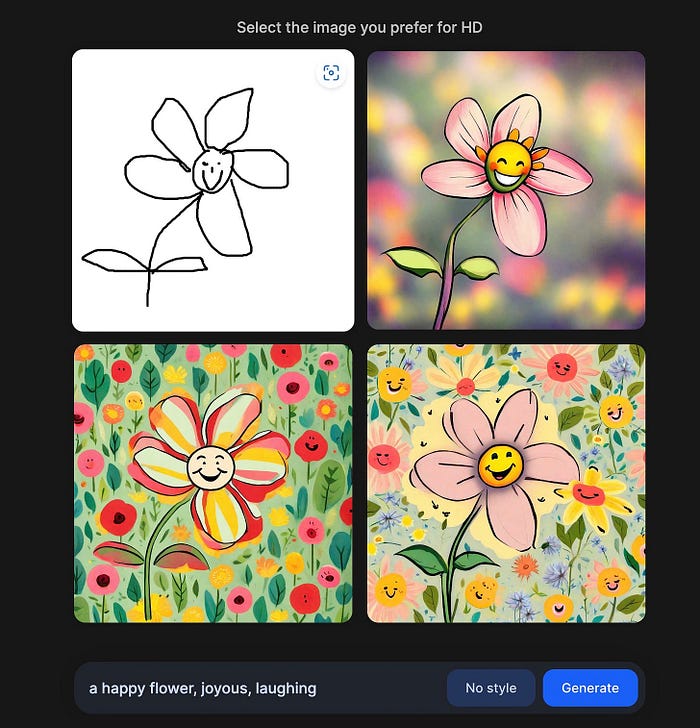
Stability AI, a startup company, has released a new tool called Stable Doodle. It can turn sketches into images.
Stable Doodle uses Stable Diffusion to analyze a sketch and create a more visually pleasing image. The tool is available through ClipDrop, a platform that Stability AI acquired.
Unlike other sketch-to-image tools, Stable Doodle offers more precise control over the image generation process. It uses a combination of Stable Diffusion XL and a control solution called T2I-Adapter, developed by Tencent's Applied Research Center. The control solution helps the AI model understand the sketch outlines and generate images based on prompts.
Stable Doodle supports 14 styles of art at the moment and aims to be a useful tool for designers, illustrators, and other professionals to save time and increase efficiency.

Talk To Yourself At Mini USA
Mini USA has introduced a new interactive AI persona called "Mini-logue" that allows people to have conversations with themselves about whether they should buy a Mini electric vehicle.
By using voice cloning and deep learning technology, the AI creates a version of the user and simulates their inner voice. Users can then engage in a conversation with themselves to help make a decision.
After the conversation, the AI generates a shareable video for social media platforms.
Mini believes that the most influential voice in the car-buying process is the customer's own inner voice.
The AI experience is part of a marketing campaign called "Trust Your Inner Mini-Logue" and includes animated advertisements featuring talking heads.

Writing Community Woes
The Writers' Guild of Great Britain (WGGB), a union representing writers in various fields, conducted a survey on artificial intelligence (AI). The survey found that 65% of respondents believed that the increased use of AI would reduce their income from writing, and 61% were concerned about AI replacing jobs in their profession. In response, WGGB published a report called "Writers and AI," which highlights the challenges and risks posed by AI while acknowledging its potential benefits for writers.
The report addresses several concerns about AI, including fewer job opportunities, lower pay for writers, copyright infringement, and the unauthorized use of writers' work. The survey showed that 81% of respondents believed writers should be paid when their work is used by AI systems.
WGGB recognizes that AI systems are not yet capable of matching the quality of writing produced by professional writers. However, the union emphasizes that AI will never be able to replicate the originality, authenticity, enthusiasm, and human touch that professional writers bring to their storytelling. The report suggests that AI, if used ethically, transparently, and responsibly, can help writers diversify their income and sustain their careers.
WGGB believes that regulations are necessary to safeguard workers' rights, protect audiences from fraud and misinformation, and strike a balance between the risks and benefits of AI. The union's recommendations aim to protect and reassure the writing community while harnessing the power of AI as a valuable tool.
Funding
Nvidia has invested $50 million in a biotech startup called Recursion.
Rocsys, a provider of autonomous charging solutions for electric vehicles, has secured $36 million in Series A funding.
Prolific, a London-based startup, has raised $32 million in funding to expand its operations. The company has built a system that uses a network of 120,000 human participants to train and stress-test AI models.
Raft, an intelligent logistics platform, has successfully completed its Series B funding round, raising $30 million.
CarePredict, a health care tech startup that partners with top home care brands, has raised $29 million in a Series A-3 investment round.
Simbe Robotics, an AI and robotics company, has raised $28 million in a Series B equity financing round led by VC firm Eclipse.
Jirav, a startup founded by Martin Zych and Steve Turner, has raised $20 million in a Series B funding round.
Partnerships
KPMG, the global accounting firm, has announced plans to spend $2 billion on AI and cloud services through an expanded partnership with Microsoft.
Axelar, a company that focuses on integrating blockchain technology with traditional internet systems, have partnered with Microsoft to explore ways to connect public blockchains with AI and improve their integration.
Shutterstock is partnering with OpenAI for six more years. This means OpenAI can use Shutterstock's images, videos, music, and data to train its AI models.
Virgin Atlantic has partnered with Fetcherr, an AI-native algorithmic pricing optimization solution, to implement its Generative Pricing Engine (GPE).
IBM has teamed up with Adobe to improve the way content is created and delivered using advanced AI technology.
Chipotle has partnered with Vebu to test a robotic solution called Autocado for making guacamole.
The Associated Press (AP) has made a two-year deal with OpenAI, the company behind ChatGPT, to share news content and technology.
Products
Chinese tech giant Huawei has introduced its own Artificial Intelligence model, called Pangu 3.0, which uses AI-powered processors. Huawei aims to compete with services like ChatGPT.
Anthropic's Claude 2 has been released for beta testing. It's similar to ChatGPT and can do things like write code and analyze text.
Kakao Brain has introduced Karlo 2.0, a powerful AI model that can generate high-quality images from text descriptions in just three seconds.
Elon Musk has launched a new company called xAI, which focuses on artificial intelligence and technology. The goal of xAI is to understand the true nature of the universe.
Other News
According to a report by Chainalysis, revenues from illegal activities involving cryptocurrencies have decreased by 65% compared to last year. Scams and illicit flows to criminal entities have declined, possibly due to improved cybersecurity in decentralized finance.
Humanoids, which are robots designed to resemble humans, are becoming a reality. Previously, humanoids were mainly found in research labs, but now companies are creating them for real-world tasks.