


The web development landscape is constantly evolving, and as we navigate through the ever-changing tides of technology, we find ourselves at the doorstep of Next.js 14 — the latest and greatest version of the popular React framework. With a slew of enhancements and features, one aspect that deserves our attention is the verdict on client-side rendering (CSR) in Next.js.
Client-Side Rendering: The OK Approach
Client-side rendering has been the bread and butter of modern web applications, providing a seamless user experience by rendering content on the client's browser. However, it comes with its set of challenges:
— Including initial page load times — SEO concerns — Performance bottlenecks.
When OK is More Than Enough
While server-side rendering (SSR) and static site generation (SSG) have their merits, client-side rendering still holds its ground. Next.js acknowledges the importance of CSR in certain scenarios, such as dynamic content updates, real-time interactions, and personalized user experiences.
In these cases, the OK performance of client-side rendering is more than enough to deliver a stellar user experience.
The Power of Choice
One of the standout features of Next.js 13 is the emphasis on giving developers the power of choice. It understands that there is no one-size-fits-all solution in web development. With enhanced support for ISR (Incremental Static Regeneration) and a seamless transition between SSR, SSG, and CSR, developers can choose the rendering strategy that aligns with their specific use cases.
Choosing between client-side rendering (CSR) and server-side rendering (SSR) depends on various factors, and understanding when to use each approach is crucial for building performant and user-friendly web applications.
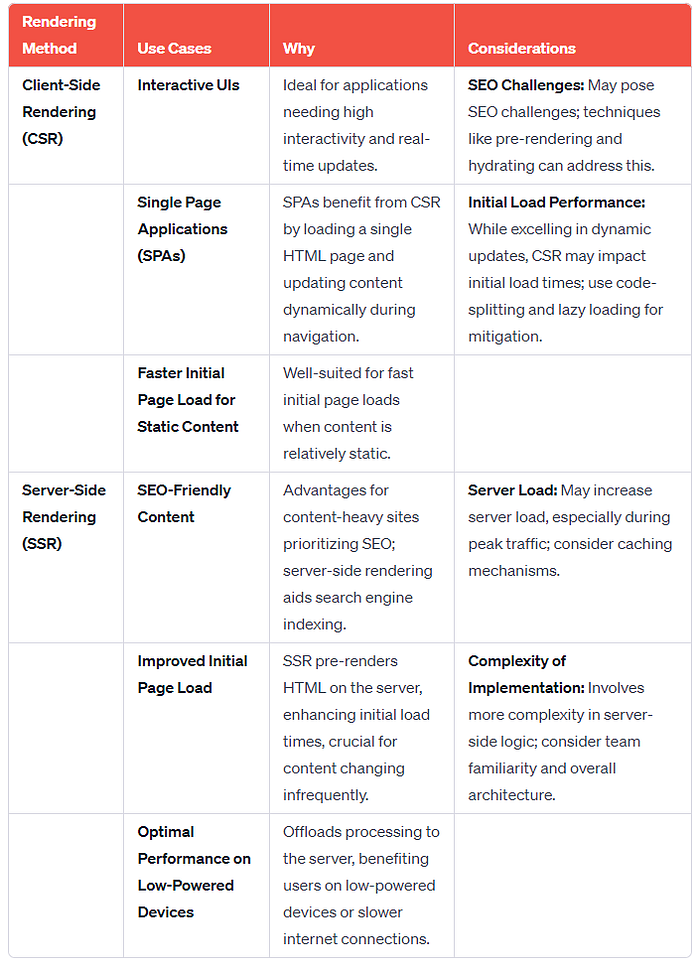
Here's a breakdown of when to use and why each rendering method:
Choosing between client-side rendering (CSR) and server-side rendering (SSR) depends on various factors, and understanding when to use each approach is crucial for building performant and user-friendly web applications. Here's a breakdown of when to use and why each rendering method:
Client-Side Rendering (CSR):
Use Cases:
Interactive User Interfaces:
- Why: CSR is well-suited for applications that require a high degree of interactivity and real-time updates. It allows dynamic content changes without refreshing the entire page, creating a smoother user experience.
Single Page Applications (SPAs):
- Why: SPAs often rely on CSR as they load a single HTML page and dynamically update content as users navigate without requiring full-page reloads.
Faster Initial Page Load for Static Content:
- Why: When dealing with relatively static content and aiming for a fast initial page load, CSR can be a suitable choice. Once the initial assets are loaded, subsequent interactions can be handled client-side.
Considerations:
SEO Challenges:
- CSR might pose SEO challenges as search engine crawlers may not effectively index content rendered dynamically. Techniques like pre-rendering and hydrating can be used to address this.
Initial Load Performance:
- While CSR excels in dynamic updates, the initial load time can be affected, especially for content-heavy pages. Considerations like code-splitting and lazy loading can help mitigate this.
Server-Side Rendering (SSR):
Use Cases:
SEO-Friendly Content:
- Why: SSR is advantageous for content-heavy websites or applications where search engine optimization is a priority. Rendering content on the server ensures search engines can easily index the content.
Improved Initial Page Load:
- Why: Applications that require faster initial page load times benefit from SSR since the server can pre-render the HTML before sending it to the client. This is especially crucial for content that changes infrequently.
Optimal Performance on Low-Powered Devices:
- Why: SSR can be beneficial for users on low-powered devices or with slower internet connections, as it offloads some processing to the server, reducing the burden on the client.
Considerations:
Server Load:
- SSR might put a higher load on the server, especially during periods of increased traffic. Caching mechanisms can be employed to alleviate this.
Complexity of Implementation:
- SSR might involve more complexity in terms of server-side logic and configuration. It's important to consider the overall architecture and development team's familiarity with SSR.
Optimal Performance with Next.js 13
Next.js 13 doesn't just settle for "OK" — it aims for optimal performance. By empowering developers with tools and strategies to make informed decisions about rendering, the framework ensures that your application performs at its best. Whether it's serving static content for blazing-fast load times or dynamically rendering content on the client-side for real-time updates, Next.js 13 strikes a balance that fits your needs.
Conclusion: Next.js 13 — Where OK is a Great Place to Be
In the dynamic world of web development, Next.js emerges as a beacon of flexibility and pragmatism. While client-side rendering may be just OK, it's an acknowledgment that in the right context, OK is more than enough. With a focus on choice, performance, and developer empowerment, Next.js 13 sets the stage for the next chapter in building modern, robust web applications.
If you like my work, please follow me and subscribe ❤️
PlainEnglish.io 🚀
Thank you for being a part of the In Plain English community! Before you go:
- Be sure to clap and follow the writer️
- Learn how you can also write for In Plain English️
- Follow us: X | LinkedIn | YouTube | Discord | Newsletter
- Visit our other platforms: Stackademic | CoFeed | Venture