
AWS SageMaker vs Azure ML Studio
A Practical Comparison for Architecting & Deploying Business Use-Cases
Choosing the right ML platform for real-world impact: a detailed guide for data scientists, architects, and tech leaders.
Machine learning in the cloud has shifted from experimentation to production at scale.
Platforms like AWS SageMaker and Azure ML Studio now promise to handle the entire ML lifecycle from data preparation and training to deployment and monitoring so that teams can focus on business value instead of infrastructure.
But the big question remains:
Which one fits your organization best ?
This blog gives you a hands-on, realistic comparison: written for people who actually build, deploy, or manage ML in production.
Quick Overview:

- SageMaker: Best for teams deep in AWS, needing managed distributed training, fine-grained compute control, and production-grade pipelines.
- Azure ML Studio: Perfect for Microsoft-centric teams who want fast prototyping, tight Azure DevOps integration, and low-code experimentation.
Highlights:
A] AWS SageMaker:
- Modular design: Studio IDE, Training, Processing, Inference Endpoints, Pipelines, Feature Store, and Model Monitor.
- Strong support for distributed training, hyperparameter tuning, and built-in algorithms.
- Deep integration with AWS stack: S3 (data), IAM (security), CloudWatch (logging), ECR (containers).
Think of SageMaker as Lego for ML pipelines: flexible, powerful, but you must know how to assemble it.
B] Azure ML Studio:
1] Two workflows:
- Designer: drag-and-drop for low-code ML.
- Studio/Notebooks + SDK: for code-first developers.
2] Integrates tightly with Azure Blob Storage, Azure DevOps, GitHub, and Azure Active Directory (AAD).
3] Built-in pipelines, model registry, and simplified deployment to ACI, AKS, or IoT Edge.
Azure ML Studio is more plug-and-play: perfect for quick experiments or enterprise collaboration.
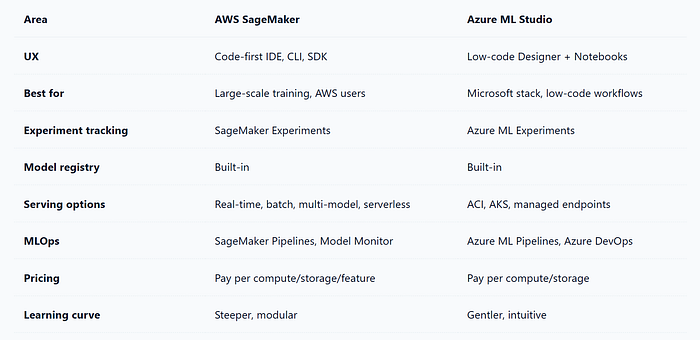
Features Comparison:
When to Choose Which:
A] Choose SageMaker when:
1] You're running heavy, distributed training jobs (multi-GPU, custom frameworks). 2] Your data and infra already live in AWS (S3, Glue, Lambda). 3] You need fine control over compute, scaling, and deployment options.
B] Choose Azure ML Studio when:
1] Your organization is Microsoft/Azure-centric (AAD, Azure DevOps, Office 365). 2] You want low-code experimentation or non-technical collaboration. 3] You prefer a tighter integration with Microsoft monitoring and compliance.
Some Examples:
A] AWS SageMaker: Training a Simple Model
import sagemaker
from sagemaker.sklearn import SKLearn

sess = sagemaker.Session()
role = "arn:aws:iam::123456789012:role/SageMakerExecutionRole"

estimator = SKLearn(
    entry_point="train.py",
    role=role,
    instance_type="ml.m5.xlarge",
    framework_version="1.2-1",
    output_path="s3://my-bucket/sagemaker-output/"
)

estimator.fit({"training": "s3://my-bucket/datasets/train/"})
predictor = estimator.deploy(instance_type="ml.m5.large", initial_instance_count=1)
train.py contains your training logic (e.g., scikit-learn model) and outputs artifacts to /opt/ml/model.
B] Azure ML Studio: Training Using SDK
from azure.ai.ml import MLClient
from azure.identity import DefaultAzureCredential
from azure.ai.ml.entities import CommandJob

credential = DefaultAzureCredential()
ml_client = MLClient(credential, subscription_id, resource_group, workspace_name)

job = CommandJob(
    code="./src",
    command="python train.py --data-path ${{inputs.data}}",
    inputs={"data": "azureml:my-dataset:1"},
    compute="cpu-cluster",
)

returned_job = ml_client.jobs.create_or_update(job)
Azure's Designer lets you achieve the same visually using drag, drop, and connect blocks for preprocessing, training, and deployment.
MLOps & Production-Grade Notes:

1] Reproducibility: Both have experiment tracking and registries. Log everything, such as parameters, metrics, and artifacts.
2] CI/CD:
- SageMaker ↔ AWS CodePipeline & CodeBuild.
- Azure ML ↔ Azure DevOps & GitHub Actions.
3] Monitoring:
- SageMaker Model Monitor for drift & bias.
- Azure integrates with Application Insights & Azure Monitor.
4] Security:
- AWS → IAM, VPC isolation, encryption.
- Azure → AAD roles, VNets, and Private Link.
Both are enterprise-ready; the difference lies in how deep your cloud roots go.
Pros & Cons at a Glance
A] AWS SageMaker
↪ Pros:
- Extremely scalable and production-focused.
- Mature features: processing, multi-model endpoints, batch transforms.
↩ Cons:
- It can feel complex with many services to configure.
- Cost management requires discipline.
B] Azure ML Studio
↪ Pros
- Low-code + SDK hybrid makes it beginner-friendly.
- Seamless Microsoft ecosystem integration (DevOps, AAD).
↩ Cons
- Some advanced setups need manual tweaks.
- Slight lag in distributed-training maturity (compared to AWS).
Real-World Tips from Practitioners:
1] Use managed experiments and model registries: don't just save to S3 or Blob manually. 2] Automate environment reproducibility via Docker + requirements.txt. 3] Prototype small (single instance), scale only when confident. 4] Control cost with spot/preemptible instances and resource alerts. 5] Log everything, such as metrics, drift, and latency, which will help early monitoring save headaches.
Conclusion:
Both AWS SageMaker and Azure ML Studio can take a model from notebook to production, but they serve different personalities:
- SageMaker: for the power user, the ML engineer who wants full control and scalability.
- Azure ML Studio: for the collaborator, the team that values simplicity, DevOps alignment, and faster prototyping.
In practice, the right choice often depends less on "features" and more on your ecosystem, team skillset, and business priorities.
If your world runs on AWS, SageMaker will feel native. If your enterprise breathes Microsoft, Azure ML Studio will click instantly.
References:
- Amazon SageMaker: https://docs.aws.amazon.com/sagemaker/
- Amazon SageMaker resources & overview page: https://aws.amazon.com/sagemaker/ai/resources/
- Azure ML Studio / Azure Machine Learning: https://learn.microsoft.com/en-us/azure/machine-learning/
- Azure product overview: https://azure.microsoft.com/en-us/products/machine-learning
- Third-party comparison (features, integrations, pricing) between SageMaker and Azure ML: https://www.cloudthat.com/resources/blog/comparison-between-amazon-sagemaker-and-azure-machine-learning/
- Additional article on choosing between AWS & Azure ML platforms: https://www.qservicesit.com/aws-sagemaker-vs-azure-ml-choosing-the-best-mlops-platform
- Another comparative source including realistic use-cases & market context: https://intellias.com/azure-ai-vs-aws-ai/