

You've undoubtedly encountered the following crucial question if you've ever developed a real-time application, such as chat apps, stock tickers, or live dashboards:
Which should I use: WebSockets, Server-Sent Events (SSE), or Long Polling?
Although these three approaches are frequently discussed in backend discussions, many developers are unaware of their distinctions or when to use one over the other. To ensure you never get confused again, I'll explain them in plain, everyday language in this post.
Long Polling: The Old Workhorse
Long Polling is like that old reliable car — not flashy, but it gets the job done.
- How it works: The client sends an HTTP request to the server and waits. If the server has no data yet, it holds the connection open until something happens (or times out). When the response arrives, the client immediately makes another request, creating a near real-time effect.
- Pros: Works almost everywhere (no special protocol needed). Easy to implement.
- Cons: Inefficient — lots of open connections. Extra latency because of repeated requests. Doesn't scale well for thousands of concurrent users.
- Best for: Simple apps with low traffic and tolerant of small delays (e.g., updating notifications every few seconds).
Server-Sent Events (SSE): The One-Way Stream
SSE is like tuning into a radio station: the server broadcasts updates, and the client listens.
- How it works: The client opens a single HTTP connection, and the server pushes updates continuously over that connection using the EventSource API.
- Pros: Lightweight (just HTTP under the hood). Auto-reconnect and built-in event handling. Great for apps that need real-time, one-way updates.
- Cons: One-direction only (server → client). Limited browser support on older versions of IE/Edge. Not ideal for two-way communication like chat.
- Best for: Live dashboards, news feeds, stock price updates, or monitoring systems where the server just needs to push data to clients.
WebSockets: The Full-Duplex Champ
WebSockets are like a phone call; both parties can talk and listen at the same time.
- How it works: After an initial HTTP handshake, the connection upgrades to a WebSocket, allowing bi-directional, full-duplex communication.
- Pros: True real-time experience. Low latency and efficient communication. Perfect for interactive apps (chat, multiplayer games).
- Cons: More complex to implement and maintain. Requires scaling infrastructure (load balancers, proxies must support WebSockets). It can be overkill if you just need one-way updates.
- Best for: Chat apps, collaborative tools (Google Docs style editing), multiplayer games, and financial trading platforms.
⚖️ Comparison Table
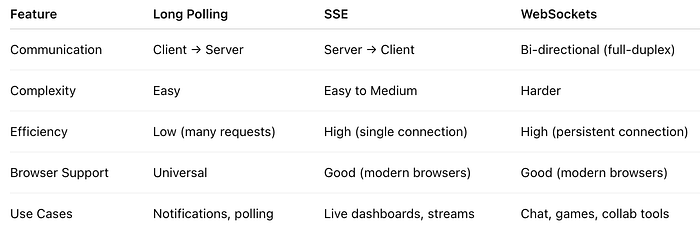
Which One Should You Use?
- Use Long Polling if you need something quick, and don't expect high traffic.
- Use SSE if you want a lightweight, server → client push mechanism (think dashboards).
- Use WebSockets if you need real-time, two-way communication at scale.
Conclusion
No "one-size-fits-all" solution exists. The traffic volume, latency needs, and complexity budget of your application will determine which of SSE, WebSockets, and Long Polling is best.
SSE excels at one-way updates and simplicity. When interaction is essential, WebSockets are the best option. Long polling is still useful for low-scale apps or legacy systems.
You will know precisely why, so the next time someone asks you which one to use, you won't just respond, "it depends."