

It's 1979. The world smells like gasoline and promise. The Cold War hums in the background, disco thumps from car radios, and every city glows with the neon confidence of a civilization certain it has mastered the future. Airplanes roar over suburbs, children collect plastic toys made from oil, and men in beige suits light cigarettes beside typewriters, drafting the policies that would define the century.
In a New York office thick with smoke, a United Nations legislator — ambitious, sharp, not yet cynical — studies a confidential report from Exxon's scientists. The graphs are clear: if humanity keeps burning fossil fuels, the planet will overheat within decades. He reads it twice, feeling the weight of a truth too large for his time.
He knows what must be done.
So he enacts a global law: a total ban on internal combustion engines. No exceptions. No "phased transitions." Just banned, the way the 1925 Geneva Protocol banned chemical warfare, or how the Montreal Protocol would later outlaw the chemicals that ate through our sky. The fossil fuel age ends before it peaks, just in case the scientists are right — that burning oil and gas could cook the planet.
The backlash is instant.
Factories shutter, car dealerships rage, oil executives swear it's "the death of civilization." Economies crash, governments wobble, and voters riot at the thought of losing their beloved engines. The media calls it lunacy. The legislator becomes the most hated person alive.
But the ban holds.
The evidence was oh, too clear to ignore. The models, precise. And the conclusion of doing nothing, terrifying.
And so, the atmosphere remains steady, ice sheets and glaciers stay whole, and nations never drown in the ocean. Yet no one builds statues for him. "Peter Gonzalez, the man who killed the engine," dies alone, branded as the fool who stalled an empire and convinced he ruined everything.
The world never thanks him for the most unpopular, visionary act in modern history — because the disaster he prevented never arrives.
But dear reader, you already know there was no Peter Gonzalez.
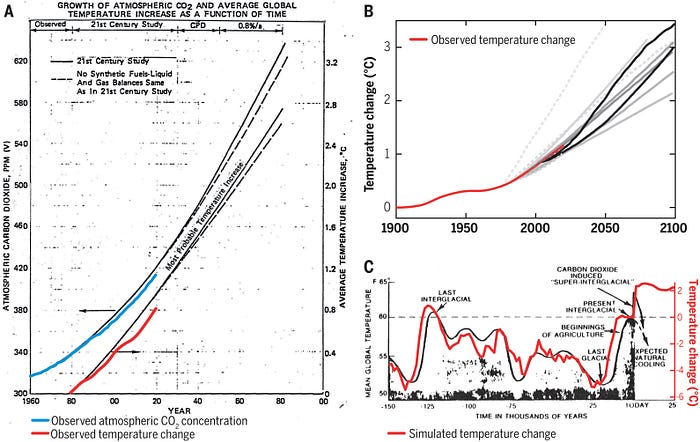
And fifty years later, Exxon's prediction keeps proving to be right.
The world he might have saved now burns, buckles, and bleeds. Poles that collapse like dying lungs. Oceans feverish and acid-sick. Crops fail in synchronized silence across continents. Floods swallow coastlines and landslides, the interiors. Refugees move not by the millions, but by the hundreds of millions. Nations fracture over water, minerals, and arable soil.
The great powers of the 21st century now fight over the wreckage they once called "growth."
There are no heroes in this version. Most leaders only look brave when it's already too late. There are only managers of chaos.
Politicians promising "net zero by 2050" while approving new oil fields. Billionaires selling "green tech" after funding the crisis. Banks that trade carbon credits like absolution. And the same oil giants that denied everything now rebrand themselves as "energy transition leaders," as if language could reverse physics.
Yet, who do we trust: the scientist who rang the alarm or the CEO who shows up in a private jet promising to fix it? Who earns the Nobel Prize, the researcher who mapped the feedback loops if we keep spinning business-as-usual, or the economist who demonstrated how innovation drives… growth?
Prevention is the chance to rewrite history quietly. Recovery is the art of pretending it's not already too late.
Everyone knows prevention is cheaper than recovery. Everyone knows it's true. But history doesn't reward those who save us quietly.
We only build monuments to the firefighters, never to the ones who banned the matches.
The Storytelling Animal
Peter Gonzalez never existed because our species doesn't reward foresight. It rewards hindsight. We worship those who explain disasters, not those who prevent them.
We like to think the future behaves like a spreadsheet: neat columns, predictable forecasts, and the illusion that chaos can be managed through equations. But history doesn't follow formulas. It pivots on outliers.
Philosopher Nassim Nicholas Taleb called these ruptures Black Swans: rare, high-impact events that no one anticipates but everyone later pretends were obvious. They are the meteorites of history — impossible until they hit.
We're drawn to what we can see, touch, and measure. We trust the expert in the suit, the numbers on the chart, the official report with footnotes. We want stories that make sense, leaders who sound confident, and solutions that feel concrete.
Most of all, we trust the narrated: the version of events that gives us a beginning, a problem, and an end.
Just see how we make sense of history:
When you look back at major events (wars, economic crashes, revolutions, pandemics), they always seem obvious in the rare view. However, there are millions of tiny details leading up to it, but our brains can't hold all that information, so we naturally filter. We tend to remember only the facts that later seem to "explain" what happened, and forget everything else that didn't fit. Eventually, we create neat stories. "Of course the housing market crashed, look at all those bad loans!" Nobody saw it coming, yet everyone has the illusion of understanding.
That's the trick of the human brain: it connects the dots after the picture is drawn, as if the chaos was always meant to be. We desperately want someone to tell us what's coming, to make uncertainty feel manageable. So we forget what it actually felt like in the moment — the confusion, the disbelief, and those "obvious" signs that weren't obvious at all — and give authority to anyone who sounds confident with their predictions (and even more, if they wear a suit), though their track record is often terrible.
- Economists with their elegant but hollow forecasts.
- Politicians with four-year plans for a planet collapsing over centuries.
- Experts with mathematical models that crumble on contact with reality.
- And us, clinging to their confidence (or even that from the fortune-tellers) like a lifeboat.
Our memories are built for storytelling, not accuracy.
The same phony mathematics that can't predict the next crisis always explains the last one perfectly. The problem is that after disaster strikes, we mistake coherence for truth. We forget that a single black bird is enough to destroy the story that "all swans are white."
How about the instant a pangolin sold in Wuhan cascaded into global lockdowns, supply chain collapse, and millions dead before governments even knew what the virus looked like? Or the afternoon Lehman Brothers collapsed and the safest assets on Earth turned into vapor, banks froze, and the financial system nearly ceased to exist? How about the second the Twin Towers fell and when nineteen men with box cutters rewrote geopolitics, launched two decades of war, and normalized surveillance states across democracies?
Each one unimaginable before it happened. Each one blindingly obvious in the aftermath.
Taleb's lesson is simple: what we can't predict defines us more than what we can. The inability to foresee these outliers (pandemics, financial crashes, wars, meteorites, or runaway tipping points) means we also can't predict history itself, because the course of history is written in the events we never see coming.
Ordinary events vanish. Only ruptures remain.
Now, take a moment.
Think about the biggest events in your own life, the ones that really changed everything. Maybe it was meeting your partner at a random party you almost didn't go to. Or losing a job that forced you into a completely different career. Or that one conversation that shifted how you see the world. Any random decision that set off a chain of consequences you're still living in.
How many of those life-changing moments did you actually plan? How many unfolded as expected? Probably very few. Who you are today is the cumulative effect of a handful of significant shocks: some good, some terrible, but most, unexpected.
That's the Black Swan principle: the things you don't know are far more decisive than the things you do. And the greater the scale, the heavier the consequences when we mistake uncertainty for control.
We're storytelling animals trapped in a chaotic world, forever explaining what just happened, forever blind to what comes next.
And the greatest Black Swan of all is already unfolding in plain sight.
The World Has Entered a New Reality
Climate change is the largest Black Swan that was never treated as one.
It fits every rule of the theory.
- First, it was dismissed as an outlier, something too abstract to fear and too slow to feel, filed under "environmental concern" or even "hoax", not civilizational threat.
- Second, it carries extreme impact: feedback loops powerful enough to rewrite the chemistry of the ocean and the structure of the atmosphere.
- Third, and most damning, it's retrospectively predictable. Every catastrophe we now explain with stunning accuracy and attribution is one we refused to act on when it could have mattered.
We don't know what could happen to the biosphere under the pressure of today's rate of emissions. There is no dataset for a planet burning this fast. So we are 100% in uncharted territory.
In finance, a crash is a Black Swan. In the climate system, it's a tipping point. Both are born from the same delusion: that the past can forecast the future. We build models assuming continuity, mistaking a calm surface for stability, when underneath, pressure builds in silence, until it breaks.
Well, the world has entered a new reality.
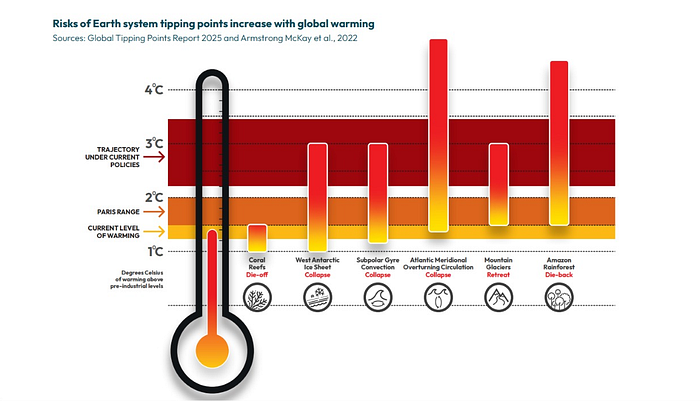
While we burn through the remaining carbon budget to stay under the ominous long-term 1.5°C threshold set by the Paris Agreement, we just breached its first tipping point linked to greenhouse gas emissions. Warm water coral reefs are facing an irreversible long-term decline due to boiling ocean temperatures. This risks the livelihoods of hundreds of millions of people.
Earlier projections placed these thresholds decades away, at several more degrees of warming. We were wrong about the timeline, yet now that it's happening, we can explain it perfectly. Again, we build models assuming predictability, when reality moves in sudden, discontinuous jumps that our frameworks for a fundamentally uncertain system can't capture.
And the report is blunt: the world is on the brink of more.
The dieback of the Amazon. The disintegration of polar ice sheets. The collapse of the Atlantic's major ocean currents.
See the triplet? Rarity, extreme impact, and retrospective predictability.
The Whiteness of the Feathers
For the first time in history, renewable energy outproduced coal. Solar and wind didn't just meet demand; they overshot it. Fossil fuel emissions from electricity plateaued, even dipped.
That's a rupture in the story we've been told, that change would take generations, that the machine was too slow to turn. We should let ourselves feel that. In the chaos of our times, these small wins are oxygen. They keep us from sinking into paralysis. They give us something to fight for, not just against.
But there are also numbers hit like a brick.
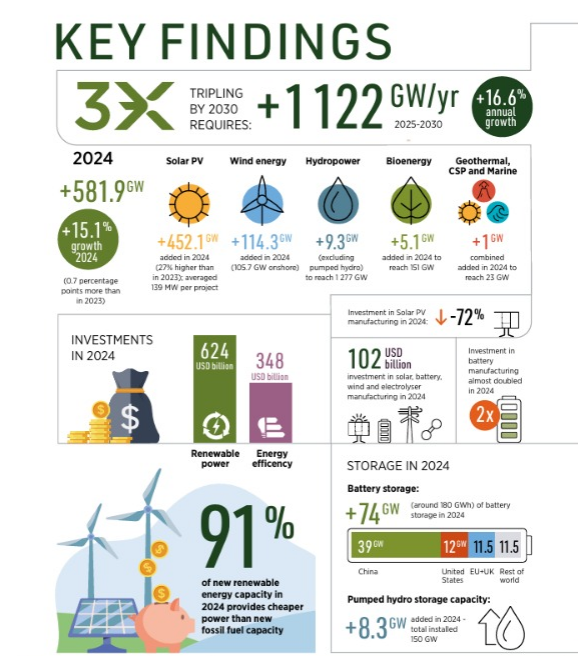
In 2024, the world added a record 582 gigawatts of renewables. To hit the COP28 UAE Consensus target, we now need double that every single year until 2030. And even if we managed that impossible acceleration, it wouldn't be enough.
Because the problem isn't the grid — it's the appetite.
Electricity demand is climbing faster than renewables can chase it. More air conditioners, more EVs, more data centers, more everything. The world keeps plugging in while pretending it's unplugging.
And still, this doesn't address the elephant in the room.
Yes, wind and solar will supply over 90% of the increase in global electricity demand through 2026. Yes, coal-fired power is expected to shrink. Emissions from the power sector will drop. All of that sounds good.
We tell ourselves we're "transitioning," but we're not replacing fossil fuels — we're stacking renewables on top of them. It's like running up a down escalator while the ground floor burns.
Even a fully decarbonized power grid can't clean up the rest of this machine. There's no "green" version of a world that still devours forests, strip-mines mountains, and poisons rivers to keep supply chains humming. Every solar panel still has a mine behind it. Every EV still has a sacrifice zone.
We should electrify, yes. But not to keep everything running as it is. Because if the goal is to preserve car culture, air travel, and endless shipping boxes, then we've already failed.
Business-as-usual, powered by sunlight instead of oil, is still business-as-usual. Growth wrapped in green paper is still growth.
And yet we celebrate. Forests fall, glaciers bleed, rivers shrink, and we clap for solar milestones. "Wind and solar will soon power the world!" the headlines cheer. Maybe they will.
But what if this is the final illusion?
Between 2016 and 2024, heat records quadrupled. Rainfall extremes jumped 40%. Cold snaps are bedtime stories for children who will never see snow. This isn't mismanagement; it's planetary overshoot, and we're flooring the accelerator.
There's no livable planet without tearing out the spine of predatory capitalism and killing the myth of endless growth. Swapping oil for solar while worshiping consumption is like switching from cigarettes to cigars to "save your lungs."
You don't save a burning house by repainting the walls. You save it by putting out the fire. And if you can't accept that, you don't understand the problem. Because this isn't a debate about policy — it's physics. It's thermodynamics. It's the laws of nature cashing the checks our economy keeps writing.
That's why our "risk assessments" are works of fiction. Economists may calculate the cost of decarbonization to the tenth decimal, but they can't quantify the unthinkable: an AMOC collapse or an ice-free Arctic, events that would reorganize the physics of the planet itself.
We keep living as if these events belong to the tail end of probability distributions. But the tails are getting fatter. And yet, every structure we depend on — insurance, finance, agriculture, migration, even optimism — is built on the assumption that tomorrow will look statistically like yesterday. And if it doesn't, we will always rewrite the past to make it sound inevitable.
Climate change will be no different. Once the glaciers have melted and the seas have claimed their new borders, historians will describe it as a "slow-moving crisis." They'll say "we didn't know enough," as if the planet hadn't been screaming in every language it had.
In the meantime, Exxon's forecast from half a century ago still sits there, cold and precise, like a time capsule of everything we chose not to believe. The scientists saw the black swan when it was starting to take flight.
But everyone else got deliberately distracted into measuring the whiteness of the feathers.
Thank you for your thorough reading and support! Subscribe for immediate insights and join the 1,700+ Antarctic Sapiens community for weekly content.