
Introduction/Rationale
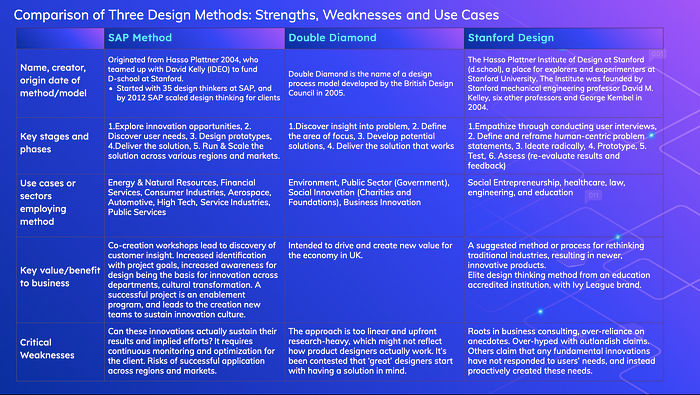
I presented, along with another classmate, the SAP method to my MBA colleagues during my business design class a few weeks ago. Today, I've chosen SAP, Stanford and Double Diamond design methods for comparison and further scrutiny.
I've chosen the SAP design method because it has been proven to be applicable in a variety of industries, and it can be inferred that this method brought about much legacy system migration to new software or emerging technology applications. This method is extremely relevant to me because of my research projects and professional involvement with new, emerging technology start ups where they could be struggling to find an immediate use case.
I've chosen the Stanford design method because of its academic roots in mechanical engineering, and integrates a variety of academic disciplines (business, law, medicine, the social sciences and humanities) into an engineering and product design approach. Presumably it caters to an executive business audience and yet when you visit the school's website, it appears to be targeted to all types of students with the primary goal of propelling creativity. Personally, I find it very interesting that there is an Ivy League version of art school.
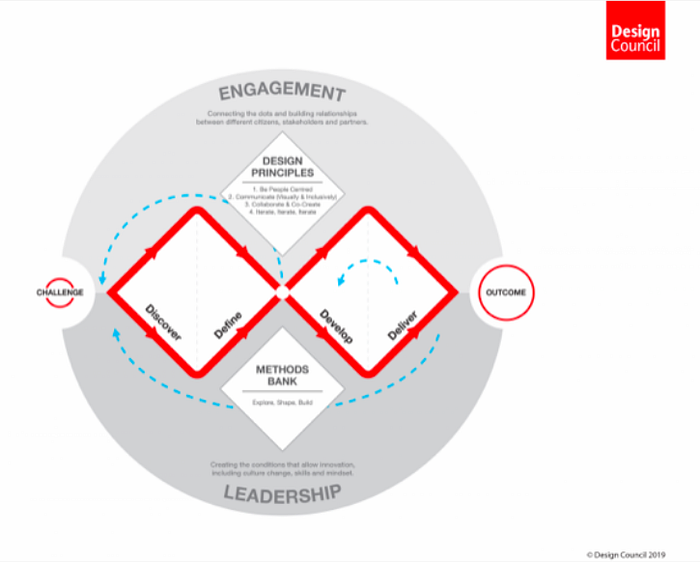
Thirdly, I've chosen the Double Diamond method because it proposes a simpler presentation of the concepts in convergent and divergent thinking. This method is offered by the Design Council in the United Kingdom, touting itself to be an "independent charity and the government's advisor on design". It views design to be a creator of value and seeks to solve economic, social and environmental challenges.
In summary, these three methods are vastly different because of their varying origins, their intended target audiences, and by implication, the challenges each method is designed to solve most effectively.
Personal Point of View
User experience and design practitioners emphasize on the non-linear aspect of design thinking methods, and they identified certain critical weaknesses in these methods that can mislead users into believing these are the only right methodologies to successful product creation or design.
While the SAP method is tailored to transforming legacy industries into technology and innovation-driven, Double Diamond and Stanford Design seek to solve difficult challenges on a society level, whether these problems are economical, environmental, or social.
My takeaway from comparing these methods is that the success of each method highly depends on the team involved. Practitioners have mentioned that superstar designers might envision the solution in mind prior to conducting research. The efficacy of each method really depends on the client problem and the way the team prefers to work.
Concluding Statement: Today and the Future
Others have commented that these methodologies are created by business consultants to create the need for new solutions. Indeed, while this is a rather cynical take on the existential value of the Stanford design thinking methods, I think it still provides a good enough foundational framework for people who have different talents to work toward a single goal when they solve for a certain challenge. In conclusion, while these frameworks will certainly be modified when different people are involved, they will become increasingly important in the future where different talents are needed.
Additional Sources:
Vinsel, L. (2018, June 18). There's So Little There There: A Response to the Stanford d.school's Defense of Design Thinking. Retrieved from https://blog.usejournal.com/theres-so-little-there-there-a-response-to-the-stanford-d-school-s-defense-of-design-thinking-3cac35a1a365
Balcaitis, R. (2019, June 17). Design Thinking models. Stanford d.school. Retrieved from https://empathizeit.com/design-thinking-models-stanford-d-school/
Anonymous. (2015, June 24). Introduction to Design Thinking. Retrieved from https://experience.sap.com/skillup/introduction-to-design-thinking/
What is the framework for innovation? Design Council's evolved Double Diamond. (2019, September 10). Retrieved from https://www.designcouncil.org.uk/news-opinion/what-framework-innovation-design-councils-evolved-double-diamond
Lipiec, M. (2019, April 10). Beyond the Double Diamond: thinking about a better design process model. Retrieved from https://uxdesign.cc/beyond-the-double-diamond-thinking-about-a-better-design-process-model-de4fdb902cf