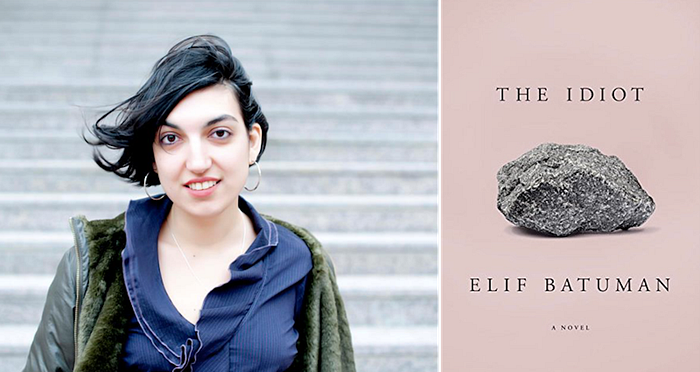


READING JOURNAL #1
I enjoyed reading The Idiot by Elif Batuman, but couldn't recommend it to others. It's too quirky! Most of the women in my Book Group (5 out of 7) did not like this book. But for me, it was delightful to be inside the mind of such an original, funny, and innocent freshman girl experiencing her first year at Harvard. I was interested in learning about the Ivy League experience, and I loved that nothing terrible happened to the main character— she wasn't raped or humiliated and didn't become a drunk and flunk out, which are all scenarios I've read (or experienced) before. Nope. Not Selin. She just went about her day quietly observing the absurdities of the world around her. And there were a lot of absurdities!
Some in my group found Selin pompous, but I didn't see her that way. She was so paralyzed with insecurity that she could barely speak when in the company of Ivan, a student who impressed her with his big math brain. Most of her observations are kept inside her head. She isn't a show off. Yet I still admire her for her originality and strength of character. She doesn't conform to the group. She doesn't feel that pressure to conform. She is a unique individual.
On the drive home from Book Group my friend Andrea explained that she didn't like the book because she couldn't figure out the point of it. She kept asking herself, what is this book about?
"I think I was trying too hard," she told me, and I have to agree. If you decide to read The Idiot, I would approach it like a visit to a foreign country. You are not going to understand everything you see and hear. But you can still passively observe, enjoy the ride, and pick up details to add to your knowledge bank along the way.
For me, what kept me moving through the book was humor. I found many of Selin's thoughts hilarious. Here's a sampling:
In linguistics class, we learned about people who had lost the ability to combine morphemes, after having their brains perforated by iron poles. Apparently there were several such people, who got iron poles stuck in their heads and lived to tell the tale — albeit without morphemes.
If that line made you laugh, as it did me, then you might like the book. Allow me to share a few more.
We learned about the ways Noam Chomsky was right and B.F. Skinner was wrong. Skinner overestimated how close humans were to animals, and then he underestimated the animals. The man didn't understand birdsong.
The pomposity of the professors dripping off that last line! I've witnessed it firsthand in the University of California system, and can't begin to imagine how over the top it must be at Harvard. I can see a professor now, pacing about in front of the lecture hall in his tweed jacket and goatee, oozing self assurance and certainty about how Chomsky is right and Skinner is wrong. Meanwhile, I'm wondering, who understands birdsong?
Yet Batuman leaves off the exclamation point on the last line which would make that point of view clear (that the professors are ridiculous). And I appreciate her lack of heavy-handedness. She describes what she's seeing and lets you decide what it means — if anything.
Early on in the book Selin meets and befriends Svetlana, who becomes a major character. As with everyone she meets, Selin finds Svetlana surprising. "It was a mystery to me how Svetlana generated so many opinions. Any piece of information seemed to produce an opinion on contact."
Selin laments that she has no opinions of her own. In fact, she seems incapable of forming them. She cites a passage from Chekov about a character with a similar affliction and says, "Every now and then, a book had something like that in it, and it was some comfort. But it wasn't quite the same thing as having an opinion."
At this point, on page 47, I'm already in love with Selin. And the book goes on for 376 more pages.
"It was a mystery to me how Svetlana generated so many opinions. Any piece of information seemed to produce an opinion on contact."
Mostly, I love her sense of humor. But that isn't all that propels me though the book. She also offers deeper insights. For example, professors tell Selin that something called the "Sapir-Whorf hypothesis" is wrong. It posits that the language you speak affects how you see reality. Yet Selin knows it is the professors who are wrong in this case, because she thinks differently in Turkish and English. In Turkish, she explains, there's a suffix you add to anything you are talking about that you didn't witness firsthand. "You were always relating your degree of subjectivity. You were always thinking about it, every time you opened your mouth."
It occurs to me just now, while writing this, that perhaps her Turkish background is why Selin is so slow to form opinions. She knows instinctively that all of life is subjective. Her first language informs her that her own perspective is not the only "true" one.
There is also beautiful writing, of course, as befits a finalist for the Pulitzer Prize. Here's a line: A heap of thermal long underwear resembled a pile of souls torn from their bodies.
Then there's exposure to the history and current state of a part of the world that I know almost nothing about. I made a number of notes about things to look up later, which I won't include here, because I don't want you to realize how ignorant I am. But if you are an American, and thus similarly ignorant about the rest of the world (not to mention our own American history, parts of which are now expunged from textbooks in Florida), you will finish this book knowing a tiny bit about what differentiates Turks and Hungarians and Russians and Serbs.
Here's a tidbit I found charming:
After 1990 all the Lenin monuments in Budapest were rounded up and deposited in a park outside the city limits. There they formed a wonderful community: much nicer than they ever imagined communism to be. Lenin greeted Lenin in front of another Lenin, while a proletarian — they called him the cloak-room sculpture — ran behind him with a banner: you left your sweater sir. The giant smiling Lenin who stood in the back had been defaced by vandals in the early eighties. Don't smile Ilych, you know how it works: in 150 years we became no Turks, the vandals had written. The rhyme was better in Hungarian.
Another Lenin statue, a gift from the Soviet people, had been damaged on the train from Moscow. The top of his head fell off and got lost. Hungarian sculptors hastily made Lenin a hat, carved from the finest marble. At the magnificent ceremony during which the statue was unveiled, it became apparent that Lenin had two hats: one on his head, and one in his hands.
I loved the image of a park of multiple Lenin statues conversing with each other, and wondered if Americans might do the same with the Confederate statues we toppled — put them all in one place to converse with each other about our past.
The passage above was written by Ivan to Selin in an email. As Andrea mentioned at the book group, some reviewer has said that Selin loves Ivan because he "gives good email." But what I loved more was her reaction to it. "I read the message over and over. I wasn't sure why he had written it, but I could see that it had taken a long time, and that he was trying to be delightful."
Here's another passage that I found informative about relations in that part of the world. Svetlana, a Serb, is having lunch with her mother and Selin, who is of Turkish descent:
Svetlana's mother reminisced about her favorite childhood holiday. "We would go to the — what's the word? Where they are dead. Cemetery, cemetery. The Turkish cemetery. And we would dance on their graves. There would be a band, oh, not large, maybe five or six musicians, and many flowers, and the girls wore the most beautiful silk dresses. Red, yellow, white, all different colors. It was a beautiful holiday."
"Mom," Svetlana said, "that's not an appropriate story to tell my Turkish friends."
"Don't be ridiculous. It was a very sweet, innocent holiday, full of dancing and flowers. Selin won't be offended. The Turks were a powerful, well-respected enemy."
This is a perspective on enemies that I hadn't considered before (not to mention the image of happy people literally dancing on graves). And I'm a fan of new ideas. They make my brain sparkle and pop in a pleasurable way.
Another thing that propelled me through the book is the same thing that seems to be the engine of most books … and songs … and movies … and stories in general: whether or not the main character will ever get together with her love interest. (I'll never tell.)
There were many other funny lines I'd love to share with you ("I felt some irrational primal resistance towards letting her buy me a hat, even though it was clear, or should have been clear, that this was the only way we would ever be able to move on with our lives."), but I think I've given you enough information to decide whether or not you would like to read this book. Paging through it to find the quotes I've included, I find myself wanting to read it again.
One thing I wondered throughout was why there was a rock pictured on the cover. A member of our group thought it related to the title and stood for "dumb as a rock." I think she's right. But also, there's more … One reviewer said it represented the book's theme of trying to find meaning in meaningless things. To which I say, Huh? Was that really the theme? And also, Are rocks meaningless? (I don't think they are.)
As for me, I have to wonder if perhaps the rock on the cover is related to this passage:
The next afternoon in the library, I picked up Pablo Neruda's "Ode to the Atom" and started to read. There were words I didn't know, but I didn't slow down. I just guessed the meaning and kept going, and I saw that Ivan was right: it was exciting not to understand.
The atom was seduced by the army — by a military man. Tiny little star, buried in metal, the military man said, or seemed to say. I will unchain you, you will see the light of day. You are a Greek god, come lie on my fingernail. I will guard you in my jacket like a North American pill.
The atom heard the army, and came out, and was unleashed. It became rabid luminosity. It assassinated germs and impeded corollas, and in Hiroshima the birds dropped like charred pears from the sky. Finally, the poem beseeched the atom to go back into the ground. "Oh, chispa loca," he said. "Oh crazy spark." Bury yourself back in your blanket of minerals, return to blind rock, collaborate with agriculture, and in place of these mortal ashes of your mask take on the noble something of the other thing, abandon your rebellion for cereal and your unchained magnetism for peace between men, so that your luminous something won't be a hell but rather happiness, hope, contribution to the earth."
Then Selin writes to Ivan about the poem, telling him it reminds her of poem her grandfather would recite when she had a stomachache as a child, urging the ache to go away to the mountains, to the stones ... "Things just aren't that easy in real life. You can't just tell an ache: "go back into the rock." Moreover, I think "peace" is misleading. It can't possibly be the same thing as cereal."
What do you think of that? I think Selin has as much "trouble" (although I don't find it troublesome) organizing the world into knowns and unknowns as I do. The poem seems to be saying something as simple as "once you let the cat out of the bag, you can't put it back in," or "once you know something, you can't un-know it," but at the same time has inexplicable elements like equating peace with cereal. Perhaps the message is our job as humans is to live with that incongruity? To understand that we don't know everything, and that we can't know everything, and yet still be open to the beauty and complexity of the experience at hand.
My reading journal
I want to mention here that I've been envying Andrea's Reading Journal since I joined this book group a few years ago. She has an orange journal with a blue place-marking ribbon in which she writes about every book she reads — and she reads a lot of books! Way more than the one a month assigned by our group. So now, at last, I'm going to begin my own Reading Journal—right here. This is entry #1.
And also, as a parting gift, one more experience from the book. Selin is in France, and speaks a little French, so when she goes out to lunch with Svetlana and others she picks out a few words she thinks she recognizes on the menu.
When our first courses arrived, I discovered that I had ordered a cantaloupe filled with port. Everyone else had ordered asparagus. I had no idea how to eat a cantaloupe filled with port. It was a whole cantaloupe, with just the very top cut off, filled to the brim. The patterns on the rind resembled ancient hieroglyphs.
How you would respond to being served a cantaloupe filled with port could be a good predictor of how much you will like or dislike this book.
Besides writing stories about movies, books, mental illness, and politics on Medium, I edit the feminist publication Fourth Wave and I've published two novels here: Thirsty Work and Count All This. Get an email whenever I publish. And if you're a writer with a story about social justice, submit to Fourth Wave.