

By Cassondra Bowden
We have been taught that minimalism is a private ceremony — something that happens inside our closets, our bank accounts, or our sleek, white-walled living rooms. We've been told that by saying "Goodbye" to our things, we find our "Self."
But the "Self" does not end at the front door.
As a strategist for the built environment, I look at the world through the Triangle of Restoration: Body, Mind, and Spirit. If the Body is grounded in the home, but the Spirit is assaulted by the street, the restoration is incomplete. We have optimized our private "Hardware" while ignoring the public "Software" that governs our frequency.
To build a true Restoration Moat, we must look at the neighborhood as an extension of the soul.
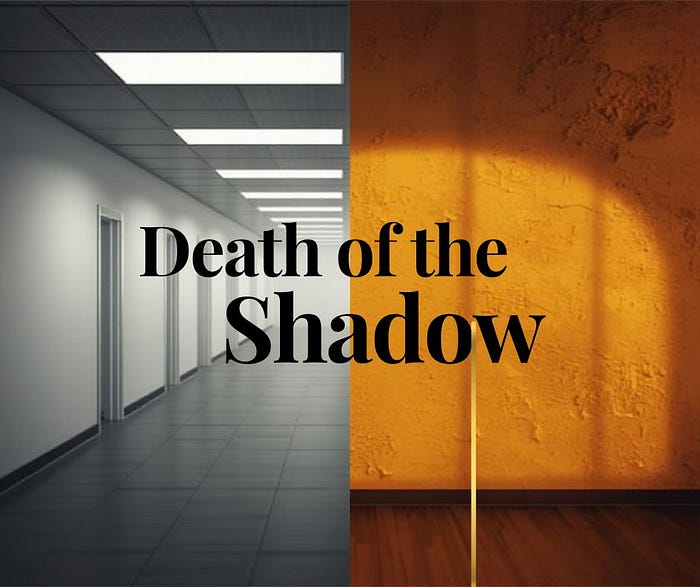
1. The Death of the Shadow
In the modern city, we have declared war on the dark. We install humming, high-glare streetlights and glass facades that erase the corners. We've forgotten what Jun'ichirō Tanizaki taught us: Gold only shines when there is shadow.
When we erase shadows from our urban planning, we erase the nervous system's ability to rest. A "Sanctuary City" is not one that is brightly lit 24/7; it is one that respects the rhythm of the dim. It is the architectural understanding that the "Spirit" needs places to hide, to dream, and to decompress. If your neighborhood is a "Kingdom of Always-Noon," your residents will live in a permanent state of the flinch.
2. The Isolation of the "Box"
Minimalism is often used as an excuse for isolation. We build "clean" suburban sprawls where every person lives in a private box, separated by a sea of asphalt. We climb into "Metal Shells" (cars) just to see a friend.
As Charles Montgomery argues in Happy City, we have systematically engineered unhappiness into our urban design. A minimalist life shouldn't mean a lonely life. True minimalism — Essentialism — is about removing the "noise" of the commute and the "hardware" of the car to make room for the "software" of the Path.
The neighborhood should be your living room. The park should be your backyard. When we design for the "Green Ribbon" — the forest floor that connects us — we restore the Environment pillar of our humanity.
3. The Neighborhood as the Successor's Mirror
Our children — the Successors — do not see "property lines." They see a single, continuous frequency. If they step out of a regulated home and into a chaotic, concrete desert, they receive a conflicting transmission.
We must treat urban planning as Legacy Work. We are not just building "units"; we are governing the frequency of the next generation. We must demand:
- Tactile Design: Streets that "hug" you back through nature and texture (The Eyes of the Skin).
- Vibrational Alignment: Neighborhoods that hum with the sound of birds and wind, not just the screech of tires.
- Sovereign Space: Communities where dignity is the primary metric of value, not just the price per square foot.
The Verdict
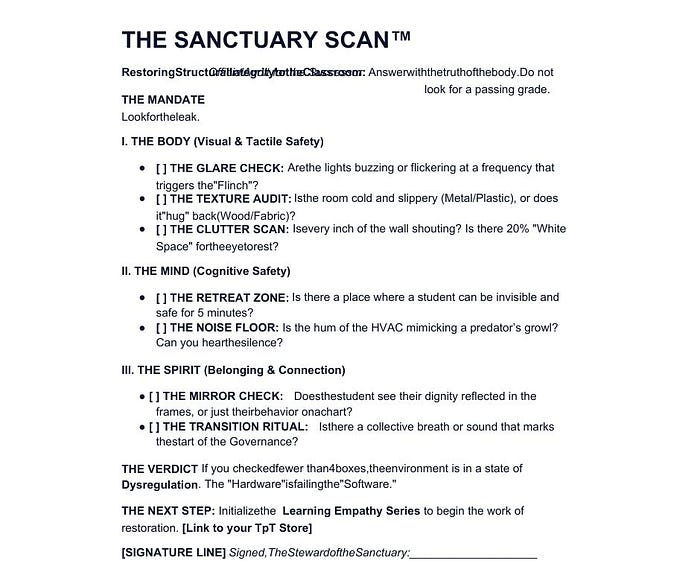
Is your environment — your home, your street, or your classroom — a Container or a Sanctuary? Use the Sanctuary Scan to identify the invisible sensory leaks in your space and initialize the protocol for restoration.
[ BUTTON: DOWNLOAD THE SANCTUARY SCAN ]
The Software is ready. It's time to install it in the streets.