


If you can't explain it simply, you don't understand it well enough
- Albert Einstein
I started working in the data science industry back in 2011 when nobody was interested in it. The first time I told my dad about my new job at a boutique analytics consulting firm, his response was — "But it doesn't even have a Wikipedia page".
Fast forward to about 15 years and everyone talks about analytics and data science. Every big firm has a data science team.
But do the people in the non-tech and business world understand data science?
In my experience, most have heard about it and throw the term around to sound like a tech wizard or math geek. Some even use it for self-deprecating humor to talk about their lack of mathematical or tech skills.
But data science is something we encounter all the time. Whether you are scrolling through social media or binge-watching your favourite show, data science is always working behind the scenes.
So, when my 15-year-old neighbour told me she was learning programming languages for data science at school, I asked her to research data science and explain it to me in simple words. What happened next blew my mind as she got back to me.
Data Science as Explained by Popular Blogs
If you Google "What is data science?" you'll likely come across definitions that sound fancy but don't really help you understand what it's about. Here are some examples.
The leading American management, strategy, and leadership education school, Harvard Business School explains data science as follows in this article:
Data science is the process of building, cleaning, and structuring datasets to analyze and extract meaning. It's not to be confused with data analytics, which is the act of analyzing and interpreting data. These processes share many similarities and are both valuable in the workplace.
Data scientists often write algorithms — in coding languages like SQL and R — to collect and analyze big data. When designed correctly and tested thoroughly, algorithms can catch information or trends that humans miss. They can also significantly speed up the processes of gathering and analyzing data.

Here is how American multinational technology company IBM explains blockchain in their website blog:
Data science combines math and statistics, specialized programming, advanced analytics, artificial intelligence (AI) and machine learning with specific subject matter expertise to uncover actionable insights hidden in an organization's data. These insights can be used to guide decision making and strategic planning.
As you can see, the above explanations are full of technical jargon that can put any normal person to sleep. Most people would give up after reading a couple of blogs because of this very reason. It's not hard to see why data science may seem overwhelming to the average person.
Data Science Explained by a 15-Year-Old
Let's take an example of creating the perfect playlist for your next party and see how data science can help you do it better.
Step 1: Data Collection
You begin gathering all the information about music and playlists. It could be songs from past parties, the most up-to-date popular playlists, or playlists your friends provided. Or perhaps the popular tracks you came across while online.
You might also want to find out popular genres in your group, feedback on playlists from previous parties, songs that were played repeatedly on demand, etc.
Step 2: Data manipulation or organization
Once you have all the information ready, you can start grouping your songs so you can slice and dice them before finalizing the playlist. You are free to decide on categories based on what feels right. There are no rules here.
E.g. genres (pop, rock, hip-hop, etc.), moods (happy, lively, romantic, etc.), and tempo (slow, medium, fast). There could be other suitable categories to better organize all the information at hand.
This will help you get a broader picture of what you have and allow you to analyze it effectively, as explained in the next step.
Step 3: Data analysis
Now, you will begin observing what worked well and what didn't work as well in the past.
- Those upbeat songs with a fast tempo got everyone to the floor
- Certain songs are crowd favorites, so you can play them again after every 5–6 tracks to bring everyone back to dancing
- Some songs are so different, that they drain the energy from the room, so it's best to avoid them unless you want to clear the floor for a quick break
- ….
- ….
Make as many observations as you can so you have the opportunity to consider everything possible.
Step 4: Decisions
You will start creating your playlist once you have jotted down all of your observations.
- Add music that will keep the party fun and alive by incorporating a variety of genres and tempos.
- Mix in a few new tracks that fit the mood together with some of the most well-known ones.
- Keep some songs handy for when you want to take a break for other activities
This will help you come up with your ultimate playlist that has a higher possibility of doing well based on what you have learned from past parties.
Step 5: Feedback and iterations
After the party, review how everything went and ask a few friends for feedback.
- Did people seem to enjoy it?
- Were there particular songs that worked well?
- Were there moments when people appeared bored? Which songs were playing at that time?
- More feedback
- and some more…
Based on the feedback, you can keep improving your future playlists. It will also improve your knowledge over time and you can help your friends do the same.
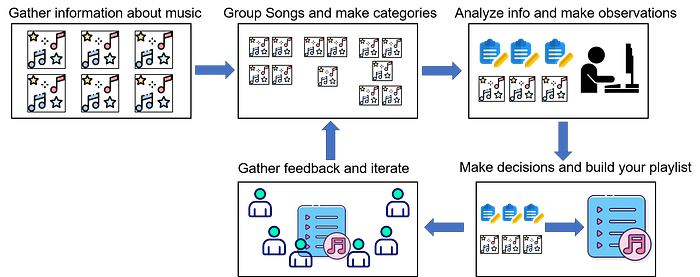
In essence, data science is all about going beyond guesswork or intuitions and making informed decisions. Instead of creating your playlist based on subjective calls or just picking a ready-made one, you used what you had to come up with something more relevant to you and your guests.
Data science is for everything
Being a data science professional, I've always been fascinated by pattern identification and the use of data in day-to-day life. That's why when I quit my job and transitioned to health coaching, I implemented the data science process for coaching clients. Here's how one can apply that to improve their fitness.
- Start with a long-term goal, such as losing inches off your waist, building muscle, or improving health stats
- Get a blood routine done, including tests like lipid profile, hemoglobin (HB), and other key health markers. Keep a detailed food and movement journal for two weeks, noting everything you eat and drink, along with any casual walks, stretches, and exercise. Be as specific as possible when collecting this information.
- After two weeks, review the information and make 1–2 small lifestyle changes, like going for a walk, doing 30 minutes of strength training, or adding two servings of vegetables to each meal.
- After 2–3 weeks, reassess and either adjust your current changes or introduce new ones.
- Continue this process as you progress toward your long-term goal.
- Seek guidance from a coach or have accountability partners to stay motivated and on track.
You can apply data science to almost anything, including your business. Even the statistics from your published stories provide valuable insights into your writing, help you understand your audience, assess SEO performance, and enable you to make adjustments for better results.
Final Thoughts
Data is the new oil and every time you google something, browse your social feeds, or buy something, you are sharing your valuable information. This data could be used for your benefit or against you, but I believe it is making the world a better place to live.
- It helps companies like Netflix and Amazon Prime to analyze user viewing history to come up with better recommendations for movies and TV shows.
- Uber uses Google Maps along with customers' activity history to determine the fastest routes, tailor promotions, and identify where drivers are needed most.
- Some hospitals can detect diseases early and even predict which treatments will work best for patients, thanks to data science.
From helping banks assess creditworthiness to supporting companies in finding the right marketing strategies to saving lives in hospitals, data science is a game-changer in nearly every industry.
Thank you so much for reading. If you like my work, please subscribe!
If you enjoyed reading this, check out Why the Upcoming Web3 and Crypto Mega Bull Run Will Catch Everyone Off Guard