

An Open Letter to Intuitive Surgical's Chief Legal and Compliance Officer, Mr. Gary H. Loeb, Regarding Potential Adulteration and Misbranding of the da Vinci 5 Robotic Surgical System
I am publishing this letter publicly on Medium.com so that patients, surgeons, hospital leaders, regulators, investors, and the broader public may understand the gravity of the situation facing Intuitive Surgical and the da Vinci 5 Surgical System (Model IS5000).
Your company's own December 2024 customer notification letter (MAT06450 v1 US 12/2024) constitutes a clear, written admission of a foundational product defect: the da Vinci 5 platform is intrinsically vulnerable to foreseeable external power fluctuations — events that are routine in clinical environments (severe weather, emergency generator testing, grid instability, wall outlet disturbances). These fluctuations can repeatedly interrupt power, damage critical circuit boards, prevent system booting, and cause prolonged intra-operative reboot delays requiring field engineer replacement, as desribed in the Intuitive letter.
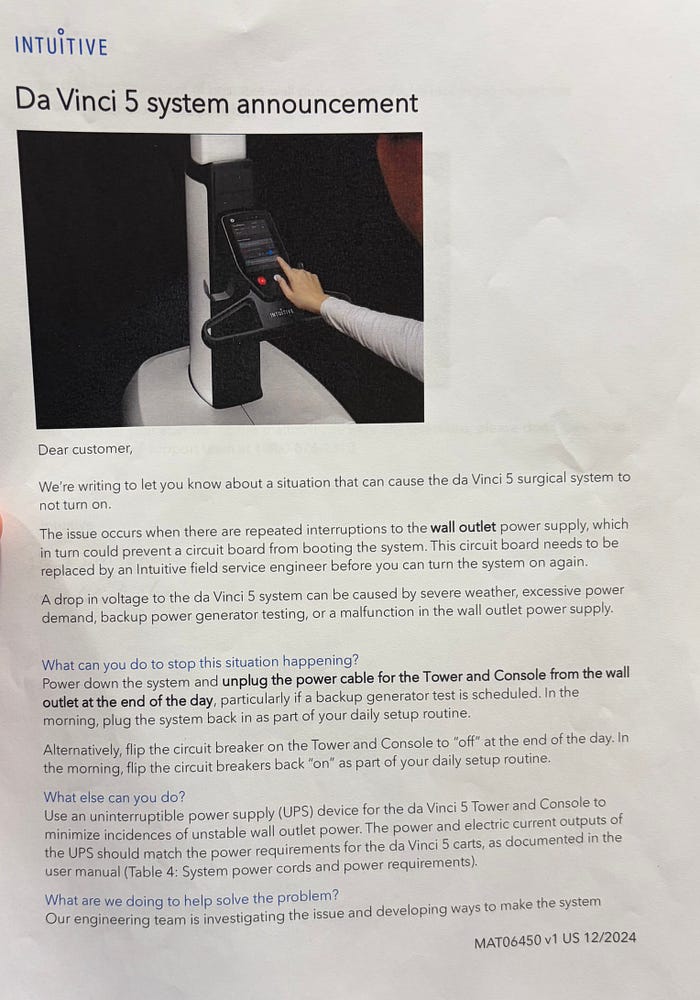
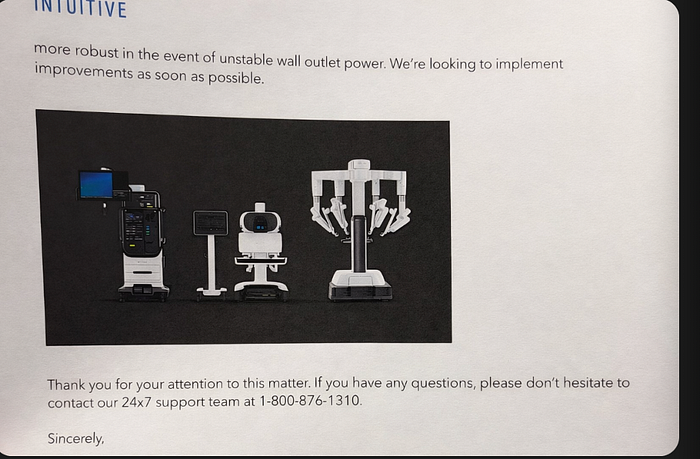
As you know, the da Vinci 5's unified tower architecture integrates the vision system, E-200 electrosurgical generator, carbon dioxide insufflator (with smoke evacuation), and other core electronics into a single power-dependent unit (FDA 510(k) clearance K232610). There is no isolated power circuit for the insufflator. A significant power interruption to the tower therefore affects the entire platform, including active insufflation, risking rapid pneumoperitoneum collapse, surgical blindness, and powered instruments remaining intracorporeal near major vessels and organs.
The company's sole response in the 2024 letter is to recommend extrinsic, user-dependent mitigations: daily power-down/unplugging of the Tower and Console, circuit breaker cycling, or installation of an external uninterruptible power supply (UPS) matched to precise specifications. These measures do not correct the defect; they transfer the burden of risk mitigation — and potential liability — onto hospitals, operating room teams, biomedical engineering departments, and administrators.
It is understandable why the company's CEO and corporate executives may want to underplay the magnitude of this problem: acknowledging the full scope of an intrinsic, foundational defect would likely require significant engineering redesign of the unified tower architecture, new regulatory submissions (510(k) or PMA supplement), extended validation testing, production halts, substantial costs, potential revenue impact from fleet grounding, and reputational risk. Choosing to rely on extrinsic mitigations and procedural workarounds appears to be a lower-cost, lower-regulatory-burden path in the short term.
However, as the company's General Counsel, you have a legal and ethical professional duty under the Model Rules of Professional Conduct (Rule 1.1 competence, Rule 1.3 diligence, Rule 1.4 communication) and under the broader obligations of in-house counsel to ensure that Intuitive Surgical complies with its statutory duties under the Federal Food, Drug, and Cosmetic Act. This includes a duty to magnify — not minimize — the magnitude of this defect to senior leadership, the Board, and regulatory authorities so that it is properly solved rather than managed through liability-shifting workarounds. The company has a statutory duty to ensure that every da Vinci device distributed in the United States is not adulterated or misbranded and is safe under labeled conditions.
Under the Federal Food, Drug, and Cosmetic Act:
- 21 U.S.C. § 351(a)(2)(B) defines a device as adulterated if it fails to conform to current good manufacturing practice. 21 CFR § 820.30 (design controls) requires validation that devices are safe and effective under reasonably foreseeable conditions of use, including typical power variability in clinical settings. Reliance on extrinsic mitigations instead of intrinsic controls (redundant power pathways, seamless failover, rapid recovery mechanisms, or onboard battery bridging) constitutes nonconformance with CGMP design requirements.
- 21 U.S.C. § 352 defines misbranding when labeling is false or misleading in any particular (§ 352(a)) or fails to bear adequate directions and warnings for safe use (§ 352(f)). The current da Vinci IFU does not mandate or warn about external UPS protection for this known hazard, nor disclose the risks of circuit board damage, boot failure, or intraoperative loss of visualization/insufflation. If UPS is necessary to prevent serious harm — as the 2024 letter implies — the labeling is inadequate and potentially misleading.
The defect also contravenes ISO 14971:2019 (FDA-recognized consensus standard): power interruption is a foreseeable energy hazard (Clause 3.3) and hazardous situation (Clause 3.4). Clause 7 requires intrinsic risk controls over extrinsic/user-dependent ones. Persistent MAUDE reports document ongoing power-related failures, reboots, vision/control loss, and complications.
Continuing to market the da Vinci 5 without intrinsic correction of this foundational defect or updated labeling that discloses the power vulnerability and requires UPS protection for safe use exposes Intuitive to significant regulatory, civil, and reputational liability.
I respectfully but formally request that Intuitive Surgical, Inc. immediately:
- Acknowledge the foundational, intrinsic nature of the power failure defect and cease shifting mitigation responsibility to user facilities.
- Voluntarily notify FDA of the defect's scope, the inadequacy of extrinsic mitigations, and the labeling deficiencies.
- Propose corrective labeling to the IFU that discloses the risk and mandates UPS protection for safe use.
- Ground or quarantine affected systems fleet-wide pending implementation of an intrinsic fix validated and cleared by FDA.
- Provide the intrinsic correction (redundant power pathways, seamless failover, rapid recovery, onboard bridging) to all customers at no cost, with accelerated deployment timelines and public reporting.
I remain available to discuss this matter and provide additional documentation — and sincerely hope that you will act decisively in the interest of correcting this defect and ensuring that da Vinci robotic systems are safe and legally compliant.
This letter is published publicly for transparency and in the interest of patient safety.
Sincerely,
Hooman Noorchashm, MD, PhD President, Harmed Americans for Reform in Medical-Device Safety Corp.