

The year was 1947 and Mano Majra was different now. The whole country wasn't the same anymore. Indians were so afraid and skeptical about change, that they found even their freedom a challenge, a mortal dare. When the Partition of India was announced, little changed in the close-knit village of Mano Majra. Harmony persisted for a while between the Muslims and the Sikhs. Until an act of violence broke the trance of the sleeping community, and they were stirred to restlessness.
Khushwant Singh's novel 'Train to Pakistan reimagines the flurry of activities that must have taken place as the country was wrecked by the blow of partition, through the lens of a small village called Mano Majra. I have meant to read this book for a very long time, but I am grateful to my procrastination that I waited for the book to come to me, at the right time.
Tragedy in Mano Majra, in the perusal of Partition upheavals, doesn't unfold because of inflicted communal hate but because it had become a necessity, to act in a certain way. To act in haste, with hate because it was expected of a Sikh or a Hindu, to exhibit blood wrath towards Muslims. Suddenly it has become the duty of certain communities, to guide, either through words or by force, the other community towards their rightful country, because Pakistan was not given, it was demanded, it was taken by a certain elite and educated group of people. And suddenly a sentence was passed upon those who were mere simpletons and had no relation to politics or the national struggle for independence, even minutely.
Singh criticizes the sheer anarchy of education, the paradox of thought it maligned history with, when knowledge, as Foucault said, ensnares Power in its shelter, it becomes something volatile, ensuing anarchy and force upon those who don't process it. The simple people of Mano Majra uphold the educated with an iridescent bemused stare of a criminal, who uses knowledge as a weapon to wretch peace.
Tragedy unfolds in episodes. Tragedy knocked on the doors of Mano Majra gradually, seeking vengeance. As a reader, I was a bit bored by the languid pace of the novel. But later I realized that the writing mimics the languishness of the community of Mano Majra, depicting its unique unprudishness and obliviousness. It was the trains that measured the days of this village, and it was the trains, laden with dead, blood-dripping bodies, coming from Pakistan which eventually claimed the peace of this village.
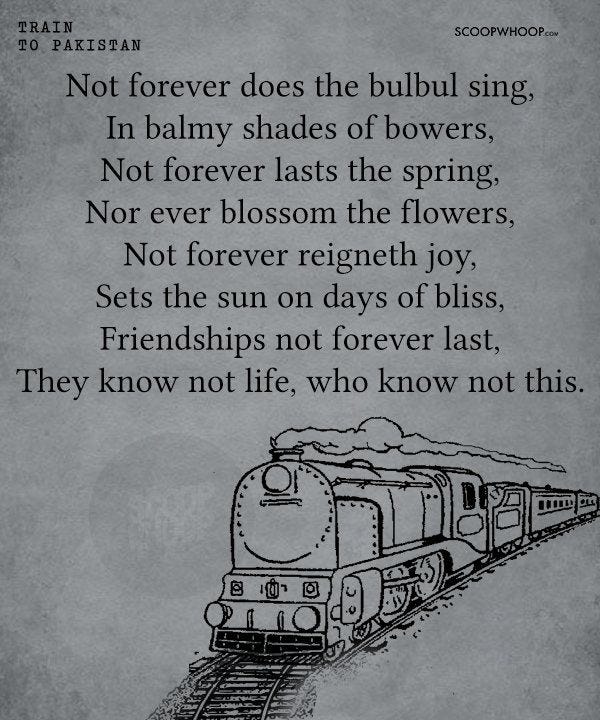
The trains come to Mano Majra, exactly like trains shouldn't, slowly and quietly as if counting a death note. Singh heralds the bloody history which marks the villainious part of the Partition, when the innocent migrants coming and going to both sides, were brutally murdered, raped, maimed, and looted, an event which forced politicians to believe in the wrongness of Partition, cursing those who ever thought of implementing such a thing.
At the heart of the novel, lies a love/lust story, between a Sikh and a Muslim. The twist which comes at the end of the novel, stamps upon the importance of love, that it is unquestionably the greatest thing in the world, beyond hate, respect, or wealth. Jugga gives up his life to save hundreds who were destined to fall prey at the mouth of vengeance.
But from the side of India, no ghost trains reached Pakistan. But that doesn't mean that Indians weren't thirsty for blood. They weren't Indians or Pakistanis, during the Partition, they were Musalmans and Sikhs, a representative of the faith of those who relished in spilling the blood of innocents.
I am very interested in the Partition from a research point of view and I think Singh's 'Train to Pakistan' plays a prominent role in analyzing the dreadest and bloodiest part of history, making us what we are today. I can never dare to rate this book, I am in awe of it.
I am in awe of Mano Majra because hate wasn't in the heart of these people, unrest was inflicted upon them, by those who had blood in their eyes weapons in their hands, and evil in their mouths. It was outsiders who broke the harmony of Mano Majra, telling them how they ought to act. When one looks back and reads about Partition, one would realize that humanity fought for survival for a very long time, before it was swallowed whole by violence and mindless hate. But it does tell us, that as humans, not all of us failed to resist. We tried, but the trains kept on coming.