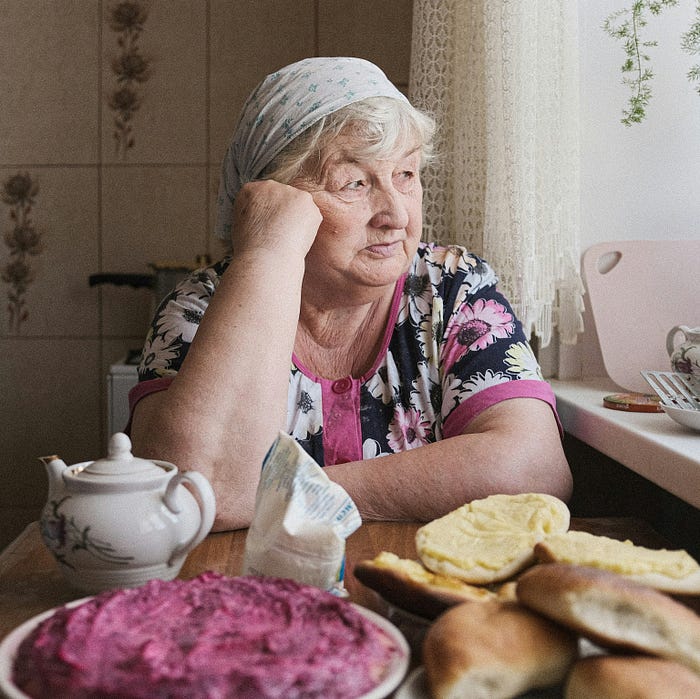


Growing up, my brother's favourite dish was called "Grandma's minced beef."
This wasn't some handed-down treasured recipe. This was ground beef in gravy from a can and is the only food I remember my maternal grandmother making.
As for my paternal grandmother, she was too busy working as a weaver in a north-England factory to spend much time in the kitchen. She was retired by the time I knew her but still, I never saw her cook.
The image of the "Cooking Grandma" — a woman whose grandkids have nostalgic memories of cooking or teaching them to cook — is baked (pun intended) into cultures across the world. As the editor of this publication, I see countless articles waxing lyrical about writers learning time-old recipes from a grandmother. Articles that celebrate the connection between food, family, love, and identity.
For those of you who had that experience, that's amazing and it should be celebrated.
But what happens if you didn't grow up like that? What if, like my grandmothers, yours couldn't, wouldn't, or didn't have the time to cook?
Are you missing out? Or are you simply one of the countless people whose Grandmother didn't fit our societally-approved mould?
If your grandmother wasn't a Cooking Grandma, you're not alone
Despite the ever-present grandmother-in-the-kitchen trope, there are studies and evidence for why you might not have had a Cooking Grandma.
One is immigration.
In her recent podcast Cooking in the Age of Infinite Recipes, Anne Helen Petersen of the brilliant Culture Study explains how immigration plays a part in the breakdown of heritage cooking:
They (immigrants) left behind the recipes that might have been passed down…as a mode of assimilation.
When researching this story, I spoke to my friend about his father's experiences, moving to the US from India as a 15-year-old boy. I asked him what his dad cooked during my friend's childhood. Was it Indian food?
No. It was all-American food. He tells me his father wanted to assimilate into American culture and that reflected in his cooking choices.
It also matters which country your family ancestors come from. Anne's podcast guest Lilah Raptopoulos talked about her husband's Irish family and their lack of passed-down recipes:
If you do ethnicity research you learn that the descendants of Irish immigrants don't have a lot of food traditions because they are descendants of the potato famine.
Or perhaps your grandmother entered the workforce so had less time to cook.
My paternal grandmother worked in a factory many hours a day. My father was a latchkey kid who had to make his own food whilst his parents worked.
This jives with the stats. From the 1950s, home-cooked food steadily declined as female participation in the workforce grew.
Aspirational cooking changed too. Gone were local ingredients. In were weird concoctions made from recipe cards and lifestyle magazines:
Their understanding of aspirational, middle-class cooking was to cook everything canned with recipes from Better Homes and Gardens…we're coming out of the depression…suddenly we have a dishwasher and we're expected to cook uniquely with cream of mushroom soup — Anne Helen Peterson, Culture Study
The 1960s through 1990s were a weird time for food, especially in countries like Britain and America. Handed-down family recipes may now be a source of pride, love and identity, but that wasn't always the case. Arguably, back then it was more aspirational to own a microwave — they weren't cheap — than it was to slave for hours over a pot.
That was certainly the case for both of my grandmothers.
Perhaps it was with yours too but of course, perhaps not. The above are generalisations and won't apply to everyone. The issue is nuanced.
But one thing is for sure. In my case, sometimes I feel like I'm missing out on something. I don't have those nostalgic memories of my grandmother cooking in the kitchen with me, teaching me her family recipes.
Other times I wonder if it's a bad thing. Because perhaps our grandmothers want to be remembered for more than their cooking credentials.
Surely there was more to them than how well they could roast a chicken.
Women are more than cooks
It's no surprise that if your grandma was a Cooking Grandma, that is what you remember about her. Food is evolutionarily designed to trigger memories. If you loved your grandmother and she cooked you something delicious, your brain will associate the two.
But there was probably more to your grandmother than her cooking.
I have a third grandma — my grandmother-in-law. I've known her for 20 years which is much longer than I knew my related grandmothers. Whilst my grandmother-in-law can bake a few fantastic desserts, she's not what I would call a Cooking Grandma.
But she is a force. She is intensely political. Her father was a bigwig in labour unions. Another relative was the secretary to suffragette Emmeline Pankhurst.
When she dies, I won't remember her for her cooking. I'll remember her for her intelligence, wit and political kudos.
The identity of the Cooking Grandma might be nice for us as their grandchildren but — unpopular opinion alert — it can do the dirty on the women themselves. Women whose identities and personalities should encompass more than what they can cook.
Or if they can cook at all.
There was probably more to your grandmothers than their food and it's tragic if they are not remembered for anything other than that.
Because there is more to love and identity than cooking and food. Families can have other traditions. Women can have more facets to their personality than what they cook.
In fact, they must.
Cooking Grandmas out. Cooking People in.
Don't get me wrong, I love the idea of handed-down family recipes. But I don't think it should always be the grandmother doing the handing down.
The chances are, this will change in the future anyway. Women may still do the lion's share of cooking for the household, but more men know how to cook now than ever before.
The nuclear family may still have a stranglehold on how we think of family — complete with grandparents — but the composition of households is changing. In 50 years time, someone could have four grandfathers but no grandmother.
You could be taught how to cook by your father. Uncle. Aunt. Unrelated family friend.
Or indeed, TikTok.
As people have children later in life, you may not know your grandparents at all. Or they may be too old to be able to cook for themselves, never mind teach you.
My maternal grandmother died when I was 11. In part, "Grandma's minced beef" was only on my brother's radar because she was too old and tired to cook much else.
Times are changing but that doesn't have to be considered a bad thing. It's just different.
And for those of us without Cooking Grandmas, perhaps it will make us feel less like we missed out on some important part of childhood.
Rooted stories are for entertainment purposes only and should not be considered as nutritional, health or any other sort of advice. And if you're looking for more great reads, check out Sista Publications, Rooted's umbrella pub.