
In this article, we will cover the topic of infinite series. We will start out by showing the notation for an infinite series and after we will handle the subjects of divergence, convergence, and absolute convergence. If you are not already familiar with sequences and limits, then I recommend you to read these two articles first: 'Finding Your Limits' and 'An Introduction to Sequences'.
The Notation
Let us first try to understand what is meant by an infinite series. To do so, we will first need to consider a sequence. Let us imagine that we have the following sequence:

This means that our sequence runs from one and until infinity. We can then say that we have:
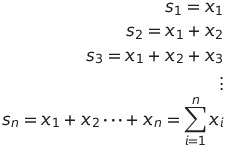
Here, the s_n are called partial sums. We also notice that they form a sequence! The sequence can be written as:

So, what if we want to take the limit of this sequence of partial sums? This can be written as:
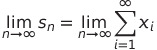
We can then say that

is our infinite series.
Convergence and Divergence of Infinite Series
One important thing to note is that if our sequence of partial sums, i.e.,
is convergent, then our infinite series is convergent as well. This also implies that we can say:
The same can be said for divergence — if the sequence of partial sums is divergent, then the infinite series is as well.
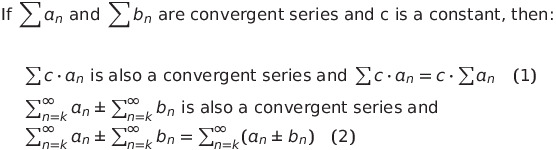
We can also present two properties concerning infinite series and their limits. They are the following:
Let us take an example of finding out whether a series is convergent or not. Let us imagine that we have the following series:

To find out whether a series converges, we need to know if the sequence of partial sums converges. It can be hard to find what the sequence of partial sums is, but the one above is a well-known one. It is defined as:
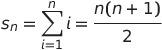
We will need to find the limit, which can be written as:
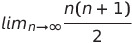
It is not difficult to see in this case that it diverges towards infinity. Hence, since our sequence of partial sums diverges then so does our infinite series.
Absolute and Conditional Convergence
We can also talk about a stronger type of convergence, which is called absolute convergence. We have the following definition:


It is important to note that if a series is absolutely convergent then it is also always convergent. We will need to know more about geometric and harmonic series, as well as the integral test before we can see some examples of how to test for absolute and conditional convergence. This will be covered in the next few articles.
Conclusion
We have now seen the notation for infinite series and how we can find out whether a series converges or diverges. We also briefly covered the subject of absolute and conditional convergence. Before we can continue with examples, we will first need to cover other subjects such as geometric and harmonic series, and the integral test in the coming articles.
References
- Dawkins, P. (2003). Section 4–4 : Convergence/Divergence Of Series. Pauls Online Math Notes. https://tutorial.math.lamar.edu/Classes/CalcII/ConvergenceOfSeries.aspx
- Dawkins, P. (2003). Section 4–3 : Series — The Basics. Pauls Online Math Notes. https://tutorial.math.lamar.edu/Classes/CalcII/ConvergenceOfSeries.aspx