
When many developers hear CQRS (Command Query Responsibility Segregation), they imagine a terrifying setup: multiple databases, message queues everywhere, and endless debates about eventual consistency.
That fear comes from a misunderstanding.
CQRS is not an on/off switch. It's a maturity path.
Most successful teams don't jump straight to "full CQRS." They move through levels as their application grows and pressure increases.
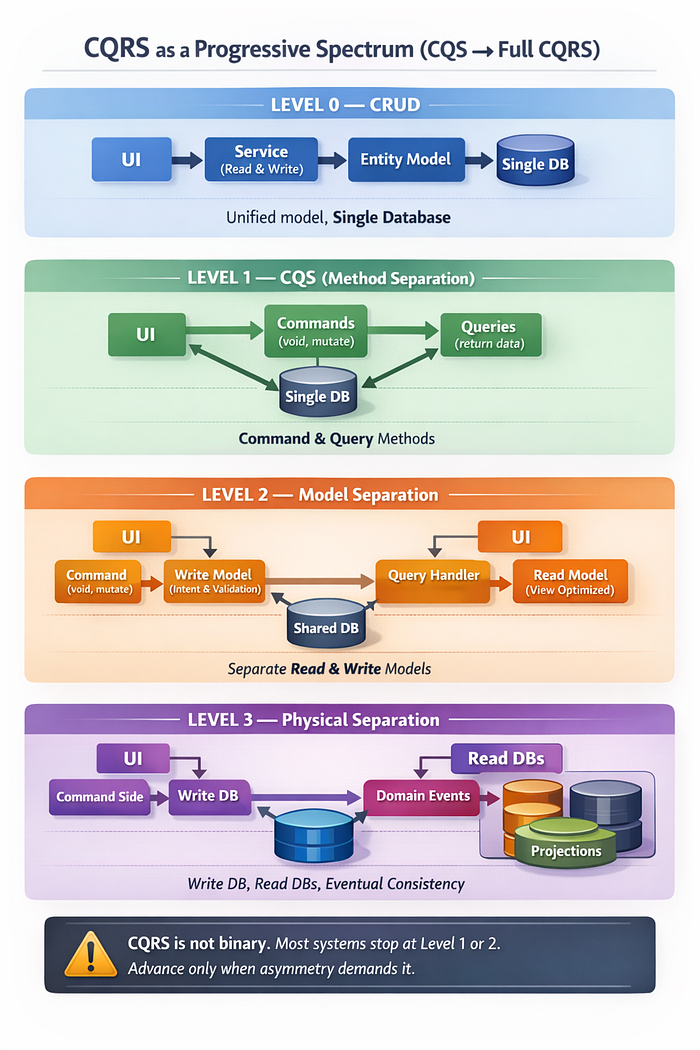
1. The Four Levels of CQRS Maturity
Instead of seeing CQRS as a mountain you must climb all at once, think of it as a series of levels. You move forward only when your current level starts to feel too tight.
Level 0: The Standard Way (CRUD)
In a basic application, one model does everything.
The same User class:
- saves data to the database
- validates passwords
- powers UI screens
The problem: As the application grows, this model turns into a God Object. Every new requirement adds another responsibility, making the code fragile and hard to change.
CRUD isn't wrong — but it doesn't scale well in complexity.

Level 1: Better Organization (CQS)
This is the first meaningful improvement — and it doesn't require changing your database at all.
You simply adopt Command Query Separation (CQS) in your code:
- Commands Methods that change state (Create, Update, Delete). They return nothing.
- Queries Methods that read data. They never change state.
The benefit:
You eliminate accidental side effects — like a GetProfile() call secretly updating a LastSeen timestamp. Code becomes easier to reason about and safer to refactor.
Many teams stop here and already see huge gains.
Level 2: Different Shapes for Different Needs
At this level, you stop forcing one data shape to serve every purpose.
- Write Model
Contains only what's needed to validate and perform a change
(e.g.,
Email,Password,Rules). - Read Model
Contains only what the UI needs to display information
(e.g.,
DisplayName,AvatarUrl,LastLoginDate).
The benefit: Your UI no longer breaks just because internal validation rules or database structures change. Reads and writes can evolve independently — even if they still use the same database.
This is where CQRS starts paying off heavily.
Level 3: The Pro Level (Physical Separation)
This is the "classic" CQRS setup people usually talk about.
- Write Database Optimized for correctness and integrity (often SQL).
- Read Databases Optimized for speed, search, or analytics (ElasticSearch, Redis, read replicas, etc.).
The trade-off: This level is powerful — but expensive. It introduces operational overhead, eventual consistency, and more moving parts.
Don't go here because it's trendy. Go here only when performance and scale demand it.
2. Intent vs. Data: Why the "Why" Matters
The biggest mental shift in CQRS is moving from data-driven updates to intent-driven actions.
In traditional systems, you often see generic methods like:
UpdateUser()SetStatus(Active)
These tell the system what changed — but not why.
In CQRS, we name the intent:
RenewSubscriptionApplyDiscountCodeApproveLoan
Why this matters: Intent-based commands read like business processes, not database instructions. They're easier to debug, easier to audit, and far more resilient when business rules evolve.
3. The Restaurant Analogy: Kitchen vs. Dining Room
If CQRS still feels abstract, imagine a busy restaurant.
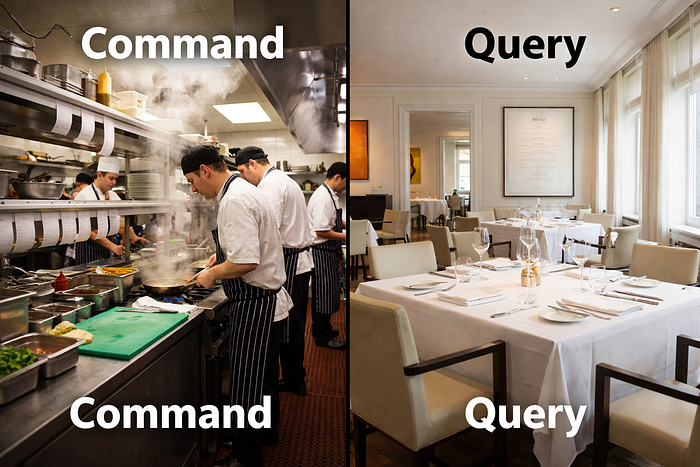
- The Kitchen (Command Side) This is where work happens. Orders follow strict rules. Safety, correctness, and sequence matter. You don't just grab food — you submit an order.
- The Dining Room (Query Side) This is about presentation and speed. The menu is easy to read and optimized for customers. No one needs to know how the stove works.
The kitchen and dining room are separate so each can excel at its job. CQRS applies the same idea to software.
4. Common Mistakes to Avoid (Anti-Patterns)
CQRS often fails quietly when teams recreate CRUD with extra steps.
❌ The "Do-It-All" Command
A command like UpdateEverythingCommand is not CQRS. It's CRUD in disguise. Commands should be small, specific, and intentional.
❌ The "Where's My Data?" Gap
At Level 3, read data may lag behind writes. This is eventual consistency.
Fix: Use optimistic UI, loading states, or "pending" indicators so users never feel the system is broken.
❌ Shared Models
Never share the same entity class between read and write sides. Shared models create tight coupling — changing one side breaks the other and defeats the purpose of CQRS.
Final Thought
CQRS is not a "better" way to code. It's a way to manage growing complexity.
- Small app? Stay at Level 0.
- Messy code? Move to Level 1.
- UI and domain pulling in different directions? Level 2.
- Performance pain at scale? Level 3.