How AI can transform authentication, authorization, and accounting in modern RADIUS-driven environments
By Bikram Maity
In most organizations, RADIUS is treated as a stable backend protocol — reliable, necessary, and rarely discussed outside network teams. But when AI is added to the picture, RADIUS can become far more than a traditional AAA layer. It can evolve into an intelligent decision engine for adaptive access, real-time anomaly detection, dynamic policy enforcement, and smarter user experience.
Why this topic matters now
AI is changing how enterprises think about security, operations, and user behavior. At the same time, RADIUS remains one of the most important protocols behind Wi-Fi authentication, VPN access, NAC systems, ISP subscriber control, hotspot platforms, and enterprise access management.
The opportunity is simple but powerful:
What if the RADIUS server did not just authenticate users — but also learned from patterns, predicted risk, adapted policies, and helped reduce operational failures before they impacted production?
That is where AI-powered RADIUS architecture becomes interesting.
What RADIUS already does well
Before talking about AI, it is worth remembering why RADIUS still matters.
A RADIUS server is built around three core functions:
- Authentication — verifying user identity
- Authorization — deciding what the user is allowed to access
- Accounting — tracking session start, stop, usage, and related events
In real environments, RADIUS often sits in the center of communication between:
- access points and wireless controllers
- NAS devices and broadband gateways
- captive portal systems
- LDAP or Active Directory
- billing engines
- policy servers
- logging and monitoring platforms
It is already the heart of access control. AI simply makes that heart smarter.
Where AI fits into a RADIUS environment
AI should not replace the RADIUS protocol. It should enhance the intelligence around it.
A practical AI-enabled RADIUS stack can help in five major areas.
1. Intelligent authentication decisions
Traditional authentication is usually rule-based. If the credentials are correct and the policy matches, access is granted.
AI adds context.
Instead of evaluating only username, password, MAC address, NAS IP, or VLAN mapping, the system can also evaluate:
- unusual login time
- impossible travel patterns
- sudden device changes
- repeated failed attempts across distributed NAS devices
- abnormal bandwidth requests
- unusual session duration trends
- deviations from normal user behavior
This allows the RADIUS layer to assign a risk score before completing authorization.
For example:
- low-risk login → full access
- medium-risk login → restricted VLAN or step-up challenge
- high-risk login → reject request or quarantine network path
That is a major shift from static AAA to adaptive AAA.
2. Dynamic authorization and policy personalization
One of the most powerful features of RADIUS is that it can return attributes in Access-Accept responses.
This means AI can influence real-time policy output such as:
- VLAN assignment
- bandwidth profile
- session timeout
- ACL selection
- captive portal behavior
- vendor-specific attributes
- reauthentication timing
Imagine an ISP or enterprise network where AI studies historical usage and automatically recommends or applies:
- higher bandwidth for high-value business users during office hours
- stricter throttling for suspicious traffic bursts
- temporary access profiles for guests showing unusual activity
- custom policies for IoT devices behaving outside expected norms
Instead of one fixed rule for all users, access becomes context-aware and behavior-aware.
3. Session anomaly detection using accounting data
RADIUS accounting logs are a goldmine.
Many environments generate huge numbers of Start, Stop, Interim-Update, Disconnect, and CoA-related records. Most teams use them only for reporting or troubleshooting after a problem happens.
AI can use this accounting data proactively.
With proper feature engineering, the system can detect patterns like:
- duplicate sessions
- session mismatch conditions
- stale sessions not closing properly
- unusually frequent reconnect storms
- failed disconnect loops
- rogue NAS behavior
- excessive retries to external authentication services
- billing-impacting inconsistencies
This is especially valuable in high-scale deployments where manual log analysis is too slow.
A smart anomaly engine sitting beside the RADIUS server can flag operational risks early and reduce both downtime and revenue leakage.
4. Predictive operations for high-load RADIUS systems
In many production systems, the biggest problems are not protocol-level issues but scale-level issues.
Examples include:
- thread pool saturation
- authentication queue buildup
- disconnect processor overload
- high CPU usage during peak login bursts
- retry storms against external services
- delayed accounting acknowledgements
- growing latency for Access-Request processing
AI can help here in a very practical way.
By learning from production telemetry such as:
- request rate by NAS
- reject rate trends
- external dependency timeout patterns
- queue depth
- CPU and heap pressure
- average response time by authentication type
…the system can predict overload before it becomes critical.
This enables actions like:
- autoscaling supporting services
- temporary rate shaping
- proactive alerting
- smarter retry backoff recommendations
- adaptive routing to backup authentication paths
- load-aware disconnection scheduling
For teams managing large subscriber bases or enterprise AAA clusters, this is where AI delivers direct operational value.
5. Automated root-cause assistance for support teams
Anyone who has worked with RADIUS in production knows that troubleshooting can become messy.
A single login failure may involve:
- NAS configuration
- shared secret mismatch
- LDAP latency
- expired user plan
- missing VSA mapping
- policy resolution bug
- database issue
- timeout to a third-party endpoint
- packet formatting issue
An AI assistant trained on logs, packet traces, configuration history, and common failure signatures can help support teams answer questions like:
- Why did this user get rejected?
- Why are disconnect requests timing out?
- Why is this NAS sending duplicate requests?
- Why is a specific vendor attribute not being returned?
- Why did session accounting stop for one device group only?
This reduces MTTR and makes RADIUS troubleshooting faster even for less experienced engineers.
A practical architecture for AI-powered RADIUS
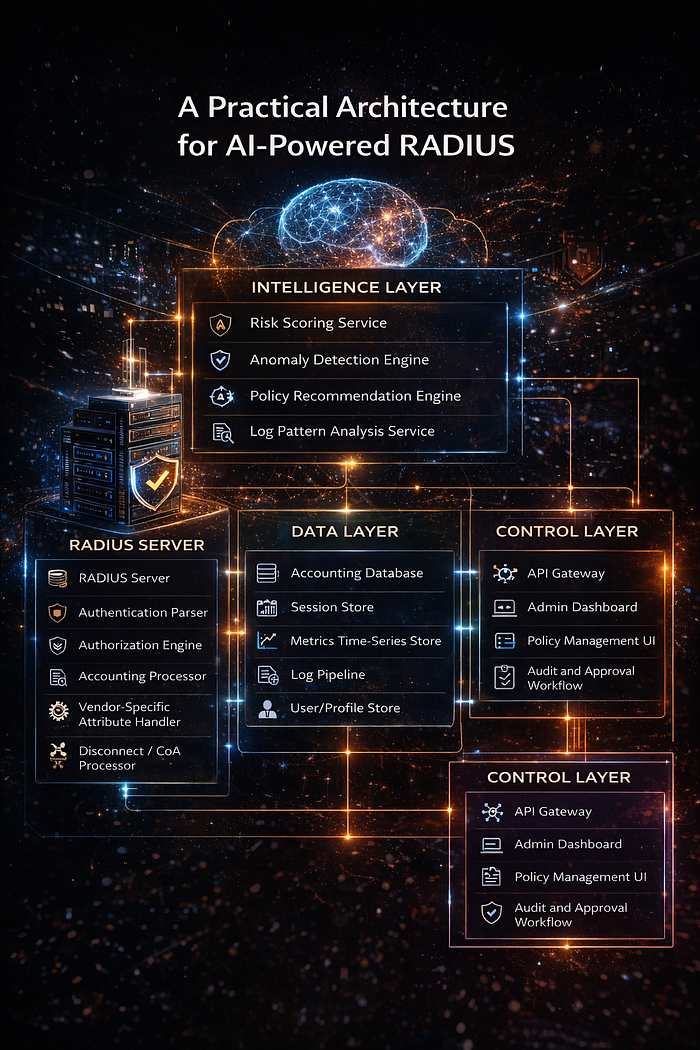
The best design is not to embed a huge AI model directly into the RADIUS core path. The safer approach is to keep the protocol engine fast and deterministic while letting AI services provide intelligence around it.
A practical architecture can look like this:
Core Layer
- RADIUS server
- authentication parser
- authorization engine
- accounting processor
- vendor-specific attribute handler
- disconnect / CoA processor
Intelligence Layer
- risk scoring service
- anomaly detection engine
- policy recommendation engine
- log pattern analysis service
- AI support assistant
Data Layer
- accounting database
- session store
- metrics time-series store
- log pipeline
- user/profile store
- NAS/device inventory
Control Layer
- API gateway
- admin dashboard
- policy management UI
- audit and approval workflow
In this model, the RADIUS server remains the execution engine, while AI acts as the analysis and decision-support layer.
Example use case: AI-assisted captive portal authentication
Consider a captive portal deployment for public hotspot or campus access.
Without AI, the flow is straightforward:
- User connects to network
- Captive portal collects credentials
- RADIUS validates the request
- Access profile is returned
- Accounting begins
With AI, the flow becomes smarter:
- User submits credentials
- RADIUS receives request and basic user context
- AI risk engine evaluates device behavior, timing, location pattern, and prior session history
- Policy engine recommends one of several access profiles
- RADIUS returns dynamic attributes accordingly
- Accounting updates are continuously monitored for anomalies
- Suspicious live sessions trigger CoA or disconnect recommendations
This creates a closed loop of authentication, observation, learning, and adjustment.
Benefits for enterprises and service providers
An AI-enabled RADIUS environment can deliver measurable benefits:
Better security
- detects suspicious access behavior earlier
- reduces blind trust in static credentials
- improves response to compromised accounts and rogue devices
Better user experience
- reduces false rejects through smarter policy evaluation
- enables more personalized access decisions
- improves consistency across multiple NAS vendors
Better operations
- highlights root causes faster
- predicts load problems before outages happen
- reduces manual analysis of logs and accounting records
Better scalability
- improves handling of high-volume authentication environments
- supports intelligent traffic and policy segmentation
- helps teams manage growth without linear increases in support effort
Important design principle: AI should assist, not destabilize
This is critical.
If AI is introduced carelessly into the authentication path, it can add latency, unpredictability, or false decisions. In AAA systems, reliability matters as much as intelligence.
So the right design principles are:
- keep the critical RADIUS path fast
- use AI scoring with strict timeouts
- fail safely to deterministic rules when AI is unavailable
- log every AI-assisted decision for auditability
- require human approval for major policy changes
- separate recommendation from enforcement when needed
In short, AI should enhance trust — not become a new point of failure.
The future of RADIUS is not old — it is intelligent
There is a common assumption that protocols like RADIUS belong only to legacy infrastructure. I think that view is outdated.
RADIUS still sits at one of the most important control points in the network: the moment where a user, device, or session asks for access.
That moment is exactly where intelligence matters most.
When AI is applied carefully, RADIUS evolves from a protocol server into a smart access platform — capable of understanding context, detecting abuse, optimizing operations, and improving how networks make real-time decisions.
The protocol itself may be old. The possibilities around it are not.
Final thoughts
AI and RADIUS are not competing ideas. They are complementary.
RADIUS gives structure, control, and proven AAA foundations. AI adds adaptability, visibility, and predictive intelligence.
Together, they can help build authentication systems that are not only secure and scalable, but also aware, responsive, and operationally smarter.
For engineers working in network access, AAA systems, captive portals, enterprise authentication, or ISP-scale subscriber environments, this combination is worth serious attention.
Because the next generation of access control will not be defined only by who logs in.
It will be defined by how intelligently the system understands that login.