
Back in my day, it used to take discipline and skill to shoot well. Totally not bragging, but I could shoot the lips off a cockroach at 300 meters.
And while it did take some natural talent — we had people get kicked out of basic training because they simply could not shoot well — a soldier's natural talents are further refined by skills gained from constant shooting practice.
We shot so much that I still have hearing loss in my right ear — it turns out, putting cigarette butts in your ears for protection because you forgot your "foamies", doesn't quite grant the same level of protection.
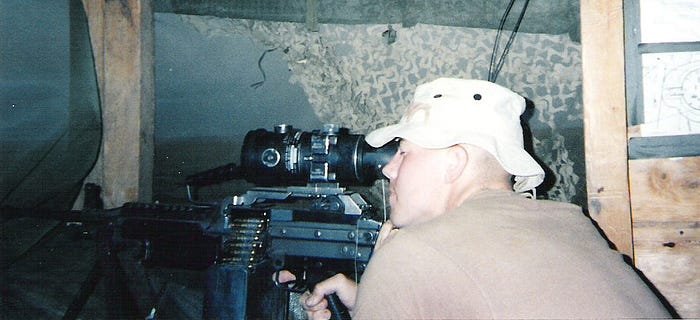
On the M4 range, the furthest targets were positioned at 300 meters. At that distance, the life-sized green plastic man-shaped targets were roughly the size of a pencil eraser held at arm's length.
Put that 300-meter target in motion, and things get even more difficult.
We weren't aware of it, but our brains would perform complex calculations: the percent of bullet drop due to gravity, wind direction, the relative speed of the target, direction of the target in two-dimensional space, the ambient temperature and humidity, our own breathing, and the barrel length of our rifles among other factors.
All of this was performed in under a second and helped us put a bullet in the same place where we thought the target would be.
But like many aspects of our modern lives, technology has largely removed the cognitive load.
Kids these days have the coolest toys…
As deadly consumer drones have made their large-scale debut in Ukraine, it quickly became clear that Ukrainian forces needed a technological solution.
Some of these solutions came in the form of "guns" that fire electromagnetic noise in an attempt to disrupt the drone's communication with its operator.
However, not every soldier is equipped with these anti-drone specialty weapons.
What every soldier is equipped with, however, is an assault rifle.
But shooting a small, flying drone, hundreds of meters away, that can move in 3D space, would be difficult or nearly impossible for even the most talented among us.
That's where the Smartshooter scope comes in.
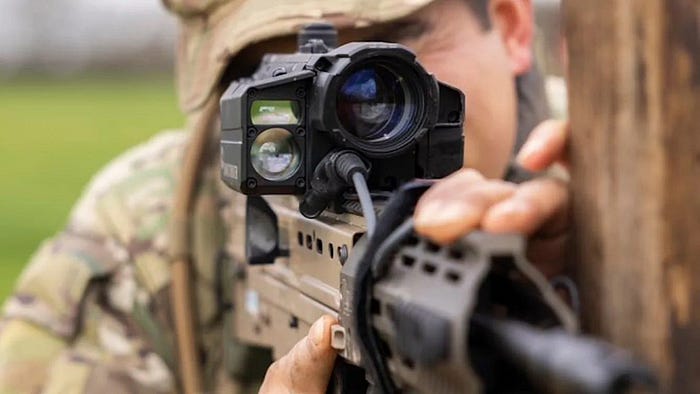
Officially called the SMASH system by Israeli company Smartshooter, this scope can be fitted to the tops of Western-style assault rifles.
It comprises a see-through optics sight where its onboard computer locks and tracks a target's movement in the sight. The system then places markers where it wants the soldier to shoot.
According to the Israeli weapons manufacturer, the system "provides kinetic protection against evolving C-UAS threats to dismounted forces by featuring built-in targeting algorithms that can acquire, track, and hit small drones."
The system is said to reduce the chance of misfire as it "only releases the trigger of the weapon it is mounted on if an optimum shot is possible. It even compensates automatically for wind.
So, the soldier identifies the target (independently or using the detection system guidance), locks on it, the system automatically tracks and then the user pulls and holds the trigger. The system synchronizes the shot release to ensure the target is hit.
According to the company, SMASH ensures a one-shot, first-round hit, day or night, while reducing engagement time. It has a 250-meter range during the day and a 100-meter range for night operations.
This rifle add-on ensures precise hit of moving targets, regardless of the soldier's level of training, including notoriously difficult-to-hit drones.
Back in 2022, an undisclosed number of SMASH systems has also been sent to Ukraine — a donation directly from Israel.
At the tactical level, every soldier in a standard Ukrainian infantry squad can't be expected to watch for drones. So, in the squad's view, it makes sense to assign a sort of "drone duty" to two or three soldiers while the rest perform their ground-level mission.
Once a drone is spotted, directions are called out, and every squad member, equipped with SMASH, would then combine fire on the incoming drone.
The SMASH system also works against human targets — which, by the way, is a terrifying thought if you're the one being targeted.
This makes shooting an enemy in close proximity to civilians safer, and far less likely to accidentally hit civilians. It would also presumably help prevent blue-on-blue or friendly fire incidents.
In the infantry, when we were expected to move under fire, we would stand up, sprint, and lay down in the time it takes to say the words "I'm up, he sees me, I'm down."
We did this to minimize the time that we were fully exposed to an enemy looking for something to shoot at.
In this new era of tech targeting, the fundamental way that an infantryman moves at the individual level may need to be rethought.
I suspect smoke grenades to obscure optical targeting will make a big comeback. The Smash X4 doesn't appear to have infrared capabilities yet, but that's an easy upgrade.
I reached out to my contacts in Ukraine to ask how these scopes were performing against drones on the battlefield.
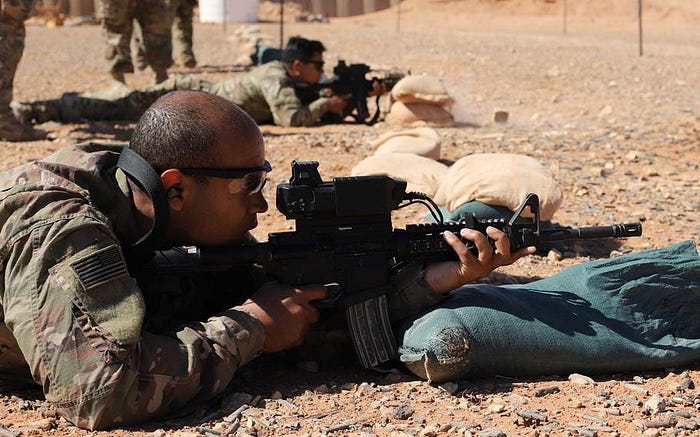
The answer? They perform extremely well. There's just not enough to go around. It's not clear if this is an issue with cost, or manufacturing capability by the Israeli company.
Ideally, every Ukrainian squad would have at least one smartshooter scope.
Smartshooter hasn't disclosed the price of the Smash system, but we can do some simple math to estimate the cost.
In July, the British armed forces announced a deal worth $2 million to purchase 500 Smash systems for the British Army.
Let's see, carry the one…

That puts us at roughly $4,000 per scope. But of course, that's not counting training, spare parts, demo units, all the things.
Even if they were $10,000 a scope, that would still be a pretty good deal as far as (smart) optics go. Those things can get pricey, even (dumb) optics for civilians, like hunters or sport shooters can be in the thousands.
The British Army expects to start fielding their Smartshooter scopes by the end of 2024. That's now.
Still, I can't help but feel a little sad for the end of an era — where the raw talent or basic skill of shooting accurately is now outsourced to technology.
Not to be outdone, the US Army's 2025 budget request includes $13.5 million for hand-held anti-drone devices to equip a full division. A large chunk of this money is earmarked for Smartshooter's SMASH system.
And as always.
Glory to Ukraine.
Glory to the heroes.
Слава Україні