
The views expressed in this essay are my own and do not represent my employer or any organization I am affiliated with.
I was twenty-two when I tested positive for HIV, in March 2008. PrEP did not exist yet. U=U had not yet given us better language.
I was a college dropout living with my fraternity brothers in an apartment in Davis, dating a few men I loved, working a 4:30 AM shift at a bagel shop. I had no insurance, no plan, and no idea how to be a person who had this.
What I had was a diagnosis I thought was a death sentence and a community that, in some of its loudest corners, told me I deserved it.
This is the story of what kept me alive when I thought my life had narrowed to one word: positive. It is also the story of the people, programs, and systems that were imperfect but real. I did not know any of that then. I only knew the word, and what I thought it meant.
The Word Before the Meaning
The phone rang while I was sitting on my bed.
The bedspread was green. I had tapestries on the walls, mandalas, the kind every stoner had hanging in their bedroom. The light came through them sideways. That is what I remember.
One of the men I was dating was on the other end. He told me he had tested positive.
Positive.
The word landed before the meaning did.
I felt devastated for him first. That was the honest reaction, the human one. One of the men I loved was going through something terrible.
Then I felt the thing underneath that.
I was going to need to get tested. I was already afraid of the answer.
We were not exclusive. We were not always using condoms. We were doing what a lot of people our age at that time were doing, which was loving each other with whatever we had.
I do not say that to excuse it. I say it because it was true.
The drive from Davis to Woodland is twenty minutes. I made it in less than fifteen.
I cannot remember if I cried in the car. I cannot remember if I had music on. What I remember is that I could not go to the student health center at UC Davis because I had dropped out, and Planned Parenthood Mar Monte in Woodland was the closest place that would see someone uninsured, broke, and already afraid of the answer.
I parked the car. I walked in. I asked for a rapid test. And I waited.
The nurse pulled me into a small room. She looked more nervous than me. She almost cried giving me the news.
She told me my rapid test had come back positive and that I would need to come back for a confirmatory test that week. She handed me a referral to a clinic in Midtown Sacramento and some resources I do not remember reading. She did not want to let me walk out of that room alone and asked if I was with someone.
I wasn't.
And I walked out.
I made it through the lobby, past the front desk, and across the parking lot to my little Honda Fit. I unlocked the door, sat down, and closed it.
And then I cried in a way I had never cried before.
I cried like something precious had been taken from me, because something had. I thought I was going to die. Everyone I loved had just become someone I would have to disclose to, and maybe someone I would lose. I was too young, unloved in my own mind, unclean in my own body, marked in a way I thought was permanent.
I am sick. I am going to die from this.
That is the inner voice I remember. It sat on top of me for a long time.
I did not know yet what treatment would make possible. I did not know there would be a life after this, full of work and people and love. I just knew the parking lot, the Honda Fit, and what that voice was telling me.
Eventually I started the car. I drove back to Davis.
What They Held, What They Could Not
I went home to my fraternity brothers, who were less equipped than loving, but loving all the same.
They stayed. They cried with me. And then, because they knew me, they decided the next move was to help me cope by passing a blunt around.
It was, for who I was at the time, the only good plan.
I told my girlfriends from college a few days later. We shared the same sadness I did with my frat. I was surrounded by people who loved me and yet I still felt like the only person in the world.
That is one of the strange things I felt about being newly diagnosed in a small college town, surrounded by other young people who had barely or not yet been touched by the hardness of life: a room can be full of love and still not reach the place where you are alone.
The confirmatory test came back positive a few days later.
I already knew.
Back then I felt marked. Diseased. Unclean. I thought I would never be loved or touched again without my body becoming a problem someone had to decide whether to accept. The medical fact of HIV was one thing. The cultural fact was another: overnight, I had become something my own community had been taught to fear.
I thought, naively, that the gay community would be the one place that knew better. The community that had lost so many people it should have known what stigma costs.
It was not.
Grindr was new then. When it came into the picture, I put my status where people could see it. I was new to all of this. I thought it was the honest thing to do. I thought it would protect me and other people. Some quiet part of me hoped it might make me less alone.
What I got was messages.
Taking loads got you AIDS, huh?
You clean or dirty?
Messages from men whose faces I could see, whose names I knew, who looked like me. Men who, in another version of the same week, could have been calling someone else from a bedroom in Davis.
They told me I had earned this. They told me I was disgusting. In language I will not repeat here because I do not want to put it back into the world, they told me exactly what kind of person I had become by getting sick.
I read those messages. I closed the app. I opened it again. I read more.
I was already "sick." And now I was reading, in real time, what some of the loudest voices in my own community thought of me.
I should have known better.
I should have been more careful.
I am dirty.
I am a risk.
That is what stigma does to you. It does not stop at the door. It breaks in, takes the words you read and hear, and turns them into the things you start saying to yourself when you cannot sleep.
I do not know how many people went through that same cruelty in those years, alone in bedrooms or cars or parking lots. I know I was not the only one. I know some of them did not make it through.
I made it. Some days I am not entirely sure how.
What I know now is that the cruelty I experienced from gay men then is one of the things I am still in recovery from, and every so often, some ignorant piece of shit still finds his way into my messages. The medicine could bring the virus under control. It could not undo what people had taught me to believe about myself.
Places to Put the Grief
The clinic in Midtown Sacramento was CARES Community Health.
I started to come back to myself there.
One of the nurse practitioners who cared for me in those first appointments would eventually become a friend, a mentor, a colleague, and, when my own mother was eight hours away and getting sicker, a kind of mother to me too. I did not know then that she would stay in my life long after the appointment ended. She taught me what care could look like when it was done right, and showed me what I would later try to build.
They invited me into a newly diagnosed support group. It met weekly. It was too sad for me, and I was terrible at expressing my feelings with the spoken word. I did not last long in it. But for a few sessions, I sat with people who had heard the same words, cried in their own parking lots, read the same kinds of messages, and entered this new life with no map.
We did not have to explain anything. We just had to be in the room.
For a few sessions, the group gave the grief somewhere to sit.
Later, in social work school, I would learn to call that a container: a place to put grief so it did not have to live everywhere at once.
A little later, CARES had a program called Positive Speakers. They trained newly diagnosed people to tell our own stories to audiences. Schools. Health departments. Community groups. They taught us that what had hurt us could still be useful, if we learned how to carry it into a room without handing people the whole wound. They taught us how to enter a room as positive people and leave having changed how a few people in that room thought about us. I learned the power of storytelling.
I went through the program. I told my story to rooms of strangers.
Writing became one container I already had. The newly diagnosed group was another. Positive Speakers was another. I have spent nearly two decades putting versions of that younger self somewhere structured enough to see what survives the telling.
I did not know it then, but that program is part of the reason I am rewriting this essay now. The skill I learned then is the skill I am using here: how to take the worst thing that I had thought happened to me and put it into language without making it smaller.
Almost nobody knows the moment they learn the thing they are going to do for the rest of their life.
That was mine. I just did not know it yet.
I was healthy. My numbers were good. The protocol then was watch and wait, so I was not started on antiretrovirals right away. For a while, I was somebody who had HIV and took no medication for it, which was both medically appropriate at the time and psychologically strange.
I did not feel sick or look sick. I did not take a pill every morning that reminded me. The diagnosis lived in me quietly and mostly invisibly.
That, too, was its own kind of grief.
I am sick and I do not feel sick. What am I, then?
Before I had language for any of that, I signed up for AIDS/LifeCycle.
Seven days. San Francisco to Los Angeles. A few thousand riders, raising money for HIV services in California. I did not know anyone who had done it or whether I could do it.
I signed up anyway.
I was still working the early shift at the bagel shop. For months, I would clock out at one, change in the back, get on my bike, and train until six.
I raised the money. I threw a double kegger fundraiser party I am still a little proud of.
The morning of the ride, a few friends drove me to Cow Palace in Daly City for the departure. I had been to Cow Palace before, in my late teens, for massive raves. It was strange to be there for something completely different, with my bike, pupils undilated, at an hour of the morning I had only ever seen from the other side.
The ride took seven days. I made friends I still have. I took pictures on disposable cameras I found recently in a drawer. I want to digitize them, look at them slowly, frame by frame, and let those days come back as something other than a blur.
Nearly two decades is a long time to carry something without looking at it.
That first ride, I rode with Positive Pedalers. We were the riders who were openly HIV positive, in jerseys that said so, riding the same five hundred and forty-five miles as everyone else.
I don't know where I got the courage to live openly positive then.
Most of the men in the group were older than me. Some by twenty years. Some by thirty. They had survived the era that had killed most of their friends. They were riding their bikes through California with their status on their chests, their bodies in motion, and a kind of dignity I did not know was available to me until I saw it on them.
I had spent the year before in my bedroom reading Grindr messages telling me what I was. Now I was riding next to men who had been positive longer than I had been alive, and who were not what those messages said any of us were.
That is what they gave me. They did not have to explain it. Their bodies on those bikes said enough.
I did the ride a few more times after that, then joined the NorCal AIDS Cycle, a smaller ride based out of Sacramento. Eventually I joined its board of directors as the youngest member. I did not know what a board was or what a board member did. I learned by sitting in the chair and hoping no one noticed.
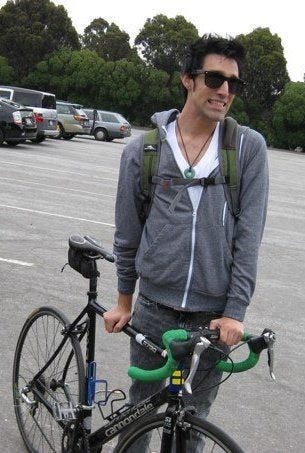
There was a photograph on the AIDS/LifeCycle website from one of those years, though it is no longer up. I am holding one of the many flags carried at the closing ceremony, the kind with handwritten names of people lost to the disease. I am looking out at something the camera does not catch. I remember feeling the weight of being permitted to carry those names, and the fear of seeing how many there were, the thought of mine being on that flag someday.
One year on the NorCal AIDS Cycle, the nurse practitioner who had cared for me after diagnosis rode it with me. So did the man I spent almost eleven years building a life with. We were three people who had met in three different chapters, all in the same jerseys, riding the same miles, raising money for the same cause.
I do not have a clean sentence for what that day felt like.
I have the photographs.
I want to say this part plainly because I do not want to make it into something it was not. These cycling events did not save my life. The community I found there did. The bike gave us somewhere to put our bodies while we figured out how to keep living.
The ride gave me one kind of family. There was another kind waiting for me off the bike.
Some of the women in my life became what I still think of as my Jewish sisters, not by blood, but by table, ritual, argument, and care. They made sure I had a place to sit, especially when the gay men on Grindr and in real life were saying the things they were saying. They cooked for me, argued with me, told me when I was wrong, and loved me when I was right.
They lit candles, poured wine, asked how I was, and waited for the actual answer.
They gave me a sense of family at the exact moment my own sense of belonging was the most fragile.
I am not sure I would have made it through that time without them.
I do not say that lightly. I do not think people survive things like this alone.
I owe them my life.
Family of Choice, of Circumstance
A few years after I was diagnosed, I met the first man I would think of as family.
We were together for seven years. He was negative. I was positive. We built a life in the ordinary ways first. Groceries. Rent. Bad furniture. The kind of peace I did not recognize as peace until later.
We had condoms, care, a lot of conversation, and not much else to go on. The tools we have now did not exist yet, so we figured it out the way people did then: imperfectly, in the dark, with love.
Eventually I went on antiretrovirals and my viral load became undetectable, not because anyone had told me what undetectable meant at the population level, but because we had decided together that the most protective thing I could do for him was to take a pill every morning.
He stayed negative the whole time.
I want to say that without turning it into a big win. I was lucky. We were lucky, and careful in a way I wish everyone in those years had been given the tools we had. A lot of people in those years did not make it work, and the difference was not love or effort or character. So much of the difference was access.
He has had his own hard seasons since. I think of him with deep love and fondness, not the careful kind, the real kind. He gave me peace. He gave me something I had never quite touched before him, and I have been measuring every quiet moment against it ever since.
His story is not mine to tell. But this part is: he was the first person who showed me that being loved without chaos was a thing that could happen to me.
We grew up together. And then, at one of the crossroads where growth happens, we grew apart.
After that relationship ended, I built another life with someone else, the closest thing I have ever had to a husband.
We were together for almost eleven years. He was also positive, and for the first time in my adult life, HIV was not the central negotiation between us. We were not navigating serodiscordance, and neither of us was protecting the other from the virus. The thing that had shaped every intimate relationship I had had since my diagnosis was simply, in our case, not the point.
We were just two men who happened to share a virus, the way some couples happen to share a hometown.
We had routines, inside jokes, shared passwords, and the quiet foundation of a life that starts to look permanent before anyone says the word.
I cannot fully describe what that did for me until I tell you what it did not require of me. I did not have to disclose, wait for a reaction, or wonder whether the person I was falling in love with was secretly weighing my body against the question of whether to keep falling.
I got to be loved without explaining the part of me I was used to explaining first.
Whatever we had to negotiate in that relationship was about us, not the virus.
That, too, is something the medicine, the science, and the history made possible. By the time we met, there were enough of us, with enough years of treatment behind us, that we could find each other and build a life where the diagnosis was background.
He rode NorCal AIDS Cycle with me one year. He showed up at the start line in his jersey, and we rode the route together. The man I was building a life with was also, that day, on a bike next to me, raising money for a cause we both cared about and had both been shaped by.
We grew, and eventually, at one of those same crossroads where growth happens, we grew apart too.
I am proud of both relationships. They were different kinds of love, arriving at different moments in my life. One asked us to love each other across fear, before the tools and language had caught up. The other gave me the quiet relief of being loved in a room where HIV was no longer the central fact. Neither ended in the kind of damage I would later learn was possible. We loved each other for as long as we could do it well, and then we stopped, with care and continued in harmony.
The Work That Became My Purpose
I did not decide after my diagnosis that I was going to become an HIV public health professional. The plot twist did not announce itself that way.
I became a volunteer first. I rode the bike, told my story for CARES, and sat on a board I did not understand. The work kept me alive before it became a calling.
After I moved from Davis to Sacramento, following the end of that first long relationship, I went back to school, worked with young people in South Sacramento, and eventually found my way to the Gender Health Center. I started as an intern, became staff, and helped build their HIV and healthcare services from almost nothing, quickly but thoughtfuly, the way you build anything when the people you serve are too marginalized to wait for perfect.
That is when the work stopped being only a way to survive.
At GHC, the work kept widening. I found myself inside research, PrEP implementation, and eventually legislative work at the California State Capitol. That was where advocacy became practical to me: hearings, bill numbers, committees, budget lines, and the long route between policy and care.
The Capitol is in the same neighborhood as CARES, now known by another name, where I had first learned how to care for myself. I walked into one as a patient. I walked into the other as an advocate.
That walk is one I have not stopped taking.
By then, I had started to understand HIV work not only as care, but as infrastructure and systems.
After graduate school, where my focus was Social Change and Innovation, I went to the state.
Today, part of my job is helping run the kind of safety net I once needed before it even existed. I help manage PrEP-AP and parts of the ADAP infrastructure, the programs and systems that turn policy, funding, medication access, and contracts into something a person can actually use.
The people I work with are not just team members on an org chart. They are the people beside me inside a complicated system, trying to make it more usable for the people it is supposed to serve. For those of us who are queer, this work is not only important. It is deeply personal. We know what late access costs. We know what cruel language does. We know what happens when systems are too hard to reach, and someone is left alone with a word they do not yet know how to survive.
Whatever I have helped build, I have built with their hands as much as mine. We work at the front line and behind the scenes, trying to make sure the next person who hears that word has more underneath them than I did.
That sentence took most of my adult life to earn.
I did not come to this work only because of what happened to me. I came to it because of the people who took care of me when it happened.
The diagnosis is where this started. The people are why it did not end there.
What Holds Me Now
The men I was dating when I tested positive are still in my life. Not in the same arrangement or relationship, but still in each other's worlds. And the closest thing I have ever had to a husband, he is still my best friend.
One of those men I was dating early on messaged me recently on social media, after a heartfelt post of mine. He reached out with kindness and told me it was good to see me beginning to let go of something that had held me for a long time.
I do not know which of us gave it to the other. I have never known, and I am not going to know. Because it does not matter. It was never about blame. It was what it was.
What I know is that what felt like the worst thing that ever happened to us, when we were young and in love and without the tools we would have used if they had existed, did not end us.
We are still here, still in each other's lives.
I got the diagnosis in that Woodland clinic. I am rewriting this now from pieces of raw journal entries and old photographs.
The young man in the Honda Fit thought he was going to die young. He thought no one would love or hold him again, that no one would ever reach for him.
He was wrong. Not immediately, not cleanly, and not without years of proof. But he was so wrong.
I am forty years old, 18 years and 1 month since March 19th, 2008. That young man would not have believed I would get here, surrounded by love, helping keep a safety net wide enough for someone like him to fall into and thrive.
Alej Contreras (he/they) is a social worker and public health professional based in California. The views expressed in this essay are his own and do not represent his employer or any affiliated organization.
If you are in California and need help accessing HIV treatment, PrEP, PEP, medication coverage, or related services, support is available.
For people living with HIV, California's AIDS Drug Assistance Program, or ADAP, helps eligible Californians access HIV medications and related medication coverage support through certified enrollment sites.
For people seeking HIV prevention services, California's PrEP Assistance Program, or PrEP-AP, helps eligible Californians access PrEP, PEP, and PrEP-related medical services through participating enrollment sites, clinical providers, and pharmacies.
To find services or learn how to apply, visit:
- California PrEP-AP main page
- How to enroll in PrEP-AP
- PrEP-AP provider and enrollment site resources
- ADAP enrollment sites and service providers
- CDPH Office of AIDS ADAP Branch
If you recently tested positive for HIV, need PEP after a recent exposure, or are unsure what services you qualify for, contact a local HIV/STI clinic, community health center, county public health department, or certified ADAP/PrEP-AP enrollment site as soon as possible.