

In today's hybrid cloud environments, malicious actors are shifting from traditional endpoint malware towards stealthy API-based attacks. Service principals, scripts, or compromised automation accounts can invoke cloud APIs — bypassing network DLP and firewall controls — to quietly exfiltrate your most sensitive documents. To stay ahead, security teams must adopt a cloud-native Zero Trust architecture, combining real-time data classification, CASB-powered policy enforcement, SIEM-driven detection, and a fully managed XDR response. This article outlines a comprehensive, vendor-agnostic blueprint and proof-of-concept lab to lock down Graph API exfiltration — complete with code snippets, compliance mappings, and a path to a 5-day workshop deliverable.
The API Exfil Threat Landscape
Traditional data loss prevention (DLP) focuses on network egress and endpoint agents, but modern cloud workloads expose rich REST APIs for automation — especially the Graph API in Microsoft-based environments. A stolen or overly-permissive service principal can call:
POST https://graph.microsoft.com/v1.0/sites/{site-id}/drive/items/{file-id}/copy…to transfer files from SharePoint or OneDrive into a personal cloud account. Because this happens entirely over HTTPS as legitimate API traffic, most tools will miss it.
Key Risk:
- Stealth: No on-disk artifacts or abnormal network flows
- Speed: Bulk exfil can occur in seconds
- Scope: Automatable and scriptable, targeting any labeled file
A Zero Trust Architecture for API-Aware Protection

To close these gaps, we layer four core capabilities:
- Cloud Data Classification
- Cloud Access Security Broker (CASB)
- Cloud SIEM Analytics
- Managed XDR Orchestration
🚀 User/SPN → Cloud Storage
     │
1️⃣ Data Classification Service (auto-label "Confidential – Executive")
     │
2️⃣ CASB Session/API Policy (block Graph API copy)
     │
3️⃣ SIEM Platform (analytics on AuditLogs & SignInLogs)
     │
4️⃣ Serverless Orchestration → Managed XDR (ticket + collaboration) 🧠
Component Deep Dive
1. Cloud Data Classification
- What? Automatically apply sensitivity labels to documents containing SSNs, salary data, executive notes, etc.
- Why? Embeds metadata so downstream controls always know "this is sensitive."
- How? Configure your Classification Service to scan SharePoint/OneDrive and label any file matching your regex or entity-recognition rules.
2. CASB-Powered Enforcement
- What? Session-level or API-level policies that inspect and block risky actions.
- Why? Prevents the actual upload/download regardless of network path.
- How? Define a policy:
- Activity: Graph API
FileCopy - Condition: File label == "Confidential — Executive" OR Caller == unmanaged script
- Action: Block + Raise Alert
3. Cloud SIEM Analytics
- What? Real-time queries over your platform's audit and sign-in logs.
- Why? Correlates policy events with identity anomalies for high-fidelity alerts.
- How? Example Analytics Rule:
AuditLogs | where OperationName == "FileCopied" | where AdditionalFields contains "Confidential – Executive" | project TimeGenerated, Caller, ClientApp, FileNameAuditLogs | where OperationName == "FileCopied" | where AdditionalFields contains "Confidential – Executive" | project TimeGenerated, Caller, ClientApp, FileName
4. Managed XDR Orchestration
- What? A fully managed detection & response service that receives SIEM incidents, triages them, and drives investigation/ticketing.
- Why? Ensures 24×7 monitoring without building a huge in-house SOC.
- How? Leverage your Serverless Orchestration (e.g., cloud-function or workflow) to:
- Trigger on SIEM incident
- Post adaptive card to Collaboration Platform
- Open a ticket in your ITSM tool
- Tag the alert with MITRE's T1537
Proof-of-Concept Lab (5-Day Workshop)

Below is a sketch of the PowerShell-driven lab you can deliver to clients in under a week. Participants leave with a working pipeline:
# Day 1: Onboard VM logs
Connect-AzAccount
Set-AzContext -SubscriptionId "SUB_ID"
$ws = Get-AzOperationalInsightsWorkspace -RG "XDR" -Name "siem-workspace"
Set-AzVMExtension -RG "XDR" -VM "windows-vm1" -Name "MonitoringAgent" `
  -Publisher "Cloud.Monitoring" -Type "Agent" -Settings @{workspaceId = $ws.CustomerId}
# Day 2: Enable Audit Logs
Set-AzDiagnosticSetting -ResourceId "/providers/Cloud.Storage/storageAccounts/logs" `
  -WorkspaceId $ws.ResourceId -Enabled $true -Category @("AuditLogs","SignInLogs")
# Day 3: Build Analytics Rule
New-SiemAlertRule -RG "XDR" -Workspace "siem-workspace" -Name "Detect-Graph-Exfil" -Query `
  'AuditLogs | where OperationName=="FileCopied" and AdditionalFields contains "Confidential – Executive"' `
  -Severity High -Tactics Exfiltration
# Day 4: Deploy Orchestration Workflow
$def = Get-Content "./ExfilTriageWorkflow.json" -Raw
New-SemServerlessWorkflow -RG "XDR" -Name "ExfilTriage" -Definition $def
# Day 5: Test & Tune
#   - Create test SPN, grant GraphData.Read.All
#   - Invoke-GraphFileCopy → Verify block & incident
#   - Adjust policy thresholds & labeling rules
Compliance & Framework Alignment
- MITRE T1537 — Transfer Data to Cloud Account
- NIST SP 800–53 — AC-4 (Remote Access Controls), SI-4 (System Monitoring)
- ISO 27001 — A.9.4 (Secure System Programming)
- GDPR Art. 32 — Processing Security
Why a Managed Service Partner?
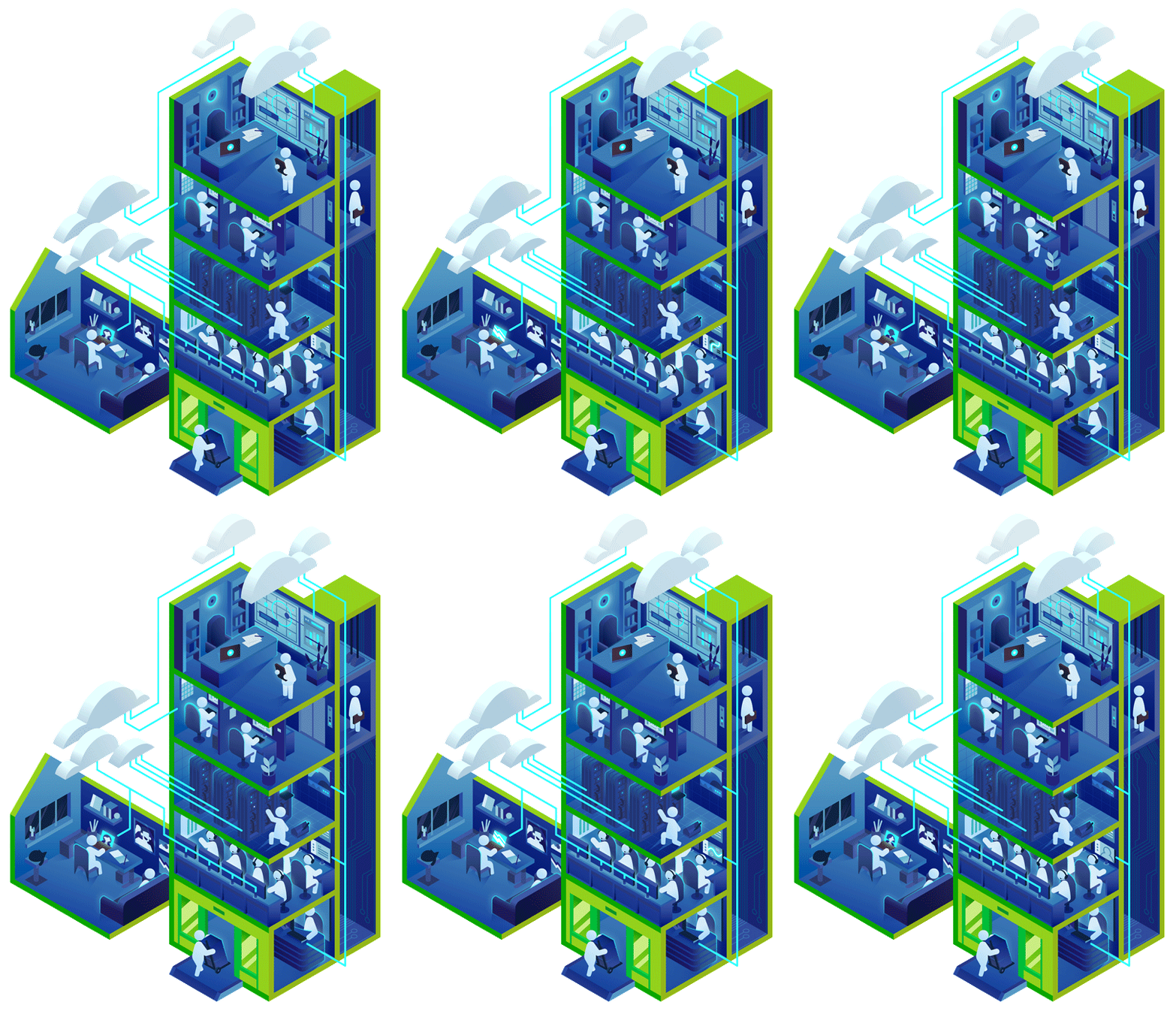
Implementing this blueprint requires deep expertise across classification, CASB, SIEM, serverless orchestration, and 24×7 XDR operations. Leading managed-security providers can package:
- ✅ Rapid Deployment Workshops (5-day "Art of the Possible")
- ✅ Pre-Built Automation (PowerShell/ARM templates + workflow JSON)
- ✅ 24×7 XDR Triage (Dedicated analysts, runbooks mapped to MITRE & compliance)
- ✅ Continuous Tuning & Reporting (False-positive reduction, ROI dashboards)
By partnering with a provider, you accelerate time-to-value, offload operational burden, and ensure your team focuses on strategic security improvements — while expert analysts handle detection and response.
Conclusion

As cloud APIs become the favorite route for stealthy data theft, you need an integrated, cloud-native Zero Trust approach that spans classification, policy enforcement, detection, and managed response. Whether you're an internal security team or leaning on a managed-security partner, the above architecture and lab deliver a turnkey path to stop API-based exfiltration — proving real-time data protection in days, not months.
Ready to see this in action? Reach out to your managed security partner to schedule a hands-on workshop and walk away with a live, hardened API-exfil protection pipeline.
This article is vendor-agnostic and outlines best practices across cloud-native services and managed XDR offerings.