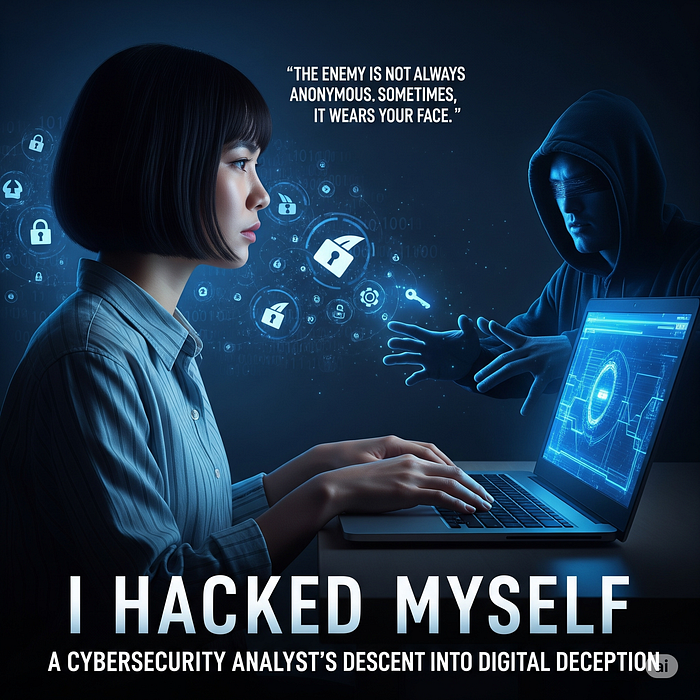

I Hacked Myself: A Cybersecurity Analyst's Descent Into Digital Deception
"The enemy is not always anonymous. Sometimes, it wears your face."
That was the last sentence I scribbled into my notebook before launching the riskiest personal experiment of my career. I am a cybersecurity analyst. I eat phishing emails for breakfast, decode malware before lunch, and map threat patterns for dessert. But for once, I wanted to understand the other side; not as an analyst, but as a victim.
So I hacked myself.
This is not a metaphor.
I crafted a digital trap using common scam tactics. I wanted to see how easy it would be to compromise myself. I faked giveaways. I built clickbait ads. I signed up for too-good-to-be-true offers. I disabled my browser's protections. I opened emails from suspicious addresses. I played dumb.
I became my own lab rat.
Phase One: The Click Temptation
The first test was simple. I created a fake Facebook ad: "Win a brand-new iPhone 14 for just one click!" I ran it anonymously and targeted myself.
Click.
Even though I knew it was fake, my curiosity reflex was faster than my training. It reminded me that phishing doesn't need to be technically perfect. It only needs to hit the right emotion: greed, urgency, fear, or hope.
According to the Verizon 2023 Data Breach Investigations Report, 36% of all data breaches involved phishing, with attackers often impersonating trusted brands or using emotional lures to manipulate victims. It's psychological warfare with a digital twist.
Phase Two: The Too-Good-To-Be-True Trap
I visited fake websites offering:
Free airline tickets
Government stimulus programs
Instant cryptocurrency returns
One redirected me to a rogue portal that harvested login credentials. Another downloaded a .zip file with a hidden keylogger: a malicious program that silently records every keystroke.
Even with all my background, I felt the pull. I wanted to believe.
This is what the "optimism bias" looks like in action. It's a cognitive bias that convinces us bad things won't happen to us, even when all the red flags are waving.

Phase Three: Social Engineering Shenanigans
I created a fake LinkedIn recruiter profile. Then I messaged myself from it.
"Hi, your cybersecurity background is impressive. We'd love to discuss a remote role with six figures. Please review the attached brief."
I opened the attachment.
It was empty. But if it weren't? It could have been a Trojan horse file: malware disguised as a harmless document. Social engineering relies on trust and urgency. According to Proofpoint's 2023 Human Factor Report, more than 90% of cyberattacks start with human error.
This is why phishing simulations are not just corporate exercises. They are essential life drills.
What I Learned
This experiment shattered my ego. It taught me that cybersecurity is not just about firewalls and encryption. It's about emotion. It's about habits. And it's about humility.
Here are a few critical takeaways:
1. You don't have to be naive to be hacked. You just have to be human.
2. Digital literacy is no longer optional. Everyone needs to understand the basics of scam tactics.
3. Overconfidence is the new vulnerability. Thinking "I won't fall for it" makes you a bigger target.
What Is Social Engineering?
Social engineering is the art of manipulating people into giving up confidential information or performing actions that compromise security. It bypasses the technical layer and goes straight for the human mind.
Common examples include:
Phishing: Emails or messages pretending to be from legitimate sources.
Vishing: Voice-based scams.
Smishing: SMS-based phishing.
Pretexting: Fabricated stories to gain trust and access.
Social engineers don't break systems. They break people.
Exclusive Insight: The Rise Of Deepfake Scams
One chilling discovery during my experiment was how advanced deepfake technology has become. Using just a few online tools, I generated a voice clone of myself reading a script.
This voice could call someone, pretend to be me, and authorize access.
Deepfake scams are not the future. They are the now. In 2023, a UK-based company was defrauded of $243,000 when scammers used AI to mimic a CEO's voice and authorize a fraudulent transaction, according to Forbes.
We are entering an era where hearing is no longer believing.

How To Defend Yourself
1. Pause Before You Click: If it feels too good to be true, it probably is.
2. Verify Before You Trust: Contact the person or company directly using official channels.
3. Use Multi-Factor Authentication (MFA): This adds an extra layer of defense.
4. Keep Your Systems Updated: Patches fix known vulnerabilities.
5. Educate Yourself and Others: Awareness is your digital armor.
Final Thought: The Human Firewall
Firewalls can't protect you from curiosity. Antivirus software can't stop emotional manipulation. But awareness can.
In cybersecurity, you are the first and last line of defense.
I hacked myself to prove a point. Not to shame the unaware, but to awaken the overconfident. If someone like me can fall for a scam I created, anyone can.
But here's the good news: if we can be tricked, we can also be trained. If we can fall, we can also rise smarter.
Cybersecurity is not a war fought in code alone. It's fought in every inbox, every click, every call.
Stay alert. Stay skeptical. Stay human, but an informed one.
I Hacked Myself: A Cybersecurity Analyst's Descent Into Digital Deception © 2025 by Ododoobari John Okpabi is licensed under CC BY-NC-ND 4.0. To view a copy of this license, visit https://creativecommons.org/licenses/by-nc-nd/4.0/