Recently, I came across news that some platforms are reconsidering or even removing end-to-end encryption (E2EE) from their messaging systems.
At first, it sounds like just another feature update. But if you look at it from a developer or system design perspective, it's not just a feature , it's a fundamental change in how data flows, who can access it, and where trust lies.
What is End-to-End Encryption?
End-to-End Encryption (E2EE) is a communication model where:
- Data is encrypted on the sender's device
- Travels across the network in encrypted form
- And is only decrypted on the receiver's device
Not even the server handling the communication can read the message.
📦 Simple Analogy
Think of it like sending a locked box:
- You lock the box with a key 🔑
- Only the receiver has the matching key to open it
- The delivery service (server) just transports it — they can't open it
How E2EE Works (Technically)
Modern E2EE systems rely on public-key cryptography.
🔑 Key Concepts:
- Public Key → Shared openly
- Private Key → Kept secret
📡 Message Flow:
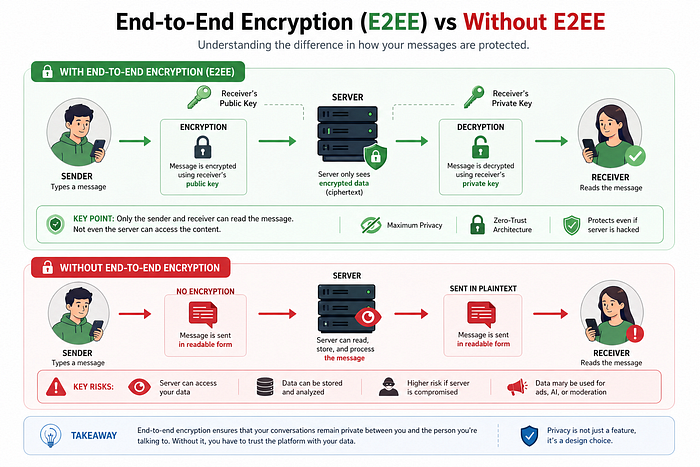
- Receiver shares their public key
- Sender encrypts the message using that public key
- The encrypted message is sent through the server
- Receiver decrypts it using their private key
Sender → Encrypt (Public Key) → Server → Receiver → Decrypt (Private Key)E2EE 🆚 Traditional Encryption
With E2EE:
Client → Encrypted → Server → Encrypted → Client- Server cannot read data
- Zero-trust architecture
- Maximum privacy
Without E2EE:
Client → Server (decrypts) → Processes → Sends → Client- Server can access plaintext data
- Relies on platform trust
- Higher risk exposure
What Changes Without E2EE?
Removing E2EE shifts control from cryptography → platform
🔻 Key Impacts:
- Messages can be read or processed by servers
- Increased risk during data breaches
- Data may be used for:
- AI training
- Content moderation
- Analytics
- Loss of zero-knowledge privacy
Why Do Platforms Remove E2EE?
This is where things get interesting.
It's not always about reducing security — sometimes it's about trade-offs:
🧩 Reasons include:
- Easier content moderation
- Detecting harmful or illegal activities
- Enabling AI features
- Regulatory compliance
Why Developers Should Care
As developers, we often focus on:
- Features
- Performance
- UI/UX
But data security architecture is just as important.
Because:
A system is only as secure as the weakest point in its data flow.
Understanding encryption helps you:
- Design better systems
- Make informed tech decisions
- Build user trust
Real-World Applications of E2EE
- Signal
- Telegram (Secret Chats)
- Secure email systems
These platforms prioritize: Privacy-first architecture Minimal data exposure
Final Thoughts
End-to-End Encryption is not just a technical implementation.
It's a philosophy of trust.
- With E2EE → Trust mathematics (cryptography)
- Without E2EE → Trust the platform
And that difference is huge.
Conclusion
In today's digital world, where data is constantly flowing, stored, and analysed:
Privacy is no longer a default, it's a design choice.
As developers and users, we should:
- Understand how systems handle our data
- Be aware of trade-offs
- Choose tools that align with our security expectations
🔗 Stay Connected
✨Let's grow and learn together — don't forget to share your thoughts
Follow me on : — | LinkedIn
Subscribe on : — | YouTube