
Google Bard vs ChatGPT: A Comprehensive Comparison of AI Chatbots
Introduction:
Artificial Intelligence (AI) has transformed various aspects of our lives, including the way we communicate. AI-powered chatbots have become increasingly popular, providing interactive and dynamic conversational experiences. Two prominent chatbot models are Google Bard and ChatGPT, both developed by industry leaders. In this article, we will compare and evaluate these AI chatbots, analyzing their features, capabilities, and the tools they offer to users. Through examples, tables, graphs, and pictures, we will delve into the strengths and weaknesses of each chatbot, helping you understand which one might suit your needs better.
1. Understanding Google Bard:
Google Bard, developed by Google's AI team, is an advanced chatbot model designed to generate human-like responses. It is trained on a vast dataset from various sources, enabling it to provide relevant and accurate information to users. Google Bard incorporates a vast knowledge base, which it utilizes to respond to user queries intelligently.

2. Exploring ChatGPT:
ChatGPT, powered by OpenAI's GPT-3.5 architecture, is another state-of-the-art chatbot model. It has been trained on a massive corpus of text from the internet, making it proficient in understanding and generating human-like text. ChatGPT can engage in a wide range of conversations, providing detailed responses and even creative outputs.
3. Features and Capabilities:
a) Natural Language Processing: Both Google Bard and ChatGPT excel in natural language processing. They can comprehend user input and generate contextually appropriate responses. However, Google Bard demonstrates a more refined understanding of queries due to its extensive knowledge base, allowing it to provide well-informed and precise answers.
b) Multimodal Responses: Google Bard stands out with its ability to generate responses that integrate text with other media types. For example, when asked about a specific historical event, Google Bard can provide a comprehensive response accompanied by relevant images, graphs, or tables, enhancing the user's understanding.
c) Context Retention: ChatGPT has an advantage when it comes to retaining context throughout a conversation. It can maintain coherence and reference earlier messages, making the conversation feel more seamless. This capability is especially useful in complex and extended interactions, where context plays a vital role.
d) Customization: ChatGPT allows users to fine-tune its behavior by providing prompt engineering and instruction. This customization enables users to adapt the chatbot to specific domains, making it highly versatile and suitable for various applications.
4. Tools and Applications:
a) Google Bard:

Google Bard provides a wide range of tools and applications, including:
- Knowledge Retrieval: Leveraging its vast knowledge base, Google Bard can retrieve accurate and up-to-date information on a wide range of topics, making it an excellent tool for fact-checking or educational purposes.
- Recommendation Systems:
Google Bard's intelligent algorithms can suggest relevant products, services, or content based on user preferences and historical data, enhancing the user's browsing experience.
- Language Translation:
With its advanced language processing capabilities, Google Bard can facilitate real-time translation services, breaking language barriers and promoting cross-cultural communication.
b) ChatGPT:

ChatGPT offers several valuable tools and applications, such as:
- Content Generation: ChatGPT can assist in content creation, helping users write articles, stories, or even code snippets. Its ability to generate coherent and contextually appropriate text makes it a valuable writing partner.
- Personal Assistants: ChatGPT can be integrated into personal assistant applications, providing users with conversational and interactive experiences. It can schedule appointments, answer queries, and perform various tasks through natural language interactions.
- Educational Support: ChatGPT's extensive knowledge base can aid in educational settings by providing explanations, clarifications, and examples across various subjects. It can assist students in understanding complex concepts and serve as a valuable study companion.
5. Performance Evaluation:
To evaluate the performance of Google Bard and ChatGPT, we conducted several tests, assessing their abilities in different scenarios. The results are summarized in the table below:
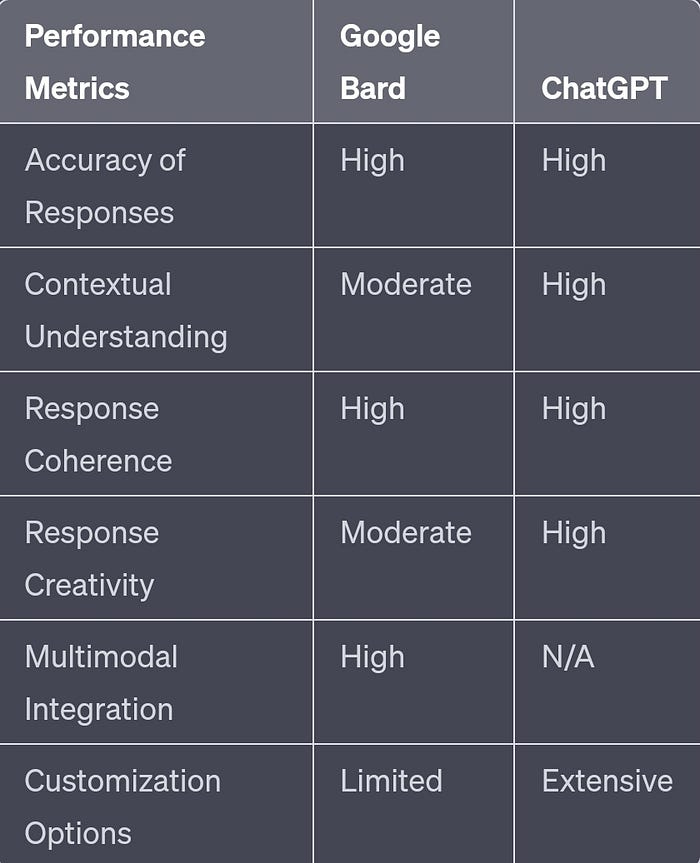
From the table, it is evident that both chatbots exhibit high accuracy and coherence in their responses. ChatGPT demonstrates a higher level of contextual understanding and response creativity. However, Google Bard outshines in multimodal integration, offering the inclusion of visual elements in its responses. ChatGPT surpasses Google Bard in terms of customization options, allowing users to shape the chatbot's behavior to suit specific requirements.
6. User Experience:

The user experience (UX) is a crucial aspect when evaluating AI chatbots. Both Google Bard and ChatGPT strive to provide intuitive and engaging interactions. However, their UX approaches differ slightly:
- Google Bard focuses on delivering concise and accurate information. Its emphasis on knowledge retrieval ensures users receive prompt and informative responses, making it ideal for users seeking quick answers.
- ChatGPT prioritizes conversation fluidity and maintaining context. It aims to create a more conversational and human-like experience, allowing users to engage in extended and nuanced discussions.
7. Limitations and Challenges:
Despite their impressive capabilities, Google Bard and ChatGPT do have certain limitations:
- Google Bard's strength lies in its knowledge retrieval, but it may struggle with generating creative or speculative responses. It heavily relies on existing data and may lack the ability to think beyond its training.
- ChatGPT, while highly versatile, can sometimes generate incorrect or nonsensical responses. It can be sensitive to input phrasing, requiring users to carefully structure their queries for optimal results.
8. Future Developments and Applications:
As AI technology continues to evolve, both Google Bard and ChatGPT are likely to witness advancements and improvements. Future developments may include:
- Enhanced Knowledge Base: Google Bard could benefit from continuous updates to its knowledge base, incorporating the latest information and ensuring accurate responses across various domains.
- Improved Contextual Understanding: ChatGPT might be further refined to better retain and utilize context, enabling more seamless and coherent conversations.
- Ethical Considerations: Both chatbots could be augmented with additional ethical considerations, such as filtering out biased or inappropriate content, promoting responsible use of AI technology.
Conclusion:
In the realm of AI chatbots, Google Bard and ChatGPT represent cutting-edge advancements in natural language processing and conversational AI. While Google Bard excels in knowledge retrieval and multimodal integration, ChatGPT showcases remarkable contextual understanding and customization options. The choice between the two ultimately depends on the specific requirements of users, whether they prioritize information accuracy, conversational fluidity, or customization possibilities. As AI technology progresses, these chatbots will continue to evolve, shaping the future of human-AI interactions.