

It seems that, once in a while, I am still naive when it comes to my film-watching choices. I can still be tricked, conned into watching unimaginably poor films. How? Well, in the case of The Son of No One, I was pulled in by its fantastic cast. Who couldn't be at least slightly curious about a film which features Channing Tatum, Al Pacino, Juliette Binoche, Ray Liotta and more! There is enough talent in that cast to convince most, I'd imagine, to give this 90 minute crime drama a chance — and if one was to line up the best film each actor had starred in, you'd have an impossibly good sequence of films. So… how is it that this 90 minute film featuring three absolute veterans and the often very good Channing Tatum could flop so badly? So badly that, despite its (welcome) brevity, it was tempting to switch the film off and move on before the credits had their chance to roll.
The simple answer is that the film is terribly made, but let's be more thoughtful than that. As fun as it can be to rag on a poorly made film, especially one which holds within its skeleton so much unmet potential, let's go deeper. What really is wrong with The Son of No One?
The film's story is shown in two different eras — one in 1986, one in 2002, both set in New York City. We begin by meeting Channing Tatum's cop character Jonathan White in 2002 before cutting back to seeing a younger version of Jonathan, nicknamed 'Milk' for being an uncommon white resident in his housing project building, as he is being chased by a drug user. Milk has stolen the man's gun — for reasons unknown — and is being chased having taken refuge in the apartment of his young friend Vinny, hiding in the bathroom. When this unnamed drug abusing character breaks in, Milk shoots and kills the man.
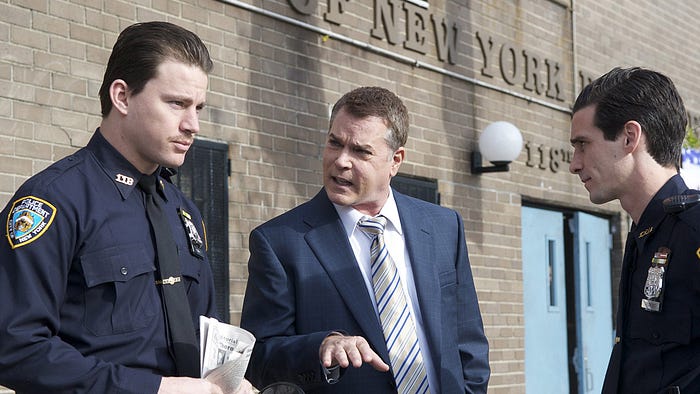
Meanwhile, back in 2002, Jonathan is a cop working two hours away from his home, right in the precinct where his long deceased father once served as a cop himself. His captain, Marion Mathers (Ray Liotta), pulls him aside to discuss something with him, passing him a newspaper which the viewer's attention is brought to by one of the most unsightly and distracting edits I have ever seen in a mainstream film (or, really, any film for that matter). It seems that someone has been sending notes to a local newspaper about an unsolved murder from 1986, a cover up by the local police, threatening to expose those involved over the coming weeks through the paper. Mathers alerts Jonathan to says but explains little — a mystery is established.
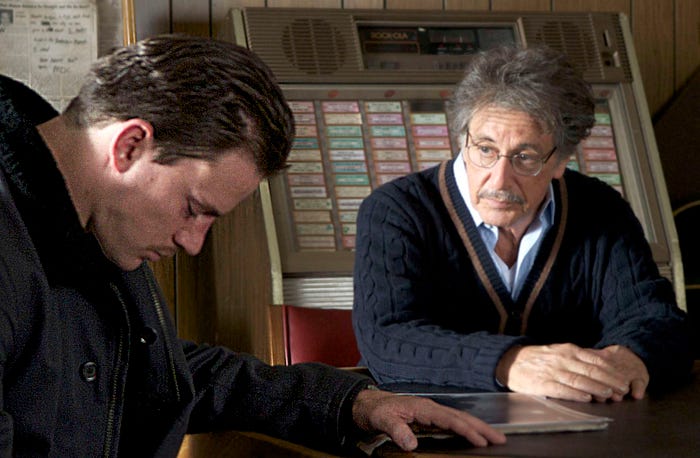
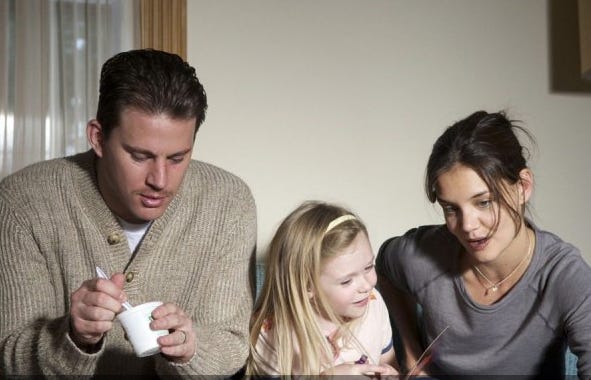
Through cross-cutting spread across the first and second act, we gradually learn that the younger Jonathan is responsible for these two murders — the first being the drug abuser whose gun he stole, the second being the one witness to that crime other than Vinny and his even younger sister. The detective in charge of those two murder cases, Detective Charles Stanford (Al Pacino), meets with young Milk and tells him directly — nobody cares about these two drug addicts, no one will look into the case, he has closed it out of respect for Jonathan's father, not wanting to dent his legacy as a cop. Between that, we see more of Jonathan's life in 2002 — his family life is struggling under the weight of Jonathan's lengthy two hour commute and his newfound distraction due to the threat of his childhood murders being exposed, distancing him from his wife Kerry (Katie Holmes) who is already struggling to look after their unwell daughter, who is prone to seizures.
Jonathan's work life is becoming increasingly troubled with Captain Mathers forcing him to confront the journalist who is publishing the letters threatening to reveal information about the happenings of 1986, Lauren Bridges (Juliette Binoche, who is completely wasted here — as she tends to be in American cinema!). Bridges detests the police, making her interactions with Jonathan difficult. But her character is never given much time to do much at all, and is quickly removed from the plot.
Binoche's character is one of many elements in the film which serve as the un-popped kernel of an interesting idea. As a film, The Son of No One is crammed with these. There are many moments throughout in which Dito Montiel's script shows promise — it's fascinating to try to navigate problems like the ignorance towards police corruption following 9/11 (and the re-instatement of 'heroic' cops), it's interesting to pull together the past and the present and to force them into a conversation with one another, and so on. But none of these ideas feel fully formed, and much of the plot actually feels missing or simply not thought through. For example, there is practically zero acknowledgement of how Jonathan is, above all else, saved by his whiteness. There is the relatively throwaway mention of his nickname being 'Milk' and how that is both a blessing and, supposedly, a curse — he is alienated in the housing projects from others, but he is also saved from, you know, a double murder sentence because of that whiteness. He is constantly protected by his superiors for two vague reasons — his father's time as a cop (and perhaps, to an extent, his own) as well as his whiteness, while Vinny — his black friend who did not kill anybody but who helped the desperate Jonathan to cover up both murders after they were committed — is made to suffer throughout the story both at the hands of cops and otherwise. This is barely touched on, despite the fact that it may be the most interesting idea in the film.
Vinny's character in general is a truly tragic one, but we never properly feel the horror of his life. He grows up in housing projects where his mental illness has seen him send away to hospitals, he is sexually abused by his mother's boyfriend (Jonathan sees this once, does nothing and says nothing of it to anyone) and, after helping Jonathan to cover up the first murder, Vinny is shipped away to hospital again where he is forced to take medicines which stop him from being able to speak or even walk properly. And yet, the focus of the film's tension is instead placed upon whether Jonathan will find himself in trouble for the crimes that he did commit. It's baffling.
Elsewhere, the film's form is truly lacking. The cinematography by Benoit Delhomme (who has an inconsistent but sometimes very impressive career) happens upon the odd good shot but generally makes a mess of things, forcing dutch angles and distracting camera movements in where they're more distracting than emotionally involving or narratively necessary. Jake Pushinsky's editing is baffling throughout, truly awful a lot of the time. Sometimes during a single line of dialogue, he will cut three or four times. In one scene, Al Pacino's detective character pulls out a gun and, for reasons completely unclear, this generally realist drama turns into a French New Wave film and shows that same action four times from different angles. Add in some dodgy green-screening during driving scenes and other completely unnecessary mistakes which miss the basics of filmmaking themselves, and The Son of No One becomes a major mess. Somehow a boring mystery crime thriller which cuts between two different eras, telling two different stories, and involving an ensemble cast, this film's 90 minutes seem to drag on and on.
Those seriously interested in filmmaking ought to conduct an exercise using this film. They should watch Sidney Lumet's overlooked masterpiece Prince of the City, and watch it closely. They should focus on what makes that film so atmospheric, so tense and stressful. Then, straight after, they should watch The Son of No One. The mistakes will become glaring, and some of the secrets to making a truly great film will reveal themselves. Outside of that exercise, and despite this film's stellar cast, The Son of No One ought not to be watched at all. Its cast looks lost, its story is all over the place (while also failing to flesh out any of its admittedly good starting points) and its form is abysmal.
For more from me on film, see the following list:
To support my writing, you can donate using Ko-fi.